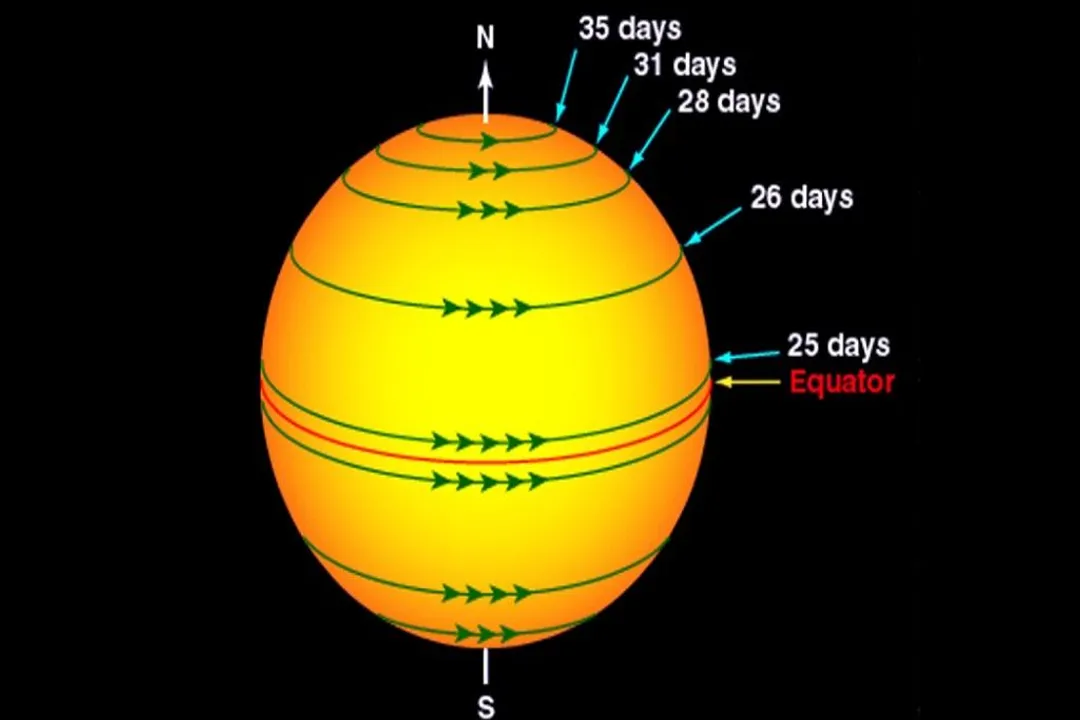
How does the Doppler shift technique calculate rotational velocity without visible sunspots?
By measuring wavelength shifts toward the blue end from the eastern limb and red from the western limb.
The Doppler shift provides a powerful, non-visual method for gauging rotational speed at various latitudes, especially useful in areas lacking sunspots. This technique relies on the principle that light waves shift frequency based on relative motion toward or away from the observer. For the Sun, the edge rotating toward the observer (the eastern limb) exhibits a slight shift toward the blue end of the spectrum, indicating motion towards us. Conversely, the edge rotating away (the western limb) shows a shift toward the red end of the spectrum. By precisely measuring this subtle difference in wavelength across the solar face, scientists can calculate the rotational velocity component at that specific latitude, confirming the differential rotation observed through sunspot tracking.