How have astronomers determined that the Sun rotates on its axis?
The determination that the Sun is not a static, unchanging sphere but a dynamic body that spins on its axis is a story rooted in careful, long-term observation. Unlike a solid object, where rotation is easily measured by marking a single point, figuring out the rotation of a massive ball of incandescent gas required ingenuity. Astronomers couldn't simply look for a fixed feature on the surface; they had to track things that moved with the plasma itself to establish its fundamental motion. [9]
# Tracking Features
The earliest and most direct way to prove solar rotation involved watching features that were carried along by the flow of the Sun's surface material. This technique essentially turned parts of the Sun into cosmic landmarks whose movement could be charted over days and weeks. [7]
# Sunspots as Tracers
The most famous and historically significant method relies on sunspots. [7] These temporary, cooler, and darker regions on the photosphere provide ideal visual markers. By repeatedly observing the Sun over several days, one can note the apparent movement of these spots across the solar disk. [7][9] This positional tracking provides concrete evidence that the surface carrying these features is turning. The ancient Chinese records hinted at this activity, and later, European observers like Galileo Galilei are often credited with documenting this rotation scientifically in the early 17th century through meticulous charting of these very spots. [7] If a sunspot appears on the eastern limb (edge), it moves across the face of the Sun, eventually disappearing at the western limb, only to reappear days later at the eastern limb, having circled the entire body. [9]
The International Astronomical Union's (IAU) educational activities often emphasize this method, suggesting that by tracking a spot over approximately two weeks, one can clearly observe the Sun's rotation. [7] The observation process is straightforward: sketch or photograph the Sun, mark the spot's location relative to the edges, and repeat the observation daily to plot its path and determine the rotational period. [7]
# Sidereal Versus Synodic
A crucial detail when discussing any rotation period derived from observing features from Earth relates to how we measure time. When we say a feature has completed one circuit, we must clarify what it has completed a circuit relative to. The period measured as the feature returns to the same apparent spot in the sky as seen from Earth is the synodic period. Because the Earth is simultaneously orbiting the Sun, the Sun must rotate slightly further than 360 degrees for an observer on Earth to see the spot return to the exact same line of sight. [2] Therefore, the actual rotation period relative to the distant stars—the sidereal period—is slightly shorter than the synodic period observed from our planet. [2] For the Sun, this difference is significant enough that understanding which period is being cited is vital for accurate astrophysical calculations.
An interesting point arises when considering the poles. While tracking sunspots works wonderfully near the equator, sunspots are rarely observed very close to the poles. This means that initial observations, heavily weighted by mid-latitude spots, might have initially underestimated the variation in rotational speed across the Sun, only to be confirmed later by other techniques.
# Differential Rotation
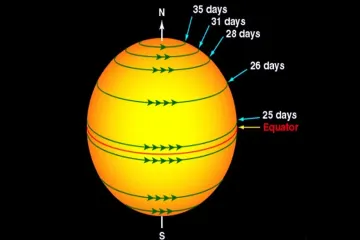
Perhaps the most surprising and important discovery made possible by precise solar tracking is that the Sun does not rotate like a solid ball, such as Earth. Instead, it exhibits differential rotation. [2][3] This means that different parts of the Sun rotate at different speeds depending on their latitude. [2][3] This behavior is characteristic of fluid bodies held together by gravity. [6]
# Latitude Speeds
The fastest rotation occurs near the Sun's equator, while the rotation slows down as one moves toward the poles. [2][3] Data collected through prolonged observation shows this variation clearly:
| Solar Latitude | Approximate Synodic Period (Days) |
|---|---|
| Equator () | |
| North/South | |
| North/South | |
| Near Poles | Approaches |
If the Sun rotated uniformly, every sunspot, regardless of where it formed, would circle back in the exact same amount of time. The fact that a spot forming at latitude takes measurably longer to return than one near the equator was definitive proof that the Sun is not rigidly rotating. [2] This differential motion is deeply connected to the magnetic field generation and the subsequent phenomena we see, such as the appearance and disappearance of sunspots over the roughly 11-year solar cycle. [5]
# Measuring Motion Inside
While sunspots are excellent surface indicators, modern astronomy offers techniques that can measure rotation speed without relying on visible features like spots, which come and go. These methods probe the movement of the plasma itself, even in areas where the surface appears featureless.
# Doppler Shifts
One of the most powerful tools for measuring the speed of any celestial object rotating towards or away from us is the Doppler effect. [2] Light from the part of the Sun rotating toward Earth is slightly blue-shifted, while light from the part rotating away is slightly red-shifted. [2] By analyzing the spectral lines of sunlight, astronomers can precisely measure the subtle shifts in wavelength caused by the line-of-sight velocity component induced by rotation. [2] This technique allows for the measurement of rotation even in latitudes where sunspots are scarce or for observing the internal layers of the Sun through helioseismology, which studies solar oscillations. [2]
The data derived from Doppler measurements aligns perfectly with the findings from tracking surface features, confirming the differential rotation profile. The National Radio Astronomy Observatory (NRAO) notes that this rotation, driven by the complex interplay of gravity and thermodynamics, is fundamental to understanding the Sun's nature. [6]
It's worth noting the inherent difficulty in observing the extreme polar regions via sunspot tracking alone. The high angle of observation near the limb makes judging precise position difficult, and spots are rare there. The success of Doppler analysis in mapping the rotation up to the poles, yielding periods closer to 35 days, demonstrates how new measurement techniques refine and complete earlier visual surveys, providing a truly global picture of solar dynamics.
# Rotation Context
Knowing that the Sun rotates, and how it rotates differentially, provides the foundation for understanding broader solar phenomena. The rotation itself is the engine that twists and organizes the Sun's powerful magnetic field, leading to the cyclical behavior we observe. [5]
# Solar Cycle Link
The Sun’s rotation is directly linked to the solar cycle. [5] The magnetic field lines, initially ordered along the north-south axis, become wrapped around the Sun due to the differential rotation. [5] The equator spins faster than the poles, stretching the field lines and eventually leading to flux emergence that manifests as sunspots and solar flares. [5] The period of roughly 11 years for the solar cycle is intrinsically tied to the 25-to-27-day surface rotation period. [5] If the Sun rotated rigidly, the pattern of magnetic activity and its resulting cycles would likely be vastly different, or non-existent in the way we currently observe them.
# Rotation Summary
In essence, determining the Sun's rotation was a multi-step verification process spanning centuries:
- Observation: Identify traceable surface features (sunspots). [7]
- Measurement: Chart their apparent movement from Earth over time to get the synodic period. [9]
- Correction: Calculate the true sidereal period. [2]
- Refinement: Use precise spectroscopic methods (Doppler shifts) to map the speed variation across all latitudes, revealing differential rotation. [2][3]
This consistent verification across different observational methods—from simple visual charting to advanced spectroscopy—builds high confidence in the scientific determination of the Sun's rotational properties. The consistency between what Galileo might have seen with a telescope and what modern instruments measure confirms an enduring physical reality about our star. [2][7]
Related Questions
#Citations
How have astronomers determined that the sun rotates on its axis?
Solar rotation - Wikipedia
Sun's Rotational Period
Sun rotation explained with sunspots - Facebook
15.2 The Solar Cycle - Astronomy 2e | OpenStax
Why Does the Sun Rotate? - National Radio Astronomy Observatory
Is the Sun rotating? Follow the sunspots! | astroEDU
[PDF] Determining the Rotation Period of the Sun
Does The Sun Rotate? - Universe Today