What is the apparent annual path of the sun on the celestial sphere?
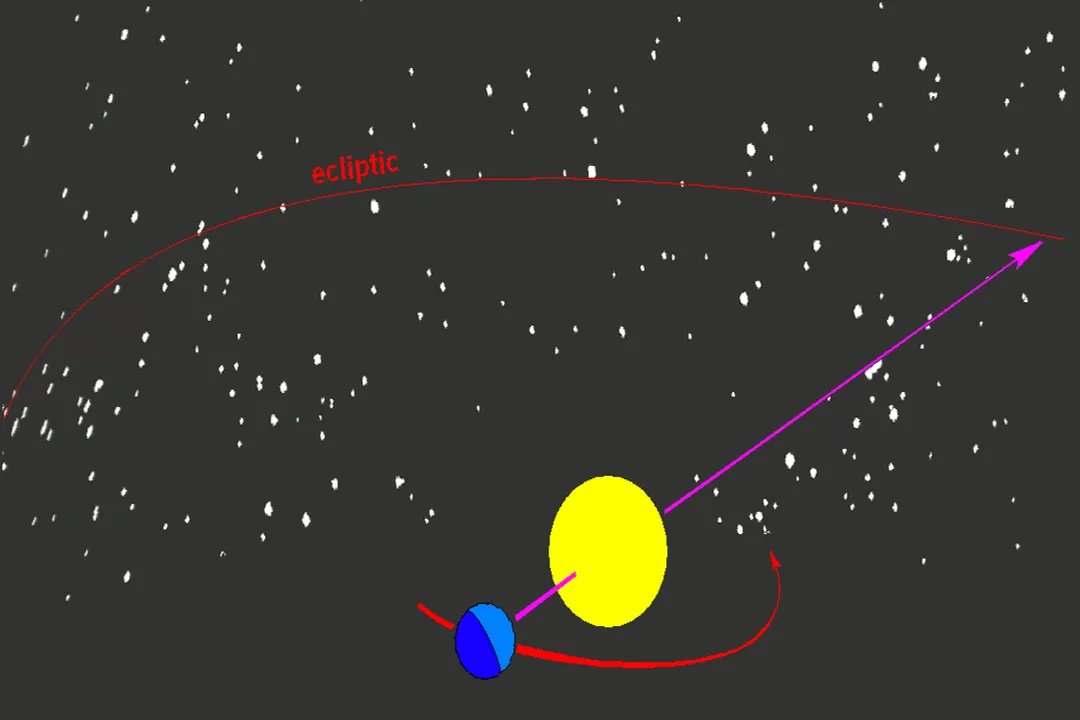
The apparent annual motion of the Sun across the sky, as viewed from Earth, traces out a specific, fundamental line upon the celestial sphere. This track is formally known by the term ecliptic. [2][6][8] It is not a physical path in space, but rather an imaginary line representing the projection of the Earth's orbital plane onto the vast, dome-like sphere that appears to surround us. [3][7] As the Earth completes its circuit around the Sun each year, our perspective causes the Sun to appear to drift eastward along this great circle. [5][7]
# Path Geometry

The ecliptic holds a special geometric status in spherical astronomy because it is defined as a great circle. [5][7] A great circle is the largest possible circle that can be drawn on the surface of a sphere, sharing the same center as the sphere itself. [5] Since the ecliptic is a great circle, it divides the celestial sphere perfectly in half. Its significance stems directly from our planet's movement; it is, quite literally, the intersection of the plane containing Earth's orbit with the celestial sphere. [1][3][4] Because the Earth revolves around the Sun, the Sun's apparent position against the distant background stars constantly shifts along this line. [3]
For anyone observing the sky, understanding this path is key to understanding the calendar and the seasons. The Sun remains centered on this line throughout the year. [7] Furthermore, this path is shared by the major bodies of our solar system. If you were to trace the apparent paths of the Moon and the planets across the sky over time, you would find them deviating only slightly from the ecliptic. [3] This celestial highway is why the term ecliptic is also related to eclipses—the Moon's orbit is inclined relative to this plane, and a solar or lunar eclipse can only occur when the Sun, Earth, and Moon align closely enough with this orbital plane to cast shadows upon one another. [1]
# Celestial Boundaries
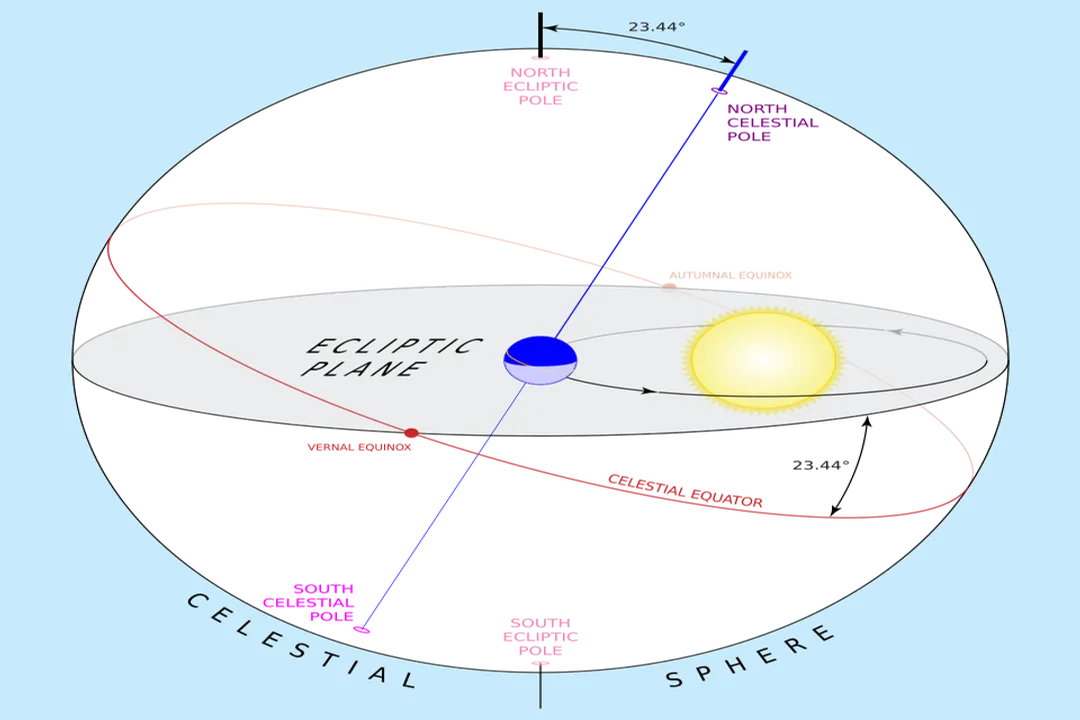
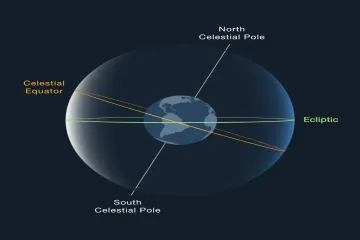
The celestial sphere is segmented by another critical great circle: the celestial equator. This line represents the projection of Earth's equator onto the sky and is always away from the north and south celestial poles. [4] The relationship between the ecliptic (the Sun's path) and the celestial equator (the projection of Earth's equator) defines a crucial astronomical measurement: the obliquity of the ecliptic. [4]
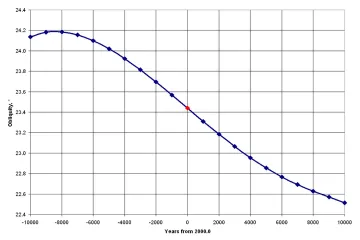
This angle, the tilt between the two great circles, is currently about . [1] This tilt is not static; it is due to the tilt of the Earth's own axis of rotation relative to its orbital plane. The fact that the Sun's path is inclined relative to the celestial equator means that the Sun spends half the year north of the celestial equator and half the year south of it. [4]
If the Earth's axis were perfectly perpendicular to its orbit—meaning the obliquity was —the Sun would always appear to travel directly along the celestial equator. In that hypothetical scenario, the Sun's apparent position would never change relative to the celestial equator throughout the year. We would have no distinct seasons tied to the Sun's altitude, as the day length would remain constant everywhere on Earth, always equal to the time it takes the Sun to cross the meridian. [4] The current tilt, however, is the direct mechanical cause of our seasonal variations in day length and solar intensity. [1]
When considering the Sun's apparent movement in terms of celestial coordinates, this tilt means the Sun's declination (its celestial latitude) varies between and over the course of the year. [1] This maximum northern and southern extent dictates the high point the Sun reaches in the local sky at noon on the summer and winter solstices, respectively.
# Key Positions
The ecliptic and the celestial equator cross paths at two specific points in the sky. [5][7] These intersections are incredibly important markers for timekeeping and the start of astronomical seasons.
These crossing points are known as the equinoxes. [5][7] When the Sun crosses the celestial equator moving north (around March 20th or 21st), it reaches the vernal equinox position. At this moment, observers worldwide experience roughly equal amounts of daylight and nighttime, a condition reflected in the name itself. Conversely, when the Sun crosses the equator moving south (around September 22nd or 23rd), it reaches the autumnal equinox position, again marking a near-equal division of day and night. [5][7] These two points define longitude on the celestial sphere, serving as the vernal equinox marker for measuring positions of other stars and objects.
The points away from the equinoxes along the ecliptic mark the solstices—the points of maximum northern or southern declination, corresponding to the longest and shortest days of the year. [1]
Thinking about local observation, the time of year dictates how high the Sun gets overhead at noon. For an observer in the Northern Hemisphere at a latitude , the Sun's maximum noon altitude on the summer solstice (when the Sun is north of the celestial equator) will be . This calculation immediately shows that a location near the equator (say, ) will still see the Sun near the zenith at noon, while observers far north will see a much lower arc. For example, an observer in London (latitude approximately N) will have a maximum noon solar altitude of roughly at the summer solstice, a significant dip from the Sun passing directly overhead, which explains the less intense solar energy compared to equatorial regions during that time of year.
# Constellation Association
The ancient origins of studying the Sun's path are intrinsically linked to the constellations. As the Sun traces the ecliptic over the year, it appears to pass in front of a specific set of constellations, which are collectively known as the zodiacal constellations. [1]
The ecliptic passes directly through the centers of these twelve constellations. [1] While we often think of the constellations as simply being "in the sky," their definition relative to the ecliptic is what gives them their traditional significance in astrology and ancient astronomy. The Sun's position against this backdrop of zodiac constellations directly determines the astrological sign associated with a given date. It is important to note that due to the precession of the equinoxes—a slow, long-term wobble in the Earth's rotation axis—the Sun today does not align with the traditional start dates of these constellations based on where they were when these systems were first codified millennia ago. [1] The tropical zodiac (used in astrology) remains anchored to the equinoxes, while the sidereal zodiac attempts to align with the actual star patterns, leading to a growing discrepancy over centuries.
# Observing the Path
While we cannot directly see the Sun's path drawn on the sky during the day, we can observe its effect on the sky. The path is best understood by noting the position of sunrise and sunset points relative to fixed landmarks on the horizon throughout the year. [5]
In the Northern Hemisphere:
- The sunrise point moves steadily northward along the horizon from the spring equinox to the summer solstice, reaching its most northerly extreme.
- It then reverses, moving southward from the summer solstice to the autumn equinox.
- The Sun's noon elevation above the horizon is highest at the summer solstice and lowest at the winter solstice, directly reflecting its maximum and minimum angular separation from the celestial equator. [4]
By tracking the time the Sun crosses the local meridian (noon) each day and measuring its altitude with a sextant or even just by noting shadows, one can map out the Sun's slow annual drift along the ecliptic relative to the local horizon over the months. This observed motion confirms the geometry established by orbital mechanics. The ecliptic, therefore, serves as the fundamental reference line for understanding celestial motion, seasonality, and the division of the year. [7]
Related Questions
#Citations
Ecliptic - Wikipedia
The apparent path of the sun upon the celestial sphere is ca - Quizlet
Understanding the Ecliptic: The Sun's Yearly Journey Across the Sky
Astronomy 104: Lecture 2 (Slide 7)
The ecliptic is the path of the sun - EarthSky
[FREE] The apparent annual path of the Sun on the celestial sphere ...
Ecliptic | Definition, Facts, Obliquity, & Zodiac - Britannica
Ecliptic - eSky - Glyph Web