What terrestrial feature is projected onto the sky to define the Celestial Equator?
Answer
Earth's equator.
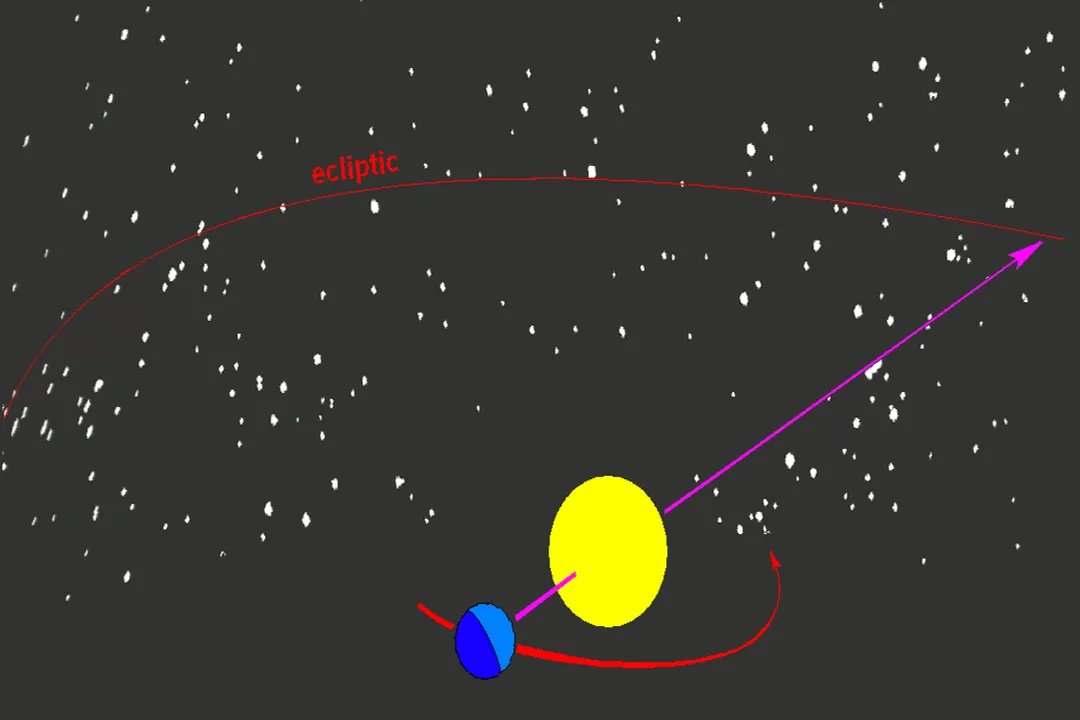
The celestial equator is a foundational reference line on the celestial sphere that serves as the counterpart to a specific geographical feature on Earth. It is defined as the projection of the Earth's actual equator onto the sky. Just as the Earth's equator defines the $0^ extrm{o}$ latitude circling the globe, the celestial equator marks the $0^ extrm{o}$ celestial latitude on the sky. Crucially, this line lies exactly 90 degrees away from both the north and south celestial poles, and its relationship with the ecliptic defines the obliquity, showing the fundamental connection between our planet's orientation and the coordinate system used for tracking celestial bodies.
Related Questions
What precisely defines the Ecliptic's path traced by the Sun on the celestial sphere?What geometric classification is assigned to the Ecliptic on the surface of the celestial sphere?What specific astronomical measurement is defined by the angular relationship between the Ecliptic and the Celestial Equator?What is the approximate current measurement defining the obliquity of the ecliptic?What terrestrial feature is projected onto the sky to define the Celestial Equator?What would be the consequence if the Earth's axis tilt resulted in an obliquity of 0 degrees?What are the two crossing points where the Ecliptic and the Celestial Equator intersect called?What defines the moment the Sun reaches the vernal equinox position?What celestial grouping do the zodiacal constellations relate to regarding the Sun's path?What physical phenomenon is responsible for the discrepancy between the tropical and sidereal zodiacs?