What geometric classification is assigned to the Ecliptic on the surface of the celestial sphere?
Answer
A great circle.
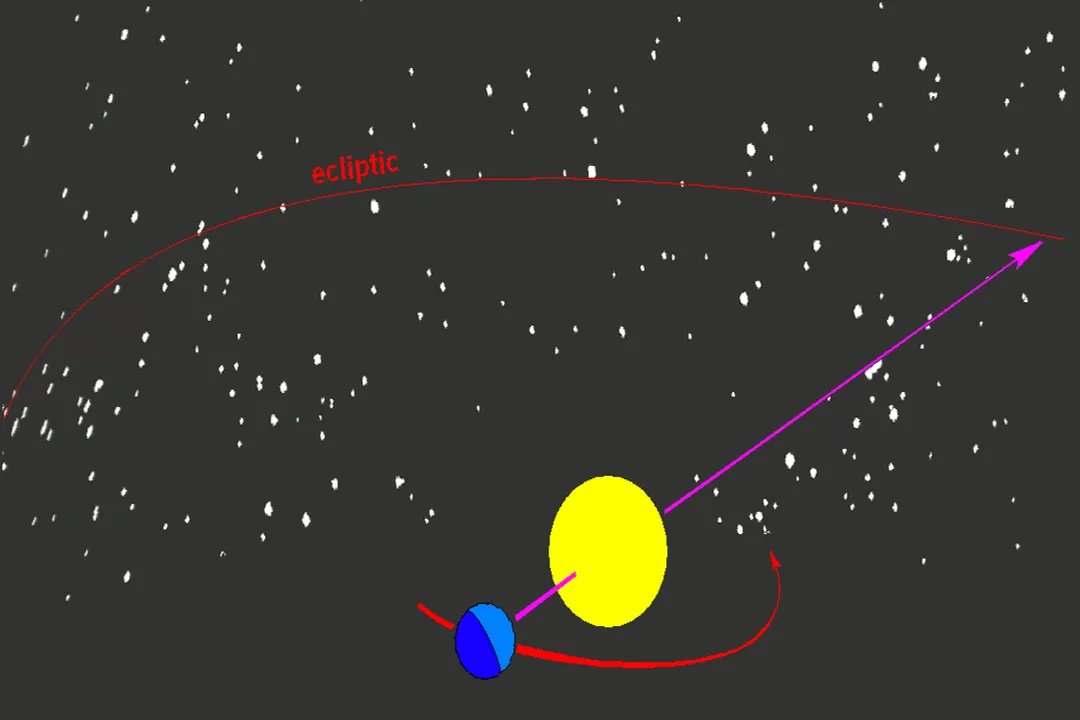
The ecliptic is formally classified as a great circle because it satisfies the necessary geometric condition: it is the largest possible circle that can be drawn on the surface of a sphere, sharing the exact same center as the sphere itself. Because the ecliptic is a great circle, it possesses the property of dividing the celestial sphere perfectly into two equal hemispheres. This geometric designation is derived directly from its origin as the intersection of Earth's orbital plane (which is planar and thus inherently defines a great circle intersection when projected onto a sphere) and the celestial sphere, highlighting its primary structural importance in celestial mapping.
Related Questions
What precisely defines the Ecliptic's path traced by the Sun on the celestial sphere?What geometric classification is assigned to the Ecliptic on the surface of the celestial sphere?What specific astronomical measurement is defined by the angular relationship between the Ecliptic and the Celestial Equator?What is the approximate current measurement defining the obliquity of the ecliptic?What terrestrial feature is projected onto the sky to define the Celestial Equator?What would be the consequence if the Earth's axis tilt resulted in an obliquity of 0 degrees?What are the two crossing points where the Ecliptic and the Celestial Equator intersect called?What defines the moment the Sun reaches the vernal equinox position?What celestial grouping do the zodiacal constellations relate to regarding the Sun's path?What physical phenomenon is responsible for the discrepancy between the tropical and sidereal zodiacs?