What precisely defines the Ecliptic's path traced by the Sun on the celestial sphere?
Answer
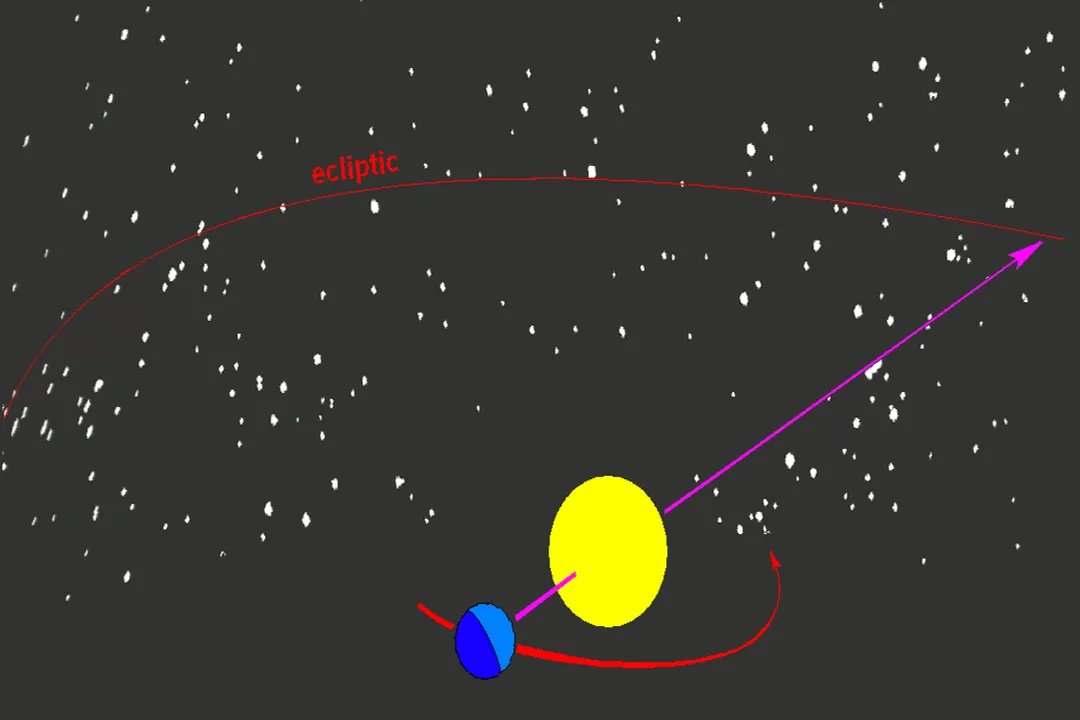
The imaginary projection of the Earth's orbital plane onto the celestial sphere.
The ecliptic is fundamentally an imaginary line, not a physical track in space. It represents the geometric intersection formed when the plane containing the Earth's annual orbit around the Sun is mapped or projected onto the celestial sphere—the apparent dome surrounding Earth. As the Earth revolves around the Sun over the course of a year, this constant change in our viewing perspective causes the Sun to appear to drift eastward along this specific great circle path against the background of distant stars. This projection is the operational definition used in spherical astronomy to describe the Sun's apparent annual motion.
Related Questions
What precisely defines the Ecliptic's path traced by the Sun on the celestial sphere?What geometric classification is assigned to the Ecliptic on the surface of the celestial sphere?What specific astronomical measurement is defined by the angular relationship between the Ecliptic and the Celestial Equator?What is the approximate current measurement defining the obliquity of the ecliptic?What terrestrial feature is projected onto the sky to define the Celestial Equator?What would be the consequence if the Earth's axis tilt resulted in an obliquity of 0 degrees?What are the two crossing points where the Ecliptic and the Celestial Equator intersect called?What defines the moment the Sun reaches the vernal equinox position?What celestial grouping do the zodiacal constellations relate to regarding the Sun's path?What physical phenomenon is responsible for the discrepancy between the tropical and sidereal zodiacs?