What defines the moment the Sun reaches the vernal equinox position?
Answer
When the Sun crosses the celestial equator moving north.
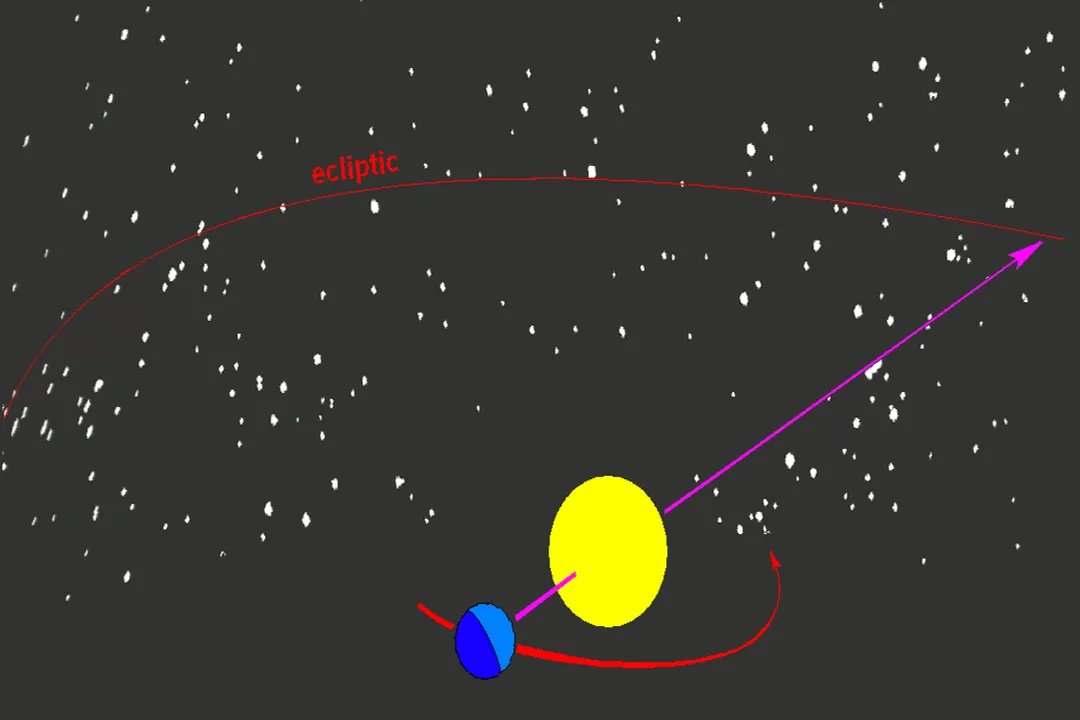
The vernal equinox is a specific point in the Sun's annual progression along the ecliptic that coincides with the Sun crossing the celestial equator while heading in the northerly direction. This event typically occurs around March 20th or 21st and marks the astronomical beginning of the spring season in the Northern Hemisphere. At this precise moment, the Sun's declination is $0^ extrm{o}$, meaning the terminator (the line separating day and night across the Earth) passes directly through both the North and South Poles, leading to the condition of roughly equal hours of daylight and darkness experienced by observers worldwide, which is inherent in the term 'equinox'.
Related Questions
What precisely defines the Ecliptic's path traced by the Sun on the celestial sphere?What geometric classification is assigned to the Ecliptic on the surface of the celestial sphere?What specific astronomical measurement is defined by the angular relationship between the Ecliptic and the Celestial Equator?What is the approximate current measurement defining the obliquity of the ecliptic?What terrestrial feature is projected onto the sky to define the Celestial Equator?What would be the consequence if the Earth's axis tilt resulted in an obliquity of 0 degrees?What are the two crossing points where the Ecliptic and the Celestial Equator intersect called?What defines the moment the Sun reaches the vernal equinox position?What celestial grouping do the zodiacal constellations relate to regarding the Sun's path?What physical phenomenon is responsible for the discrepancy between the tropical and sidereal zodiacs?