What is the great circle on the celestial sphere?
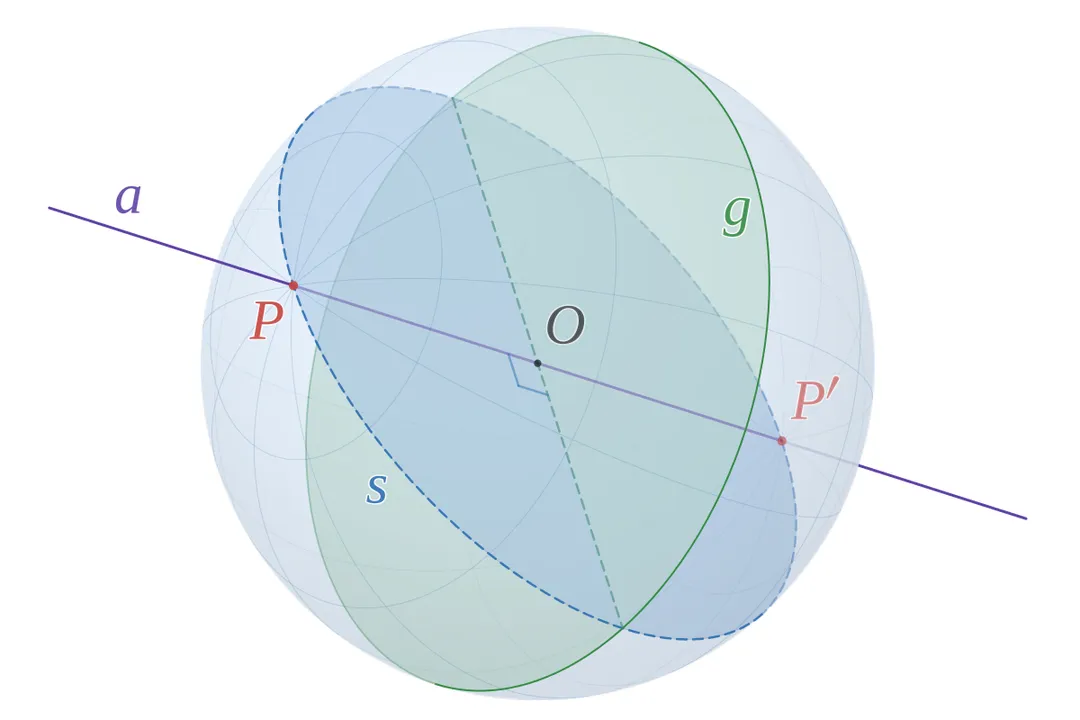
The concept of a great circle is fundamental to spherical geometry, providing the most direct path between any two points on the surface of a sphere. [1] If you imagine slicing a sphere cleanly through its exact center, the resulting edge where the cutting plane intersects the surface defines a great circle. [1][2] This perfect circumference possesses a unique property: it divides the sphere into two identical halves, called hemispheres. [2] Think of the Earth's equator; it is a perfect example of a great circle because the plane creating it passes directly through the Earth's core, splitting the globe into the Northern and Southern Hemispheres. [2] Any line of longitude, or meridian, that runs from the North Pole to the South Pole is also a great circle. [2]
# Defining Geometry
The primary importance of any great circle lies in its role as the shortest distance marker. [1] When planning a long-distance flight or a sea voyage, the shortest route isn't a straight line on a flat map, but rather an arc tracing a segment of a great circle connecting the departure and arrival points. [1] On a sphere, this path is unique, unlike smaller circles on the sphere (like lines of latitude, excluding the equator) which do not pass through the center and therefore offer longer routes between points. [1]
# Celestial Projection
When we turn our attention skyward, astronomers project the entire cosmos onto an imaginary sphere surrounding the Earth, known as the celestial sphere. [4] This conceptual tool allows observers to map out the positions of stars, planets, and other celestial objects as if they were fixed onto this enormous, distant surface. [4] Just as on Earth we use the equator and meridians as our fundamental coordinate references, the celestial sphere relies on its own set of great circles to establish a grid system for locating objects. [3][4]
# Celestial Equator
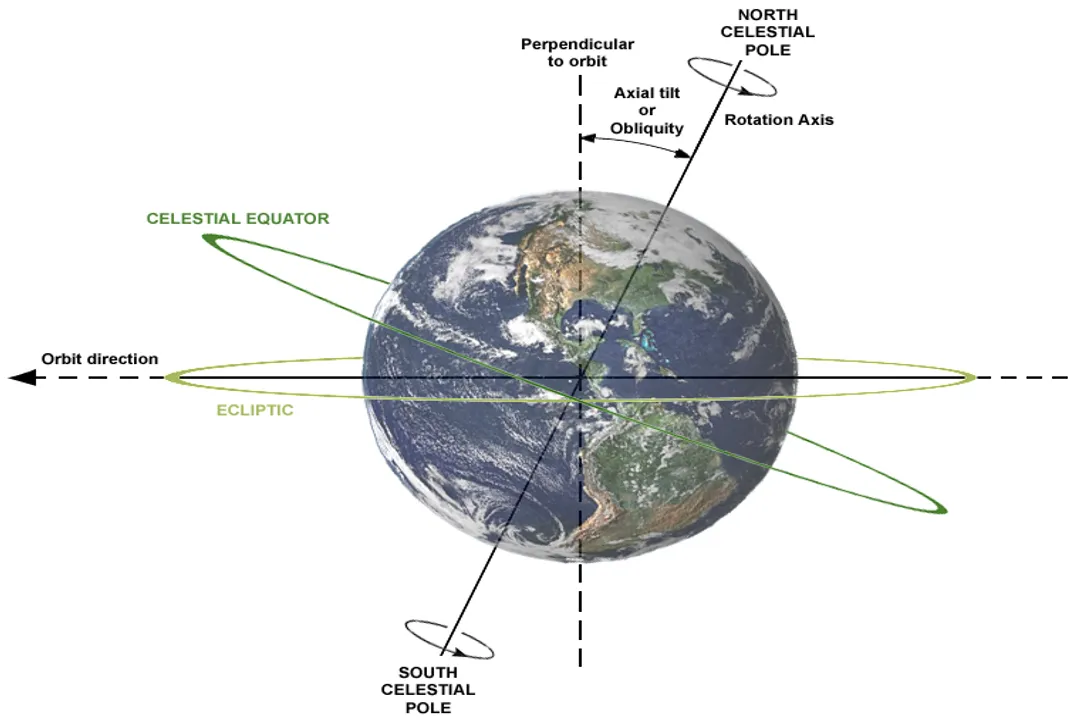
The single most important great circle in this sky-based coordinate system is the celestial equator. [3][4][7] This line is the direct projection of our planet’s physical equator onto the celestial sphere. [3][7][9] Because it is a projection of the Earth's equator, it too must be a great circle, slicing the celestial sphere into northern and southern celestial hemispheres. [7] It represents the point in the sky where the declination, the celestial equivalent of latitude, is zero degrees (). [7]
The celestial equator is essential for observers worldwide because it serves as the fundamental zero point for angular distance measurement above or below the celestial plane. [7] While the physical equator on Earth is tied to geology and rotation, the celestial equator is purely an artifact of geometry relative to the observer's location and the Earth's axis. [9] A curious consequence of this relationship is that every point on the Earth, except for the poles, will see the celestial equator pass overhead at some point during the year, tracing a predictable arc through the sky. [7] If one were to plot their viewing angle daily, the celestial equator remains fixed, while other celestial features appear to move relative to it. [4]
For an observer standing exactly on the Earth's physical equator, the celestial equator passes directly overhead, appearing as a great circle crossing the zenith (the point directly above the head). [3] Contrast this with an observer at the North Pole, for whom the celestial equator appears as a circle lying precisely on the horizon. [3] This illustrates how the imaginary great circle on the sphere above us is rigidly linked to the physical orientation of the observer on the ground below. [4]
# The Ecliptic Path
While the celestial equator is defined by Earth's rotation, another, equally significant great circle traces a different motion: the ecliptic. [5] The ecliptic represents the apparent path the Sun traces across the celestial sphere over the course of one year. [5] Since the Sun’s apparent motion is governed by the Earth's revolution around it, the ecliptic plane is actually the plane of the Earth’s orbit projected outward. [5]
This makes the ecliptic a critical reference line for understanding seasons and calendar cycles. [5] For an eclipse to occur, the Moon must pass very close to or exactly on this great circle, as the Moon's orbit must intersect the plane defined by the Earth's path around the Sun. [5]
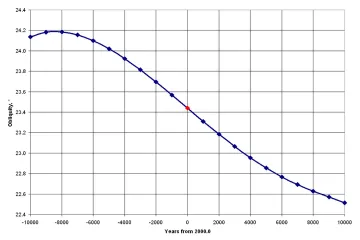
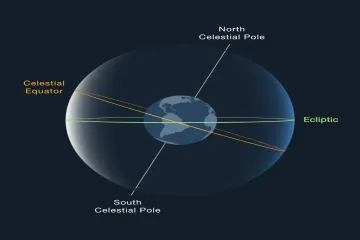
When we compare the celestial equator and the ecliptic, we find they are not the same circle. [5][7] They intersect at two points in the sky, known as the equinoxes. [7] The angular separation between the celestial equator and the ecliptic is known as the obliquity of the ecliptic, which directly dictates the severity of our planet’s seasons. [7] The tilt between these two great circles is a defining feature of our solar system's geometry.
To help visualize the difference in their definitions, consider this: the celestial equator is defined by the Earth’s spin (rotation), whereas the ecliptic is defined by the Earth’s orbit (revolution). [5] This geometric difference between the two great circles is why the Sun crosses the celestial equator only twice a year (at the spring and autumnal equinoxes), marking the start of spring and fall, even though the celestial equator itself remains stationary relative to the distant stars. [7]
# Charting Practice
Understanding which great circle you are referencing is key to effective celestial navigation or amateur astronomy. If you are measuring an object's position relative to the overhead point or the Earth's axis, you are using coordinates based on the celestial equator. [7] If you are tracking the Sun's yearly progress or looking for predictable conjunctions of planets that tend to cluster near the Sun's path, you are working with the ecliptic. [5]
For example, a novice stargazer might notice that the planet Jupiter seems to rise and set almost perfectly aligned with the familiar path of the setting sun in winter, suggesting it is currently near the ecliptic. However, if Jupiter is directly overhead at noon during the summer solstice, its declination (distance from the celestial equator) would be near its maximum value, showing a position far north of the celestial equator. [4][7] A seasoned observer learns to map these two major great circles onto their mental sky map, recognizing that one represents our planet's daily spin coordinate system, and the other represents our annual orbital route through the solar system. Without these fundamental great circles—the celestial equator and the ecliptic—the complex mapping of the heavens would collapse into an unintelligible scatter plot of stars. [3][4]
#Videos
What Are Great Circles On A Sphere? - Physics Frontier - YouTube
Related Questions
#Citations
Great circle - Wikipedia
Great Circle - National Geographic Education
Celestial equator | astronomy - Britannica
Chapter 2: Reference Systems - NASA Science
What do you call the great circle of celestial sphere in which Earth ...
What Are Great Circles On A Sphere? - Physics Frontier - YouTube
Introduction to Principles of Astronomy
Celestial equator - Definition, Meaning & Synonyms - Vocabulary.com