How far is the Perseus Arm from Earth?
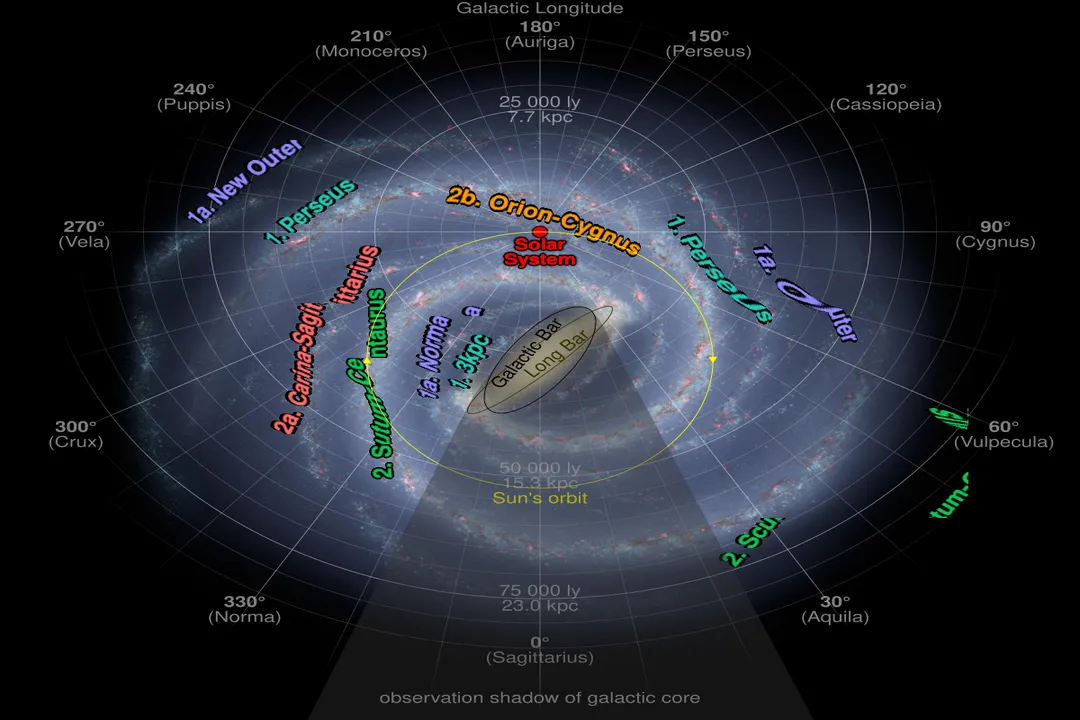
The sheer scale of the Milky Way galaxy often makes precise measurements feel like an abstract exercise, especially when trying to locate features that are essentially "outside" our immediate neighborhood. Pinpointing the exact separation between our stellar home and the next major band of activity—the Perseus Arm—has been a decades-long puzzle in galactic astronomy. We know the Sun resides within the relatively modest structure known as the Orion Spur or Orion Arm, [2][1] which is a relatively small feature tucked between the larger structures of the galaxy. [1] Determining where that local arm ends and the next great structure, the Perseus Arm, begins, requires measurements of staggering precision.
# Distance Refinement
For many years, the consensus estimate for the distance separating Earth from the Perseus Arm hovered around a figure near 13,000 light-years. [2] Some earlier calculations, based on less direct methods like comparing the observed brightness of stars to their expected intrinsic brightness, placed it even further out, near 14,000 light-years. [3] However, a landmark series of observations fundamentally revised this picture, bringing the great cosmic structure significantly closer to home.
Modern radio astronomy, employing techniques that achieve nearly unparalleled resolution, has established a much tighter figure. A collaboration of international astronomers, using the Very Large Baseline Array (VLBA), focused on a specific, bright star-forming region within the arm: the methanol maser source known as W3OH. [3][4] By carefully measuring the trigonometric parallax—the tiny shift in apparent position as Earth orbits the Sun over a year—they achieved an accuracy of milli-arcsecond. [3] This incredible resolution is what allowed them to break through the previous ambiguity.
The result published around 2005/2006 placed the W3OH region, and by extension, this section of the Perseus Arm, at approximately 6,400 light-years away. [3][2] A separate scientific paper detailing the finding reported the distance to W3OH as precisely kiloparsecs (kpc). [4] To put that into perspective for those less familiar with cosmic metrics, $1.95$ kpc translates to just under 6,360 light-years. [4] This meant the arm was nearly half as distant as the older estimates suggested, a difference that drastically changes our view of the immediate galactic environment.
# Galactic Architecture
The discrepancy in older distance estimates was not just due to limitations in technology; it was partly rooted in the complex dynamics of the arm itself. One of the reasons the measurements were so confusing stemmed from the fact that the portion of the Perseus Arm observed exhibited anomalous motions. [4] The object W3OH, for instance, was found to orbit the galactic center slower than the general galactic rotation in that region, and it was even tracked as having a slight inward trajectory toward the center. [3] These localized velocity differences skewed distance calculations relying on simple rotational models.
The structure of the Milky Way is still being mapped, but current understanding suggests the Perseus Arm is one of the most prominent features originating near the central bar. [2] It is named for the constellation Perseus, the direction in which it appears from our vantage point. [2] Its structural classification presents an interesting point of contrast among sources: while some refer to it as one of the four major arms, [2] others classify it as a minor or secondary spiral arm, less massive than giants like the Sagittarius Arm. [1] Regardless of the label, its placement is crucial: it sits outside our Orion Arm, [1] between the Cygnus Arm and the Carina–Sagittarius Arm, or perhaps the Outer Arm, depending on the precise delineation being used. [2][1]
Consider what this new proximity means in practical, visual terms. If the Perseus Arm is approximately $6,400$ light-years away and possesses a typical width of around $1,000$ light-years, [2] the arm itself would subtend an angle of nearly nine degrees across the night sky when viewed edge-on from Earth. That's equivalent to about eighteen times the apparent diameter of the full Moon laid out end-to-end—a substantial structure even if appearing relatively thin from our perspective inside the galactic disk.
# Precision Measurement Methods
The ability to resolve the $6,400$ light-year distance over the older $14,000$ light-year figure hinged on moving beyond simple stellar brightness comparisons and incorporating three-dimensional tracking. [3] The key to this breakthrough was the maser source W3OH. Masers (Microwave Amplification by Stimulated Emission of Radiation) are highly compact, intense radio sources that act as near-perfect beacons against the background noise of space. [3][4]
The process relied on:
- High Resolution: The VLBA network, a global collection of radio telescopes working in concert, provided the necessary angular resolution—a capability one reference noted was analogous to being able to distinguish which hand a person on the Moon was using to hold a book. [3]
- Trigonometric Parallax: By measuring the small apparent shift of W3OH over several months of observation, astronomers could construct a triangle using Earth’s orbital path, yielding a highly accurate spatial distance. [4]
- Motion Mapping: Crucially, the five observations taken between July 2003 and 2004 allowed the team not just to find the distance, but to map the object's movement through space, confirming its anomalous velocity relative to the rest of the arm. [3][4]
This methodological advancement has provided a critical anchor point for mapping the rest of the Milky Way. As astronomers continue to apply these precise VLBA parallax measurements to other maser sources across the galaxy, our models of the spiral structure are becoming far more accurate than those based solely on carbon monoxide emissions or stellar motions alone. [2][3]
# Deep Sky Targets
While the precise distance remains a topic of ongoing refinement, the Perseus Arm is an incredibly rewarding area for stargazers looking away from the galactic plane toward the constellation for which it is named. [2] Because spiral arms are the primary sites of active star formation, they are rich in young, hot, and massive stars, as well as the molecular clouds from which they form. [1]
For those equipped with a modest telescope, the Perseus Arm hosts several famous celestial landmarks, many cataloged by Charles Messier:
- The Crab Nebula (M1), the remnant of a supernova observed in 1054. [2]
- A trio of spectacular open star clusters: M36, M37, and M38. [2]
- The visually stunning Double Cluster (NGC 869/884), which is often considered one of the arm's signature sights. [2]
If you are setting up an observing session and want to focus your sights toward the Perseus Arm, a good tip is to look toward the constellation Perseus itself, perhaps starting with the bright, easily spotted Double Cluster. Knowing that you are looking nearly $6,400$ light-years outward, rather than $14,000$ light-years, provides a tangible connection to the structure you are observing—you are looking past our local suburb, the Orion Spur, and into the neighboring major lane of stellar birth and activity in our galaxy. [1][2] This recent understanding allows astronomers and enthusiasts alike to better situate our Solar System within the vast, spinning collection of stars we call home.
Related Questions
#Citations
Perseus Arm - Wikipedia
Mapping the Milky Way | Astronomy.com
Perseus Arm Definition - Intro to Astronomy Key Term - Fiveable
The Distance to the Perseus Spiral Arm in the Milky Way - arXiv