How do rockets re enter Earth's atmosphere safely without burning up?
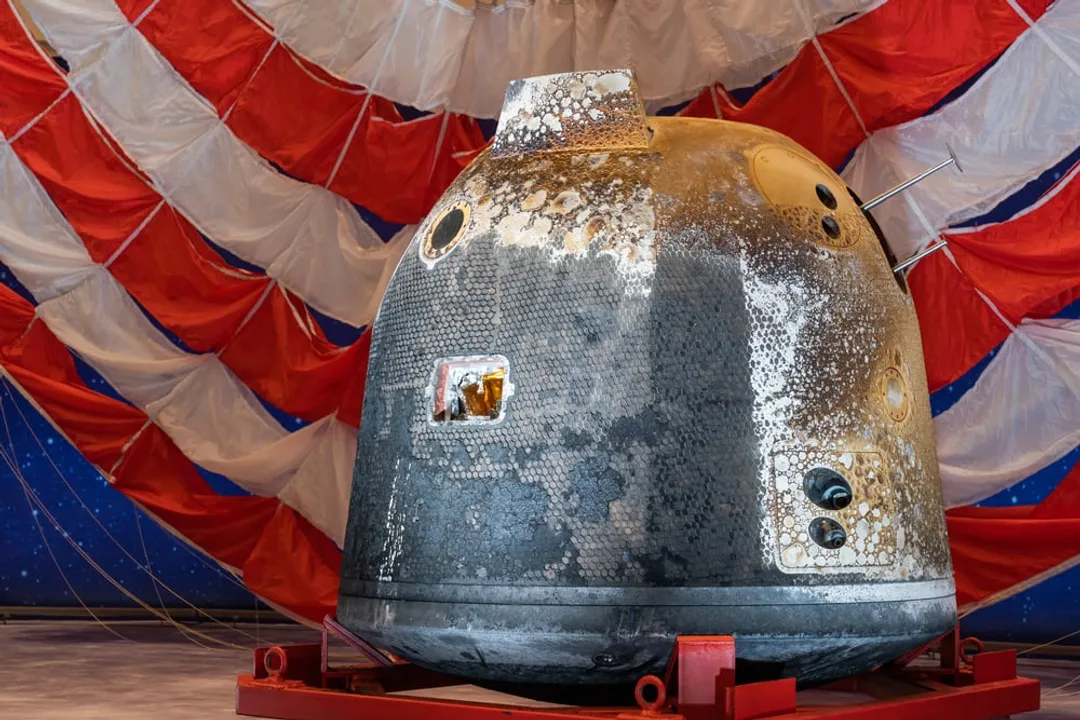
The spectacular sight of a spacecraft hurtling back toward Earth, often appearing as a fiery streak across the sky, immediately raises the question of how it avoids simply vaporizing mid-descent. The answer isn't simply that the air is thick; it’s a highly engineered ballet involving extreme speed, precise angles, and incredibly advanced materials science designed to manage colossal amounts of energy transferred in a very short period. [1][5]
The energy involved in re-entry is staggering. A vehicle returning from low Earth orbit is traveling at phenomenal velocities, often around $17,500$ miles per hour, or roughly Mach $25$. [2][9] It’s this speed, not necessarily friction alone, that generates the intense heat capable of melting metal. [6]
# Physics Heating
When an object slams into the atmosphere at orbital speed, it doesn't just rub against the air molecules; it slams into them so fast that the air directly ahead of the craft cannot move out of the way quickly enough. [1][6] This rapid deceleration of the air itself causes massive, localized compression, creating a superheated shock wave that stands off a short distance from the vehicle's surface. [6] This process, known as adiabatic compression, is the primary source of the intense thermal energy experienced at the stagnation point—the very front of the spacecraft. [6]
While friction certainly plays a part as the vehicle shears through the air, the energy converted from kinetic motion into heat via this compression shock wave is the dominant factor, often reaching temperatures in the thousands of degrees Celsius. [1][6] Consider the difference between exiting space and returning: during launch, the rocket uses powerful, sustained thrust to fight gravity and push through the atmosphere—an active process. Re-entry, conversely, is passive; the vehicle uses the atmosphere itself as the braking system, converting its massive orbital energy into heat and drag. [6]
# Speed Essential

If a craft could enter the atmosphere gently, say by drifting down slowly over the course of days, it would never reach the catastrophic heating levels associated with re-entry. [4] The challenge lies entirely in the initial velocity. If you could somehow decelerate to a much lower speed before hitting the thick lower atmosphere, the energy transfer would be manageable. [4] However, to return from orbit, the vehicle must shed that orbital energy, which is precisely what creates the fireball effect around the craft. [2]
Imagine the energy transfer not as a slow simmer, but as a near-instantaneous dump of kinetic energy. A return capsule, designed to be blunt, maximizes this effect intentionally. The blunt shape forces the high-energy air to compress far ahead of the heat shield, creating a thick, standoff shock layer that absorbs the majority of the thermal load. [2][9] This keeps the actual surface of the capsule cooler than the plasma shockwave surrounding it.
# Angle Tolerance
The margin for successful re-entry is remarkably narrow, often referred to as the entry corridor of survival. [2] This corridor is defined by the entry angle relative to the horizon.
If the angle is too shallow—meaning the vehicle grazes the upper layers of the atmosphere without biting deeply—it might generate insufficient drag to slow down effectively and instead "skip" off the denser air back into space, much like a flat stone thrown across a pond. [2] This has happened historically with unrecoverable stages or upper-stage modules. [2]
Conversely, if the angle is too steep, the vehicle plunges too quickly into the denser atmosphere. [2] This results in an excessively rapid deceleration, which translates directly into immense G-forces that can physically crush the crew or structure, alongside a massive, nearly instantaneous spike in heating that the thermal protection system may not be able to cope with. [2] For crewed missions, this corridor might only span a few degrees of inclination, requiring extremely precise navigation and guidance systems to maintain the correct trajectory. [1]
# Protection Systems
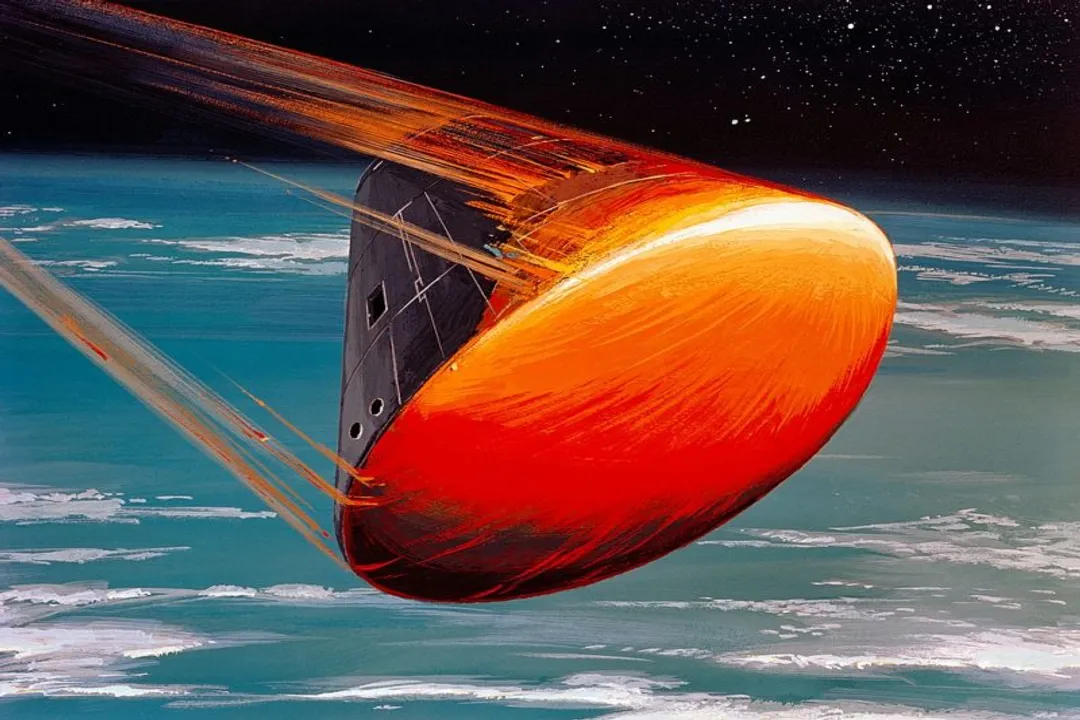
To survive the intense thermal environment, spacecraft rely on specialized Thermal Protection Systems (TPS). [3] These systems fall into two main categories, depending on the mission profile and reusability goals.
# Ablative Shields
Historically, many capsules, such as those used in the Apollo and early crewed missions, relied on ablative heat shields. [5] An ablative shield is designed to sacrifice itself. As the spacecraft enters the plasma, the outer layer of the shield material—often a composite resin—chemically breaks down, vaporizes, and chars away. [9] This process consumes the massive incoming heat energy and carries it away with the gaseous material, keeping the underlying structure safe. [5] Once the material has burned off, the shield is gone and cannot be reused.
# Reusable Surfaces
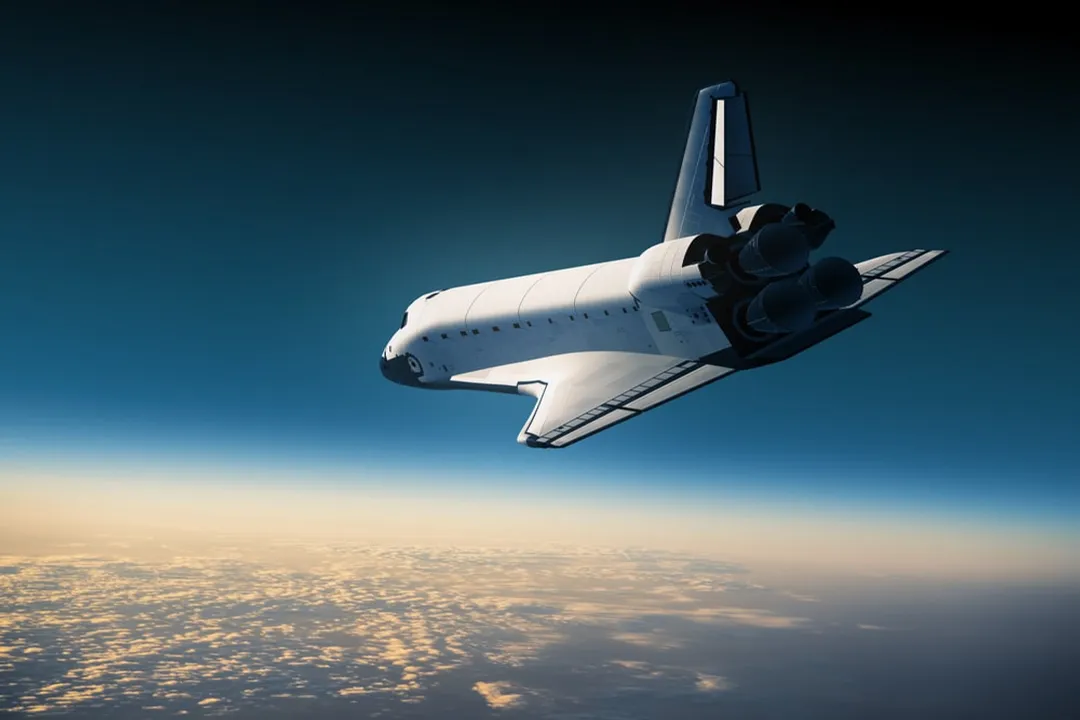
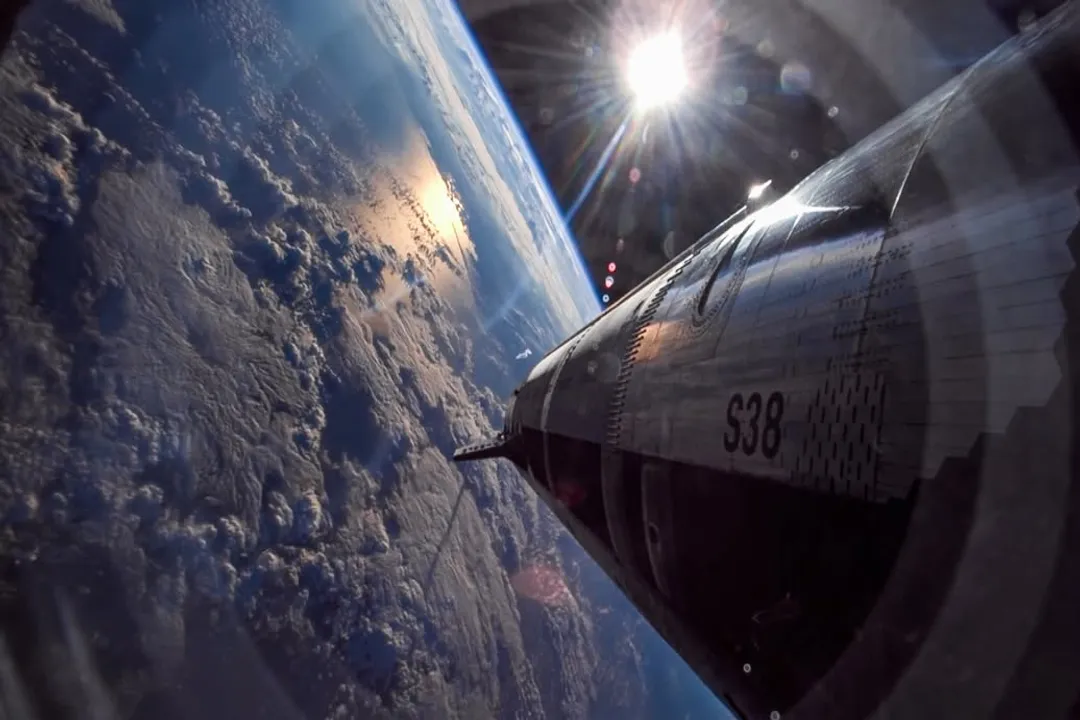
For vehicles designed for multiple uses, like the Space Shuttle or future systems like SpaceX’s Starship, a different approach is necessary: radiating heat away. [3][7]
The Space Shuttle, for example, was covered in specialized tiles made of silica fiber material. [3] These tiles were incredibly light and could withstand extreme temperatures while being poor conductors of heat. The exterior surface of a tile might glow incandescently white from the heat, but the inner surface, where it met the aluminum structure of the orbiter, remained cool enough to touch just moments later. [3] This ability to radiate the heat back into the atmosphere, coupled with the protection offered by the blunt nose and leading edges, allows for reusability. [3] Similarly, Starship employs advanced ceramic tiles designed for high temperatures and repeated thermal cycling. [7]

# Control Deceleration
The way a vehicle bleeds off speed dictates the overall thermal stress it endures. Blunt-body capsules prioritize maximizing drag quickly via their inherent shape to manage the entire event over a relatively short time. [2]
Winged vehicles, on the other hand, employ aerodynamic lift to control the deceleration path over a much longer duration. [5] This allows them to spread the same amount of kinetic energy dissipation over a greater distance and time, reducing the peak heating rate at any given moment. [5] A capsule, being less aerodynamic, is essentially locked into its descent path once committed. [2]
A key operational difference lies in how pilots manage the energy. For a capsule, the main goal after achieving the correct entry angle is usually to keep the vehicle centered within the guidance corridor, correcting for minor crosswinds or drift, but the overall rate of braking is relatively fixed by physics. [1] For a lifting body like the Shuttle, the pilot or autopilot can actively change the lift vector to steepen or shallow the angle slightly throughout the descent. An example of this active management involves deliberately "porpoising"—making small, controlled ascents back up into thinner air to reduce immediate thermal load, followed by a steeper dive back down to continue scrubbing off orbital speed. [5] This active management is a constant balancing act, ensuring the vehicle slows down enough to land safely without experiencing excessive heat pulses on the outward arc or excessive G-loads on the inward arc. It requires constant computation, often miles above the surface, to determine the exact point where the vehicle must dip back into the denser air for the next braking segment. [5]
The complexity ensures that re-entry remains one of the most challenging and precisely controlled maneuvers in aerospace engineering, transforming a piece of orbital hardware back into a manageable glider or lander without letting the laws of thermodynamics turn it into space dust.
#Videos
Do Spacecraft Really Have To Endure The Hazards of Reentry
Related Questions
#Citations
How to enter the atmosphere without burning up? : r/AskPhysics
Atmospheric entry - Wikipedia
Core Area of Expertise: Entry Systems - NASA
Can a spaceship re-enter the Earth's atmosphere without burning up ...
Do Spacecraft Really Have To Endure The Hazards of Reentry
Why do spaceships heat up when entering earth but not when exiting?
Why doesn't SpaceX use fuel to slow down Starship during re-entry?
How Do Spacecraft Withstand Re-Entering Earth's Atmosphere?
How Do Spacecraft Return To Earth Without Burning Up?