What happens to space-time when cosmic objects collide?
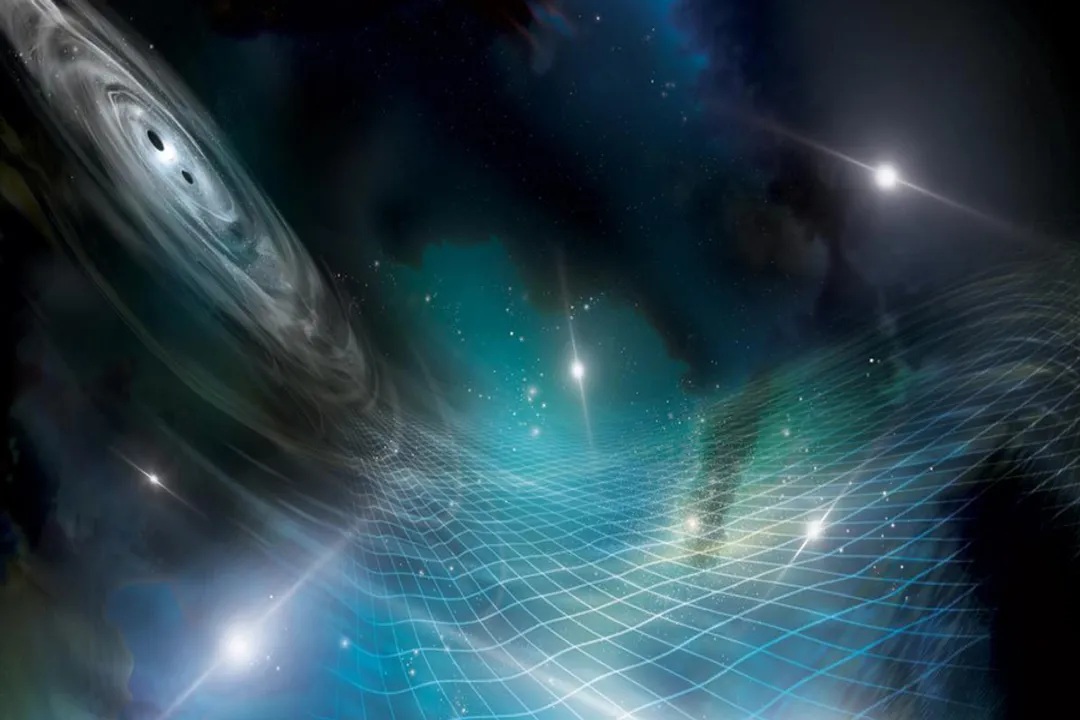
The universe is not composed of static objects existing on an empty stage; rather, space and time are woven together into a single, flexible continuum known as spacetime. [1] When massive cosmic objects engage in a violent collision, the very structure of this continuum is dramatically affected. These events are not merely spectacular light shows; they are physical disturbances that shake the fabric of reality itself, sending out ripples that travel across the cosmos. [4][5]
# Spacetime Fabric
To understand the impact of a collision, one must first grasp what spacetime is. It is the four-dimensional manifold described by Einstein's theories of relativity. [1] In this context, gravity is not a force pulling objects together, but rather the manifestation of the curvature or warping of spacetime caused by the presence of mass and energy. [7] Massive objects, like stars or planets, create dips or curves in this fabric, and other objects simply follow those curves—which we perceive as orbits or motion. [7]
# Violent Mergers
The most profound distortions of spacetime occur during the merger of extremely dense, compact objects. The prime examples are binary systems composed of black holes or neutron stars. [1][5] When two such objects spiral inward toward each other, their relative motion accelerates to incredible speeds. This rapid acceleration of enormous mass generates extreme, time-varying changes in the local spacetime geometry. [3][4]
While every object with mass creates some distortion, the collision of, say, two white dwarfs or even two massive stars, does not produce the clear, detectable gravitational wave signal we look for. The extreme curvature change during the final inspiral and merger of black holes or neutron stars is what generates the signature we can measure, differentiating them from less energetic stellar events. [1][3] The energy involved in these final moments can approach the mass-energy of the Sun converted entirely into gravitational waves. [3]
# Wave Generation
The immediate consequence of this dynamic warping is the creation of gravitational waves. [1] These waves are disturbances, or ripples, that propagate outward from the source at the speed of light, much like the waves generated when a stone is dropped into a pond. [4][6] As these waves pass, they momentarily stretch space in one direction while simultaneously compressing it in the perpendicular direction, only to reverse the effect moments later. [4][5] This stretching and squeezing is the actual motion of spacetime itself. [4]
The event marks a transition where the gravitational field of the merging objects is no longer static or slowly changing but is violently oscillating. The frequency and amplitude of these oscillations depend entirely on the masses of the objects and the precise details of how they spiral and coalesce. [3] For instance, the final merger of two black holes results in a brief, intense burst of gravitational radiation before settling into a final, distorted spacetime configuration. [5]
# Signal Damping
Once created, these ripples travel vast cosmic distances. As a gravitational wave moves away from its source, the energy it carries spreads out over an ever-increasing spherical surface area. [4] This geometric spreading causes the wave's amplitude—the magnitude of the stretching and squeezing effect—to diminish rapidly as it travels through the vacuum of space. [4]
To put the scale of distortion into perspective, when a detectable wave from a distant merger reaches Earth, it alters the length of a 4-kilometer detector arm by less than one ten-thousandth the diameter of a proton. This emphasizes the extreme sensitivity required to 'hear' the universe's most violent crashes, which are typically billions of light-years away. [3] Detectors like LIGO are specifically engineered to measure these minute changes in distance caused by the passing wave. [3] The successful detection of these faint whispers confirms that spacetime is indeed dynamic and elastic, rather than a rigid background. [1][4]
# Light Bending
In addition to emitting propagating waves, the powerful gravitational fields immediately surrounding the merging objects exert a static (or slowly changing) influence on nearby photons. This profound curvature of spacetime causes the path of light passing near the collision site to be deflected. [7] This phenomenon, known as gravitational lensing, means that if any background stars or galaxies happen to align perfectly behind the collision, their light paths will be distorted or multiple images might momentarily appear around the merging objects. [7]
For a black hole merger, this effect is particularly pronounced because the objects possess event horizons from which nothing, not even light, can escape. The final result of the merger, whether a single, larger black hole or a hyper-massive neutron star, retains the extremely warped spacetime around it. This resulting curvature dictates the paths of all matter and light that approach it afterward. [5]
When we study these cataclysmic collisions—whether by capturing the resultant gravitational waves or by observing the electromagnetic light emitted by merging neutron stars—we are essentially using spacetime itself as our medium for observation. [1][3] The event fundamentally reorganizes the local geometry, sends out echoes of that reorganization across the universe, and alters how light propagates past the disturbed region. [7] It provides a direct probe into physics under conditions of gravity that are simply impossible to replicate in any terrestrial laboratory setting. The collision transforms an abstract geometric concept into a measurable physical phenomenon traveling across the cosmos.


#Videos
What If The Largest Objects In The Universe Collided? - YouTube
Related Questions
#Citations
What happens to space time when cosmic objects collide?
What happens to space-time when cosmic objects collide?
What are Gravitational Waves? | LIGO Lab - Caltech
Understanding gravitational waves: Ripples in spacetime explained
Black Holes, Cosmic Collisions and the Rippling of Spacetime
Eli5 how did the collision of those two supermassive blackholes ...
How Gravity Warps Light - NASA Science
What If The Largest Objects In The Universe Collided? - YouTube