What happens if a cosmic ray hits you?
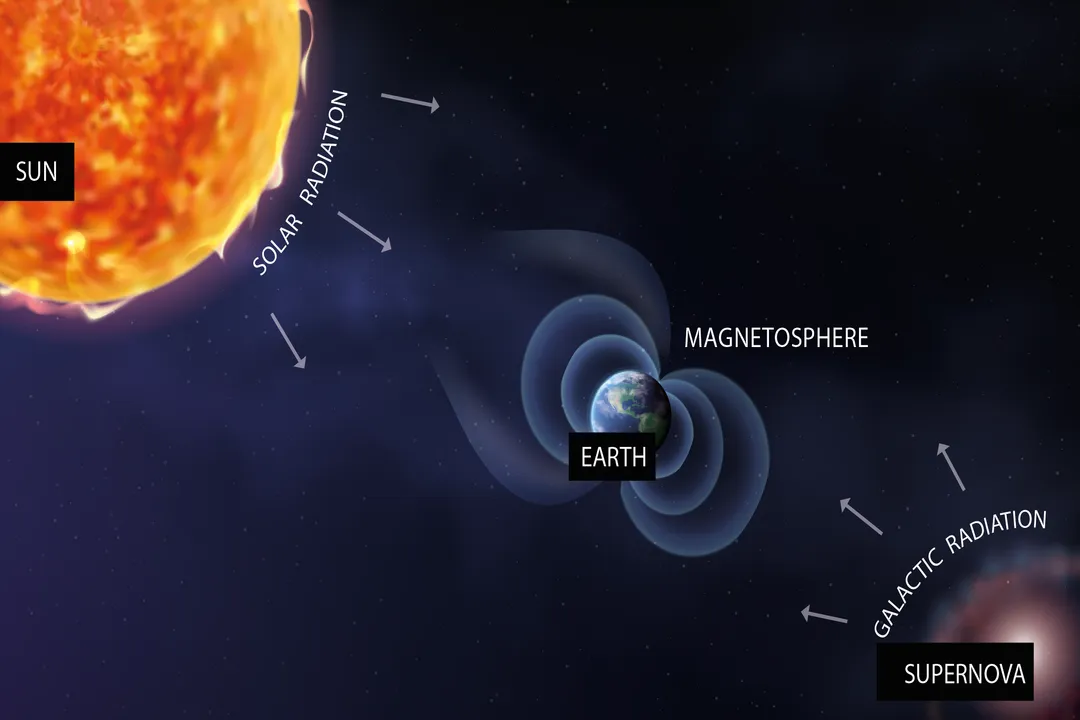
The concept of being struck by a cosmic ray often conjures images of instantaneous, visible destruction, perhaps a bolt of energy from the heavens. In reality, the vast majority of these high-energy visitors from space pass through us every second without notice, largely because of the protection afforded by our planet’s magnetic field and atmosphere. Yet, when we consider the few particles that reach Earth with truly immense kinetic energy, the question of what happens shifts from mundane background noise to a profound physical interaction on a cellular level.
Cosmic rays are not actually "rays" in the traditional sense; they are extremely energetic subatomic particles, most commonly protons, but also including heavier atomic nuclei, originating from outside our solar system—sometimes from distant supernovae or active galactic nuclei. Because these primaries are charged particles, they interact with the Earth’s magnetic field, which deflects most of them away from the planet. Those that make it through are then subjected to collision with the atmosphere, where they create showers of secondary particles that cascade down to the surface.
# Atmosphere's Role

For anyone standing on the Earth’s surface, the atmosphere acts as an incredibly effective shield. The air molecules—primarily nitrogen and oxygen—absorb and scatter the incoming radiation, reducing the primary particle flux to manageable background levels. The radiation dose we receive daily from these sources is constant and natural, a fact that often gets overlooked when discussing the potential hazards of space. While we are exposed to radiation from cosmic sources, we are also exposed to terrestrial radiation and radon gas from the ground beneath our feet. The risk profile changes dramatically when you leave this protective blanket, such as during high-altitude air travel or, most significantly, in space.
# Particle Nature
The danger posed by a cosmic ray depends entirely on its energy and its charge. The most common, lower-energy particles might cause minor, statistically insignificant ionization events in our bodies—the same sort of minuscule electrical disruption that happens millions of times daily due to natural radioactive decay within our own bodies. However, the truly fascinating, and terrifying, scenarios involve the ultra-high-energy cosmic rays (UHECRs).
The famous "Oh-My-God" (OMG) particle, detected in 1991, serves as the benchmark for these extreme events. This particle carried an energy equivalent to about electron volts. To put that scale into a more visceral context, consider that a proton with the energy of a typical fast-pitch baseball () would still only have an energy of about eV. The OMG particle carried the kinetic energy of trillions of baseballs concentrated into a single proton. If such an event were to occur directly inside a person, the effects would be catastrophic, though likely not in the way one might imagine a physical collision.
# Instant Sensation?
If a regular, atmospheric-shower-creating cosmic ray passed through you, you would feel absolutely nothing. The interaction is purely subatomic. If you were an astronaut outside the shielding of the spacecraft, you might occasionally perceive a brief, white flash or streak of light, even with your eyes closed. This phenomenon is attributed to the particle exciting the molecules in your retina or, perhaps more broadly, generating Cherenkov radiation within the fluid of your eye as the ionizing particle travels faster than light in that medium.
For an event as energetic as the OMG particle hitting you directly on the ground—a scenario that physicists consider astronomically improbable due to the atmosphere acting as a buffer—the sensation wouldn't be a thud or a jolt like being hit by a physical object. Instead, the energy deposition would be rapid and localized. The particle would smash into the first few atoms it encountered, creating an immediate, dense shower of secondary particles (pions, muons, electrons, etc.) through electromagnetic and strong nuclear interactions. The resulting cascade would deposit a massive amount of energy in a very small volume, essentially creating an intense, invisible, high-energy radiation burn along the particle's path.
# Cellular Damage
The core hazard of any ionizing radiation, whether from a medical X-ray or a cosmic ray, is its ability to knock electrons loose from atoms, creating ions. In biological tissue, these ions can break molecular bonds, especially within DNA strands. When a typical, ground-level cosmic ray passes through, the resulting damage is minor and usually repaired by cellular mechanisms.
However, a UHECR interaction would be different. The cascade effect means that instead of a single track of ionization, you have a dense "tree" of secondary particles erupting outward. If this occurred within a sensitive area—say, crossing the brain or a major artery—the sheer localized dose could cause acute cellular death in that small region almost instantly. While the energy is vast, it is delivered over a distance of perhaps only a few meters at most before the energy dissipates into the surrounding environment, meaning the effect is highly concentrated but geographically tiny. It would be analogous to firing a relativistic nuclear bullet through a very small patch of tissue; the damage is extreme in that tiny channel, but the rest of the body might remain unaffected unless the initial particle was aimed perfectly through a system-critical component.
# Everyday Exposure
It is essential to keep the discussion anchored in reality regarding the average person's daily exposure. We are constantly bathed in cosmic radiation, and the risk assessment models used by radiation protection agencies are built around this continuous, low-level exposure. A few extra muons or electrons passing through your body during your morning commute do not meaningfully increase your lifetime cancer risk beyond the statistical baseline.
Consider air travel. People who frequently fly polar routes receive a slightly elevated dose because they are at a higher altitude where the atmosphere is thinner, and the Earth's magnetic field provides slightly less deflection than it does at sea level. An astronaut on the International Space Station, lacking the full atmospheric and magnetospheric shield, can receive a dose rate many times higher than that experienced on Earth's surface. This comparison helps illustrate the relative safety of remaining grounded: the atmosphere does its job well.
If you are concerned about exposure, focusing on readily controllable sources, like ensuring your home has low radon levels or avoiding unnecessary medical imaging, presents a far more actionable path than worrying about a one-in-a-trillion cosmic ray strike. The radiation hazards associated with space exploration are well-studied precisely because they represent the scenario where a person is directly exposed to the full, unmitigated spectrum of cosmic radiation.
# Ultra-Energy Events
When modeling what happens during a direct hit by a true UHECR, we are discussing physics at the edge of our current understanding, often requiring us to extrapolate from particle accelerators that cannot reach such energies. Such a particle would initiate a massive particle shower—an air shower, if it occurred in the atmosphere, or a tissue shower if it occurred inside a body. The resulting energy release would cause localized heating, fragmentation of molecules, and massive ionization, leading to immediate, irreversible damage along the path of the shower's core. For a low-energy ray, the path is a thin, negligible scratch; for a UHECR, the path is a microscopic, high-intensity explosion of subatomic debris.
While the energy involved is immense, the chance of one of these particles hitting a specific person on the ground is practically zero. The total cross-sectional area of a human body is minuscule compared to the surface area of the Earth, and the atmosphere filters out everything except the most robust, lower-energy remnants of the original cosmic influx. Therefore, the actual risk associated with "what happens if a cosmic ray hits you" is overwhelmingly tied to the continuous, low-level exposure we all share, not the dramatic, singular event implied by the phrase.
#Videos
Why Are Cosmic Rays Dangerous? | How The Universe Works
Related Questions
#Citations
What would it have felt like if the high-powered cosmic ray ... - Reddit
If someone were hit by an extremely high energy cosmic ray would ...
Oh-My-God particle - Wikipedia
Cosmic ray hazards - Physics Stack Exchange
The Effects of Galactic Cosmic Rays on the Central Nervous System
Cosmic Radiation: Why We Should not be Worried
Why Are Cosmic Rays Dangerous? | How The Universe Works
Cosmic rays revealed: Is this invisible, impactful force dangerous?
Cosmic Charges | NASA Earthdata