What are cosmic clouds?
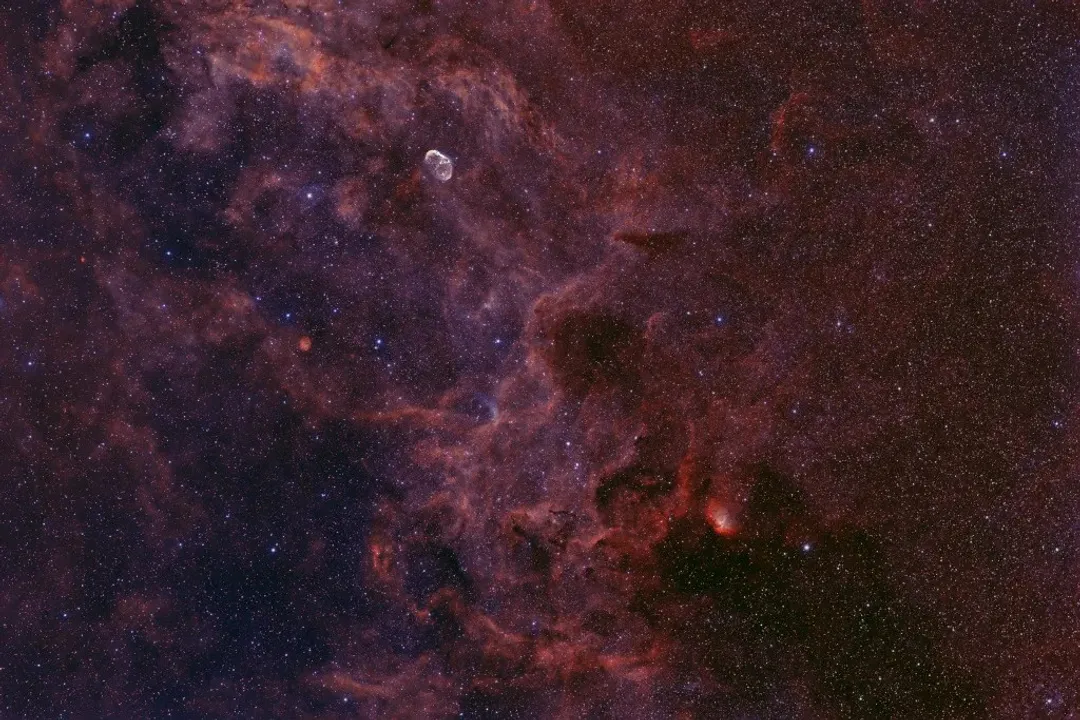
Cosmic clouds represent the vast, sprawling collections of gas and dust that permeate the space between stars, known technically as the interstellar medium. [1][4] These structures are far more than just empty voids; they are the fundamental raw materials from which future generations of stars, planetary systems, and even life itself will eventually coalesce. [9] When we look up at the night sky, much of what we perceive as darkness or a faint glow is actually light interacting with or being obscured by these massive, diffuse structures scattered throughout the Milky Way and other galaxies. [2] Grasping what these clouds are requires looking past our everyday sense of scale, as they can encompass regions far larger than entire star systems. [8]
# Raw Ingredients
The primary components of these interstellar clouds are incredibly simple on a chemical level: about 99% of their mass consists of gas, predominantly elemental hydrogen and helium, while the remaining 1% is made up of microscopic solid particles we call cosmic dust. [1] This dust is crucial; it is composed of heavier elements that were forged inside previous generations of stars and ejected when those stars died. It includes silicates, carbonaceous materials, and even traces of water ice. [1]
The physical conditions within these clouds vary dramatically. Temperature is a key differentiator, ranging from extremely cold regions near absolute zero in the densest cores to much hotter, ionized gases near active star-forming regions or powerful stellar winds. [1] This vast thermal spectrum dictates the cloud's behavior and its ultimate fate. To truly appreciate their presence, it helps to recognize that these clouds are the universe's inventory—the available stock of matter waiting for gravity to sculpt it anew. While the average interstellar space between stars is an almost perfect vacuum, the densest molecular clouds represent a significant concentration of this raw material, making them the only places where gravitational collapse can successfully initiate star birth. [9]
# Light Interactions

The appearance of a cosmic cloud to an observer depends entirely on how its material interacts with the electromagnetic radiation—primarily visible light—emitted by nearby stars. [1] This interaction creates four main descriptive categories that astronomers use to classify them:
# Dark Clouds
These are perhaps the most visually striking against a bright stellar background. Dark nebulae, or absorption clouds, appear as dark patches or silhouettes because they are so dense with dust and gas that they effectively block the light coming from stars located behind them. [1] They are relatively cool, often containing molecular gas, making them prime candidates for future star formation. [9]
# Emission Clouds
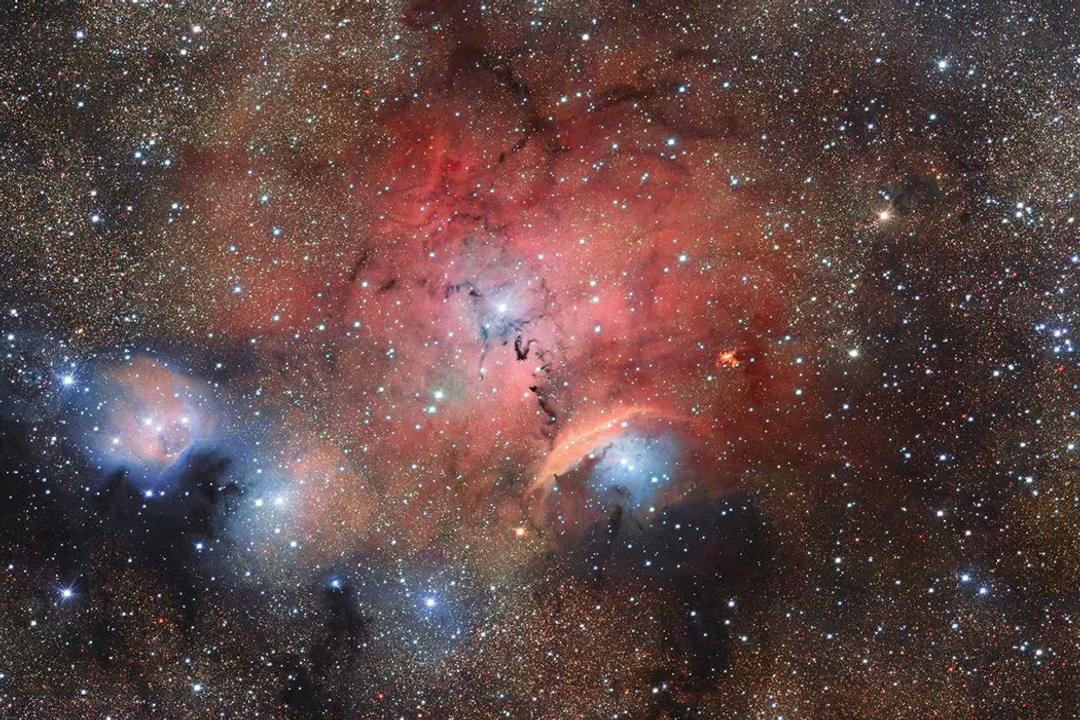
Conversely, emission nebulae glow with their own light. This occurs when intense ultraviolet radiation from very hot, young stars within or near the cloud excites the surrounding hydrogen gas, causing it to become ionized and then emit light, typically in a characteristic reddish hue as the electrons recombine with the protons. [1]
# Reflection Clouds
These clouds do not produce their own light, nor are they dense enough to fully block it. Instead, they appear blue because the fine dust particles preferentially scatter the blue wavelengths of light from nearby stars more efficiently than the longer, redder wavelengths, much like how Earth’s atmosphere makes our sky blue. [1]
# Molecular Nebulae
While not strictly defined by light emission alone, molecular clouds are fundamentally important. They are the coldest and densest environments in the interstellar medium, where hydrogen exists primarily as molecules () rather than individual atoms. [1] These conditions, requiring temperatures around 10 to 20 Kelvin, allow gravity to begin winning the long battle against internal pressure, leading directly to stellar nurseries. [1][9]
# Galactic Scale
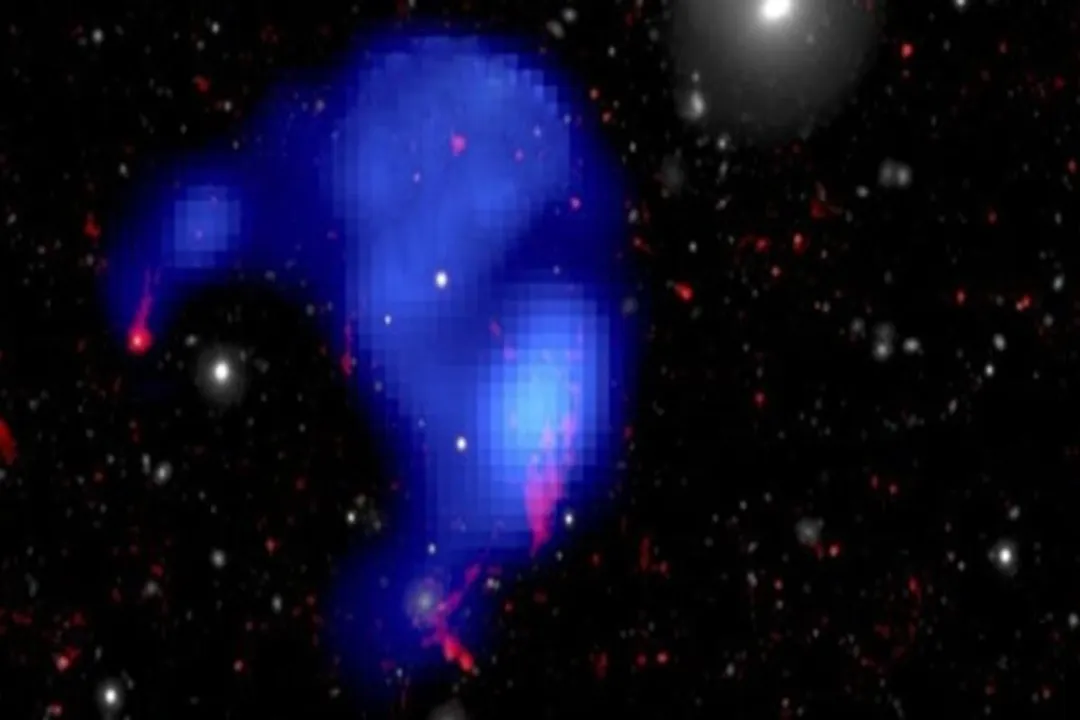
The sheer size of some cosmic clouds challenges terrestrial comprehension. While we often picture them as localized features, many are immense structures existing on galactic scales. [8] Certain complexes are known to span hundreds of light-years, and some of the largest known gaseous structures are estimated to be larger than the entire diameter of the Milky Way galaxy itself. [8]
Because these objects are three-dimensional, understanding their true shape requires careful observation from various angles and employing specialized techniques. [2] When looking at a two-dimensional photograph, we are seeing a projection of an enormous, often filamentary, structure, which can lead to misinterpretations of its depth or density distribution. [2] The perception of how a cloud looks—whether wispy or dense—is therefore tied closely to our viewing perspective relative to the light sources around it. [2]
# Forging Stars
The most critical function of cosmic clouds, particularly the dense molecular variety, is their role as the birthplaces of stars. [9] The process begins when a portion of the cloud becomes sufficiently dense and cold that the force of mutual gravitational attraction between particles begins to overcome the outward pressure exerted by the gas's internal heat and turbulence. [9]
As gravity pulls material inward, the core of the collapsing region heats up dramatically due to the conversion of gravitational potential energy into thermal energy. This dense, hot core eventually becomes a protostar, initiating thermonuclear fusion once the core temperature and pressure reach the necessary threshold—the moment a star is truly born. [9]
The complexity of this process is so significant that modern astrophysics often relies on intricate modeling to understand the turbulence, magnetic fields, and density fluctuations within these collapsing structures. For instance, scientists are now using advanced techniques, including the creation of physical, 3D-printed models based on observational data, to unravel the dynamics governing how material collapses within these clouds to form new stars. [6] These tangible models allow researchers to test theories about fragmentation and accretion in ways that purely digital simulations cannot always capture, providing a physical analogy for processes occurring light-years away. [6] A specific area where these processes are actively studied is the Cygnus region, a massive star-forming complex where new stars are currently illuminating the surrounding natal clouds. [3]
# Observing the Invisible
Studying these clouds requires a multi-wavelength approach because no single wavelength of light reveals the entire picture. Visible light captures the reflection and emission features, but to see into the densest, coldest cores where stars are actually forming, astronomers must look at longer wavelengths, such as infrared or radio waves, which can penetrate the obscuring dust. [1]
Furthermore, observing the motion and composition within these clouds often requires looking at the specific spectral lines emitted or absorbed by different molecules, which acts as a chemical fingerprint for that region of space. [1] This combination of techniques provides the expertise necessary to map out the temperature, density, velocity, and chemical makeup of objects that are otherwise only visible as dark silhouettes or faint glows against the backdrop of the galaxy. [1] The effort dedicated to mapping these structures helps build an authority in understanding the lifecycle of cosmic matter, allowing us to trace the path from diffuse gas to radiant stellar bodies. [2]
#Videos
Cosmic Clouds: Exploring Nebulae for Children : Astronomy for Kids
Related Questions
#Citations
Interstellar cloud - Wikipedia
A 3D guide to cosmic clouds with Queen guitarist Brian May
Cosmic Clouds in Cygnus - NASA Science
Cosmic Cloud - Alien Species Wiki - Fandom
Cosmic cloudscape - ESA/Hubble
3D Cosmic Clouds Reveal How Stars Are Formed | Scientific American
Cosmic Clouds: Exploring Nebulae for Children : Astronomy for Kids
A Cosmic Cloud Bigger Than The Entire Milky Way - Telescope Live
How the Universe Forges Stars from Cosmic Clouds - JSTOR Daily