What excites the hydrogen gas in emission nebulae to cause glowing?
Answer
Intense ultraviolet radiation from very hot, young stars within or near the cloud.
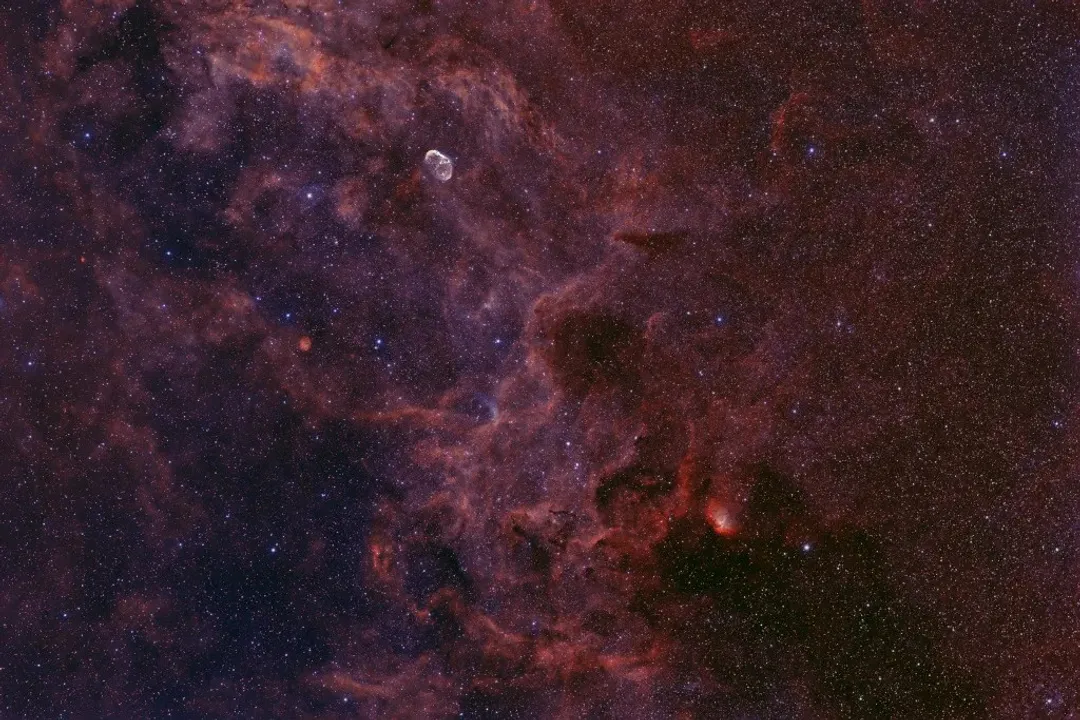
Emission nebulae shine because they are actively interacting with high-energy photons originating from nearby stellar objects, specifically very hot, young stars. These stars emit copious amounts of intense ultraviolet radiation. When this high-energy radiation strikes the surrounding, relatively cooler hydrogen gas, it strips electrons from the protons, ionizing the gas. As these free electrons subsequently recombine with the protons, they release energy in the form of visible light, often resulting in the characteristic reddish hue associated with hydrogen emission spectral lines.
#Videos
Cosmic Clouds: Exploring Nebulae for Children : Astronomy for Kids
Related Questions
What is the primary mass component of interstellar clouds?Why do dark nebulae appear as silhouettes against stellar backgrounds?What causes reflection clouds to appear blue to an observer?What characterizes the hydrogen state in molecular nebulae environments?What force must overcome internal pressure for star birth in dense clouds?What excites the hydrogen gas in emission nebulae to cause glowing?Where do the heavier elements composing cosmic dust originate?What wavelengths must astronomers use to penetrate dense cores where stars form?What tangible models do scientists use to test theories on fragmentation in star formation?How large are some of the largest known gaseous structures relative to the Milky Way?What challenge arises when viewing the three-dimensional shape of a cosmic cloud in a 2D photograph?