How large are some of the largest known gaseous structures relative to the Milky Way?
Answer
Estimated to be larger than the entire diameter of the Milky Way galaxy.
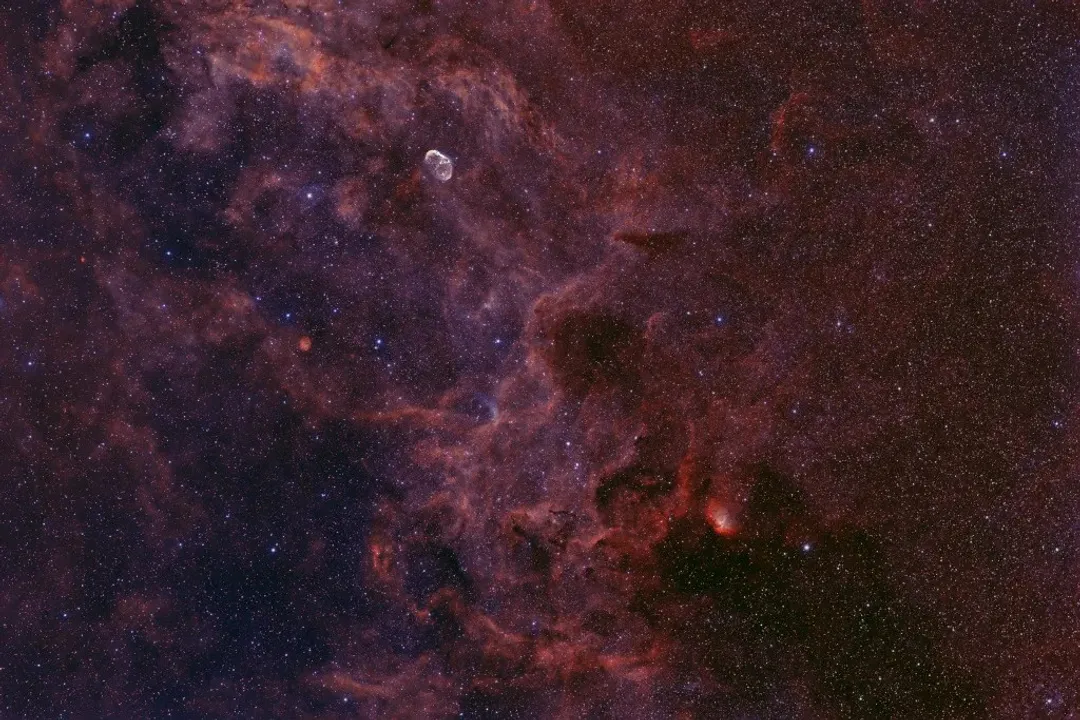
The scale of cosmic clouds challenges terrestrial comprehension due to their immense size on a galactic level. While many clouds are vast, spanning hundreds of light-years, the most massive gaseous structures known push the boundaries of even galactic dimensions. Some of these extremely large complexes are estimated in size to surpass the entire diameter of our home galaxy, the Milky Way. This demonstrates that these structures are not isolated features but massive reservoirs of raw material existing across enormous scales within the galactic environment.
#Videos
Cosmic Clouds: Exploring Nebulae for Children : Astronomy for Kids
Related Questions
What is the primary mass component of interstellar clouds?Why do dark nebulae appear as silhouettes against stellar backgrounds?What causes reflection clouds to appear blue to an observer?What characterizes the hydrogen state in molecular nebulae environments?What force must overcome internal pressure for star birth in dense clouds?What excites the hydrogen gas in emission nebulae to cause glowing?Where do the heavier elements composing cosmic dust originate?What wavelengths must astronomers use to penetrate dense cores where stars form?What tangible models do scientists use to test theories on fragmentation in star formation?How large are some of the largest known gaseous structures relative to the Milky Way?What challenge arises when viewing the three-dimensional shape of a cosmic cloud in a 2D photograph?