What challenge arises when viewing the three-dimensional shape of a cosmic cloud in a 2D photograph?
Answer
It can lead to misinterpretations of its depth or density distribution.
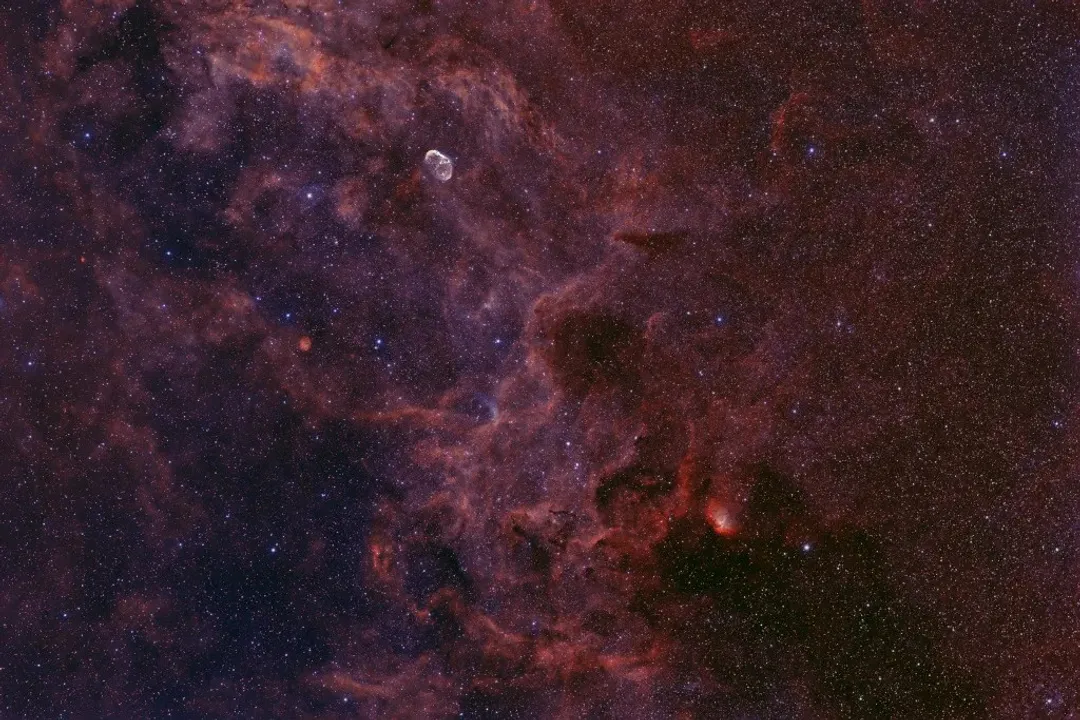
Because cosmic clouds are fundamentally three-dimensional objects, projecting their structure onto a two-dimensional image, such as a standard photograph, inevitably results in a loss of depth perception. What an observer sees is merely a projection of an enormous, often complex and filamentary structure onto a flat plane. This perspective distortion can cause misjudgments regarding how deep the cloud actually extends or where the densest concentrations of matter truly lie relative to one another and the background stars, emphasizing the need for multi-angle observation.
#Videos
Cosmic Clouds: Exploring Nebulae for Children : Astronomy for Kids
Related Questions
What is the primary mass component of interstellar clouds?Why do dark nebulae appear as silhouettes against stellar backgrounds?What causes reflection clouds to appear blue to an observer?What characterizes the hydrogen state in molecular nebulae environments?What force must overcome internal pressure for star birth in dense clouds?What excites the hydrogen gas in emission nebulae to cause glowing?Where do the heavier elements composing cosmic dust originate?What wavelengths must astronomers use to penetrate dense cores where stars form?What tangible models do scientists use to test theories on fragmentation in star formation?How large are some of the largest known gaseous structures relative to the Milky Way?What challenge arises when viewing the three-dimensional shape of a cosmic cloud in a 2D photograph?