Why don't meteors hit satellites?
It is easy to imagine a satellite, hanging silently in the black vacuum above, suddenly being vaporized by a stray rock from space, like a scene from a disaster movie. While the threat from natural meteoroids is real, the constant bombardment faced by spacecraft is often dominated by a more insidious enemy: man-made space debris. The reason we don't see frequent, catastrophic, random meteoroid strikes on active satellites comes down to a combination of orbital mechanics, passive protection, and the sheer vastness of space itself.
# Orbital Density
To appreciate the risk, one must consider the environment. Space is enormous, and while orbits like Low Earth Orbit (LEO) are getting crowded, they are not densely packed in the way a crowded city street is. Satellites are small targets navigating a massive volume. The probability of a random, untracked object—whether natural or artificial—hitting a specific, small satellite at any given moment remains statistically low.
The risk profile changes significantly based on altitude. Objects orbiting closer to Earth, in LEO, are passing through a volume containing a much higher concentration of junk, from spent rocket stages to tiny paint flecks, than those higher up in Geostationary Orbit (GEO). Satellites in LEO must contend with this higher density of cataloged and uncataloged material daily. Even seemingly minor objects travel at incredible velocities, sometimes reaching 17,500 miles per hour in LEO. At these speeds, even something microscopic carries massive kinetic energy.
# Debris Distinction
A critical piece of context is separating natural meteoroids from orbital debris. A "meteoroid" is a natural chunk of rock or dust in space. When one enters Earth's atmosphere, friction causes it to burn up, creating a "shooting star" or meteor. The atmosphere acts as a colossal, natural shield for everything on the ground, and even for satellites operating above the densest atmospheric layers.
However, satellites are operating beyond the atmosphere, meaning they are exposed to micrometeoroids—the natural, small particles—unimpeded. The reality is that satellites are regularly hit by both natural micrometeoroids and human-made orbital debris (OD). The primary difference is that OD includes fragments generated by past satellite breakups, collisions, or even accidental explosions of old rocket bodies, creating a growing population of hazards that orbit right alongside active spacecraft.
For operators, the threat matrix often prioritizes the known objects. Space surveillance networks track larger pieces of debris, which provides a catalog of potential high-risk encounters. Natural meteoroids, being unpredictable and originating from countless different sources, cannot be tracked in the same way. Therefore, the debris that causes operators to schedule avoidance maneuvers is usually the cataloged artificial junk, not the random natural visitor.
# Shielding Layers
Because complete avoidance of every particle is impossible—especially the uncataloged natural ones and the very small pieces of debris—satellites rely heavily on passive protection. They are not just simple metal cans; they are armored to withstand continuous bombardment.
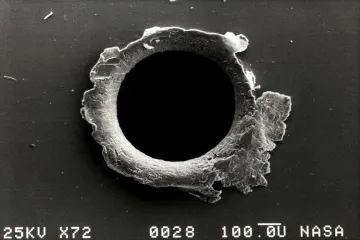
One of the most common defensive structures is the Whipple shield. This is not a single solid plate. Instead, it is a multi-layered barrier designed specifically to mitigate hypervelocity impacts. The concept involves having a thin outer bumper (the first layer). When a particle hits this bumper, the impact energy causes the particle to shatter and vaporize into a plume of high-velocity plasma and fragments. This dispersed cloud then spreads out before it reaches the main structural wall of the spacecraft. A subsequent, thicker rear shield absorbs the energy from this spread-out impact cloud, effectively dissipating the force over a larger area, thus preventing penetration into sensitive equipment. This design is effective against both the natural dust that constantly streams through the solar system and the shards of artificial debris.
The effectiveness of this layered defense means that while small impacts are common—often causing pitting or microscopic surface damage—they rarely lead to mission-ending failure, which is why the general public does not hear constant reports of satellite destruction by space pebbles.
# Maneuver Reality
When an object—be it a piece of debris or, theoretically, a large meteoroid if one were detected—is on a collision course, the satellite can sometimes move. Collision Avoidance Maneuvers (CAMs) are performed using onboard thrusters to shift the satellite’s trajectory slightly.
However, this is a fuel-intensive process, and fuel reserves are finite, representing the operational lifespan of the satellite. Therefore, maneuvers are only executed when the calculated probability of collision exceeds a specific threshold, usually for objects large enough to cause severe damage. Furthermore, the capability to track and predict an object's path accurately dictates whether a maneuver is possible.
The sheer number of natural meteoroids makes tracking them all for predictive avoidance completely impractical, even if our sensors were sensitive enough to spot them miles away. The cost, time, and fuel expenditure required to adjust orbit for a statistically tiny chance of impact from a natural object simply does not justify the action when compared to the known, cataloged risk from debris. Space agencies focus their active, high-cost avoidance strategies on the predictable threat: the debris left behind by humanity. For the random, unannounced natural threats, the industry relies almost entirely on the engineering solution: the protective armor.
If we consider the physics of the situation, a satellite's orbit is essentially a "thin-sheet" environment relative to the particle stream. While the LEO shell is getting thicker with junk, the actual time spent by any single satellite intersecting a particularly dense volume of large, fast-moving natural meteoroids over its operational lifetime is quite limited. The odds are stacked in the satellite's favor for large natural impacts, even if they are constantly being peppered by the unavoidable, tiny particles that the shielding is designed to handle.
#Videos
How To Recognize Space Rocks vs Satellites - YouTube
Related Questions
#Citations
TIL that satellites are programmed to avoid meteorites so they don't ...
How do satellites remain safe from space debris and meteorites?
Why don't any meteoroids hit satellites? - Quora
Chapter: 4 The Meteoroid Environment and Its Effects on Spacecraft
How come when there is a meteor shower they never hit anything in ...
Shooting Stars Can Shoot Down Satellites - IEEE Spectrum
How To Recognize Space Rocks vs Satellites - YouTube
Why doesn't the ISS suffer catastrophic damage from micro-meteors?