What is the biggest Messier object?
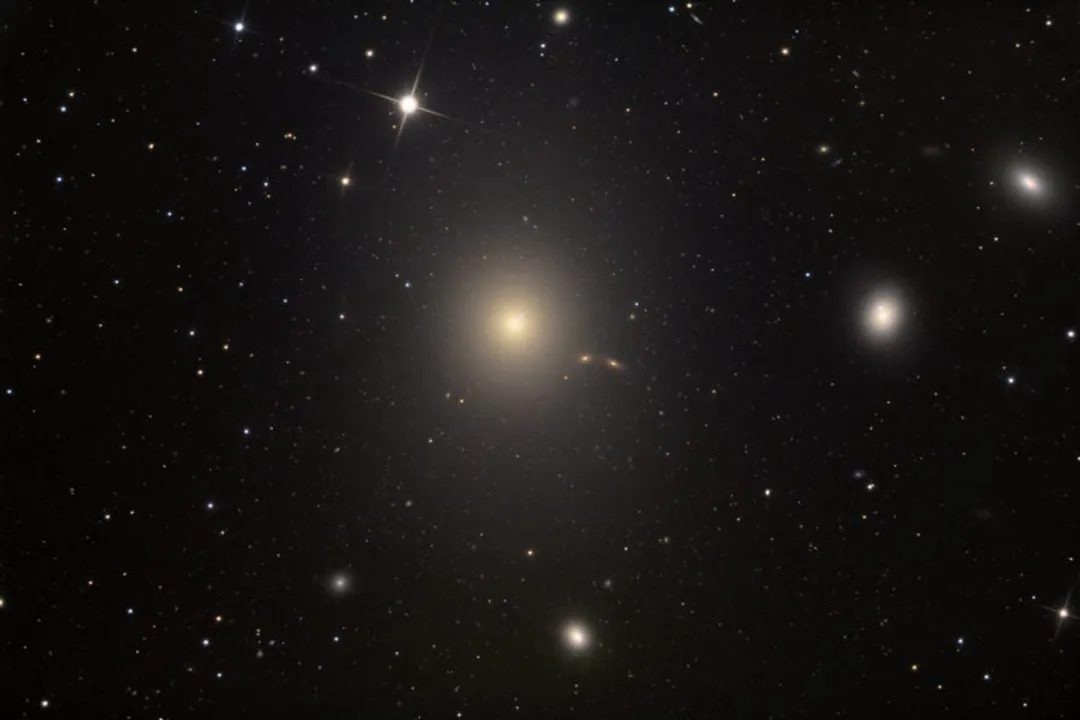
The search for the most significant or largest object within Charles Messier's famous catalog of deep-sky sights inevitably points toward a singular, colossal entity residing in the Virgo constellation. While many Messier objects—like the Pinwheel Galaxy (M101) or the Andromeda Galaxy (M31)—are breathtakingly large or bright, one galaxy stands out when considering sheer physical scale: Messier 87. [3] This immense object, also cataloged as Virgo A, is not just another fuzzy patch for amateur astronomers; it represents one of the most massive single galaxies known in the nearby universe. [1][6]
# Catalog Basics
The objects cataloged by the French astronomer Charles Messier in the 18th century were initially compiled as a list of non-cometary objects that he repeatedly observed while searching for new comets. [5] His catalog, now known as the Messier Catalog, contains 110 entries, ranging from faint nebulae and star clusters to entire galaxies residing far outside the Milky Way. [5] Astronomers today still use the "M" designation when discussing these celestial landmarks. [5] While Messier was interested in not confusing these fixed objects with moving comets, modern observers are fascinated by the vast differences in size, composition, and distance represented within that small collection. [5]
# Defining Size
When we ask what the "biggest" Messier object is, the term itself requires careful definition. Does "biggest" refer to the apparent angular size seen through a telescope, the total mass, or the true physical diameter across space? For Messier 87, the answer that secures its title is usually its actual physical diameter. [3] Apparent size is heavily dependent on distance; a nearby, small galaxy might appear larger than a more distant, truly massive one. [3] M87, however, wins on inherent scale.
Many of the Messier objects are galaxies, and these naturally vary in size. For instance, the Andromeda Galaxy (M31) is a vast spiral galaxy, often cited for its impressive span. Yet, the sheer volume and stellar population packed into M87 push its physical boundaries far past its spiral counterpart. [3] If you were observing M87 through a modest amateur telescope, its appearance would be deceptively simple—a bright, slightly elongated smudge in the sky. [6] The true scale of this object, however, is only revealed when astronomers model its enormous stellar halo and calculate its total physical extent. [3]
# The Colossus M87
Messier 87 is classified as a giant elliptical galaxy. [1][6] These galaxies are generally older than spirals, lacking the distinct disk structure and ongoing star formation seen in systems like our own Milky Way or M31. [1] M87 sits near the center of the Virgo Cluster, a massive congregation of galaxies, making it a dominant gravitational force in that local group. [4][6] Its distance is estimated to be around 50 million light-years away. [1]
What makes M87 so exceptional in terms of size is its estimated physical diameter. Sources suggest that M87 may stretch out across as much as 500,000 light-years. [3] To put that staggering number into context, our own Milky Way galaxy is estimated to be about 100,000 to 120,000 light-years across. [3] This means M87’s stellar halo extends at least four times the diameter of our home galaxy. [3] When we look at the true physical extent of this Messier object, it dwarfs nearly every other galaxy in the catalog. [3] If you could place the Milky Way next to M87, our galaxy would look like a small satellite system clinging to the edge of the giant elliptical. [3] This sheer physical size is what solidifies its reputation as the "biggest one of them all" among the 110 entries. [3]
If we consider the light we see arriving today, that light has been traveling for 50 million years. [1] This distance is considerable, yet M87 remains bright enough (apparent magnitude of about 8.6) to be spotted by dedicated observers using moderate aperture telescopes, though it requires dark skies away from city lights. [6]
# The Energetic Core
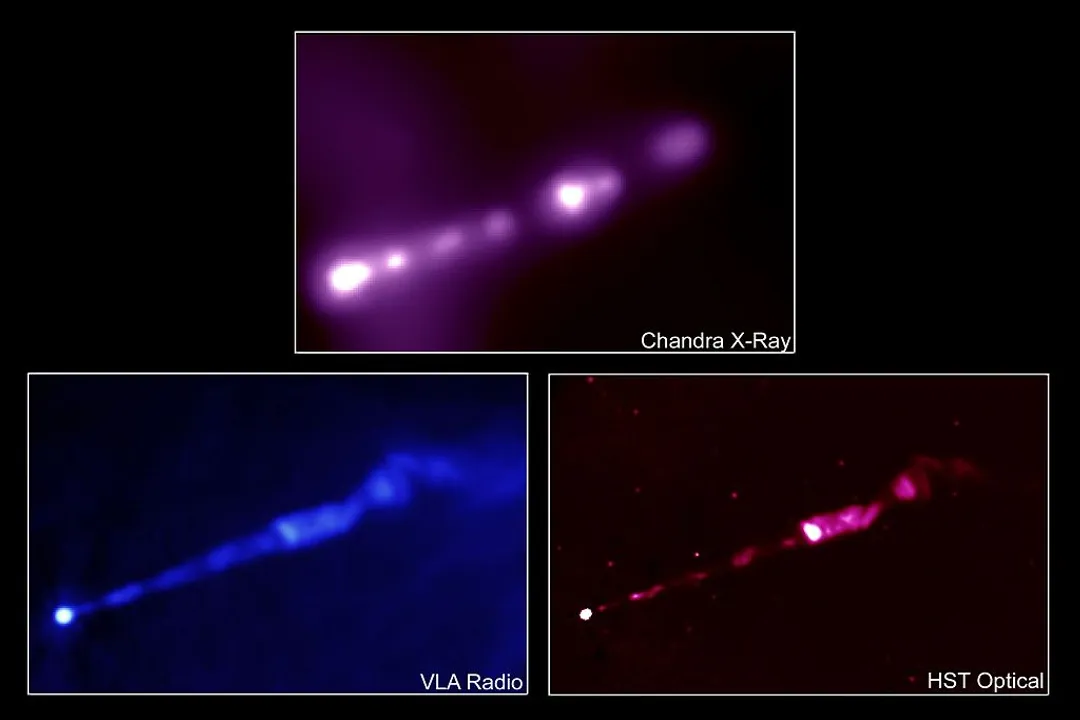
Beyond its immense physical diameter, M87 commands attention for its incredible central engine. At the heart of this giant galaxy resides a supermassive black hole. [2][4] This is not just a large black hole; it is one of the most massive known, possessing the equivalent mass of perhaps 6.5 billion times that of our Sun. [2] This central mass dominates the galaxy's dynamics and powers its most spectacular feature.
The evidence of this massive black hole’s activity is visible across the electromagnetic spectrum, but perhaps most famously in the visible light images captured by the Hubble Space Telescope. [2] Hubble clearly resolved a powerful jet of superheated plasma erupting outward from the galactic core. [2][4] This jet is essentially material being ejected at near light speed due to the intense gravitational and magnetic fields around the black hole. [2] The jet itself is a staggering feature, observable extending for thousands of light-years away from the nucleus. [2] This visible manifestation of extreme physics within an otherwise visually 'simple' elliptical galaxy adds a layer of notoriety that few other Messier objects can match.

# Comparison and Scale Context
While M87 is arguably the largest in terms of overall physical dimension among the Messier objects, other candidates are noteworthy for different reasons. M31, Andromeda, is often the most massive galaxy we can see in the local group (though M87 is much farther away) and is the largest spiral in the catalog by diameter. [3] However, its true physical span, while large for a spiral, does not compete with the spread of the giant elliptical M87. [3]
When looking at lists of "big things" in the sky, Messier objects are often contrasted with other large but non-Messier objects, such as the vast, faint structures of the Coma Cluster which M87 anchors. [4][8] However, restricting the comparison strictly to the 110 cataloged items, M87’s sheer volume and diameter make it the champion. [3] For an amateur astronomer attempting to visualize this, think about mapping out the entire breadth of the Milky Way—about 100,000 light-years—and then realizing M87 is five times that distance from edge to edge in its fainter outer reaches. [3] This immense scale hints at the massive merger history this galaxy has likely undergone, accumulating material over billions of years to reach its current status. [1] The presence of so many stars packed into such a volume, yet distributed over such a large area, is an astronomical puzzle that keeps researchers busy observing M87 using instruments like the James Webb Space Telescope as well. [7]
# Observing the Giant
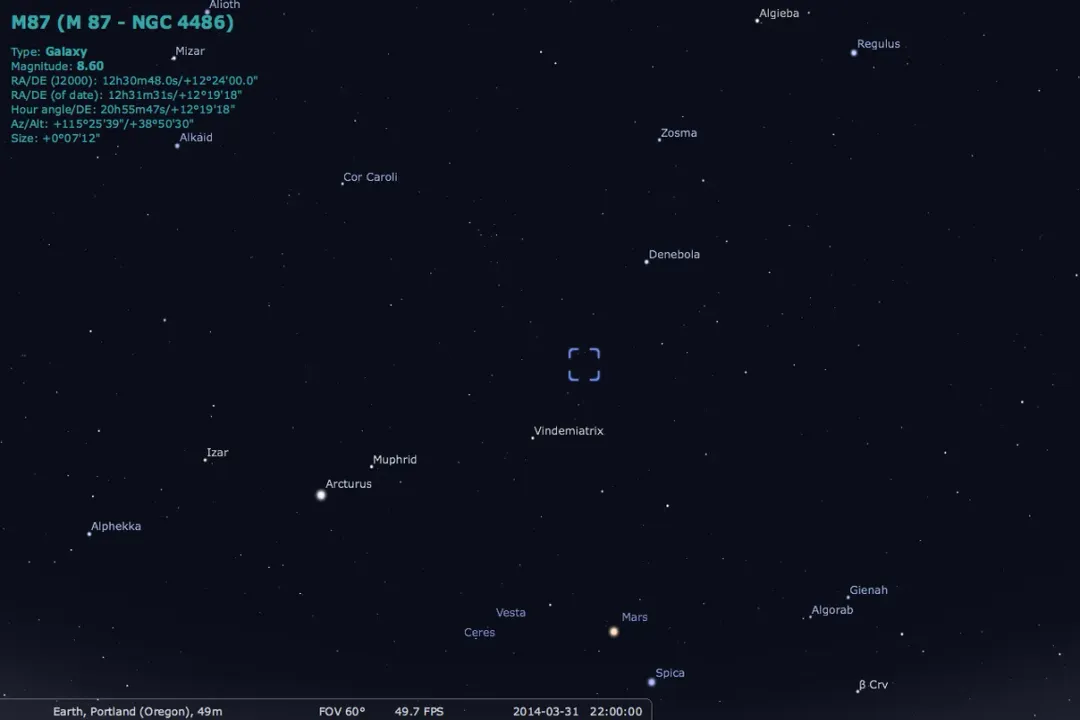
Although M87 is the largest Messier object, observing it effectively requires patience and clarity, especially if you wish to perceive anything beyond its core. Located in the constellation Virgo, it is best observed during the spring months in the Northern Hemisphere when Virgo is highest in the sky. [6] Because it is part of the Virgo Cluster, M87 is often observed alongside many other galaxies, making it a rewarding target for deep-sky imaging sessions. [4]
For visual observers, finding M87 is often part of a larger "Virgo Galaxy Tour." While faint galaxies are challenging, M87’s comparatively higher brightness (magnitude 8.6) compared to other cluster members makes it a reliable target. [6] A helpful tip for locating it visually is to use the star Spica (Alpha Virginis) as a guide, though M87 lies slightly north and west of the central constellation area. [6] An interested observer should note that while the central nucleus is easily visible, discerning the full extent of the galaxy—the 500,000 light-years span—requires long-exposure astrophotography, as the outer stellar halo fades rapidly into the background sky. [3] A visual impression, even a slightly fuzzy one, is still a connection to the single largest cataloged structure by Charles Messier. [5]
Related Questions
#Citations
Messier 87 - Wikipedia
Messier 87 - NASA Science
Messier Monday: The Biggest One of them All, M87 - Medium
Messier 87 - the Virgo A Supergiant Galaxy - Universe Today
Messier 87: Virgo A
Messier 87: The Large Central Elliptical Galaxy in the Virgo Cluster
Statistics of the Messier objects - Cambridge University Press
The Biggest things in the Sky - RASC Calgary Centre