Which astronomical entity was believed to encompass nearly the entirety of the known universe before Hubble's work resolved the spiral nebulae debate?
Answer
The Milky Way
Prior to Edwin Hubble's definitive measurements resolving the nature of spiral nebulae like M31, the prevailing cosmological understanding held that the Milky Way galaxy comprised the entirety of existence. Stars, gas clouds, and everything observable were thought to be confined within its structure. If the Andromeda Nebula had been merely a cloud within this framework, its distance would have been estimated only in the thousands of light-years, making it a local feature rather than a separate, colossal structure.
Related Questions
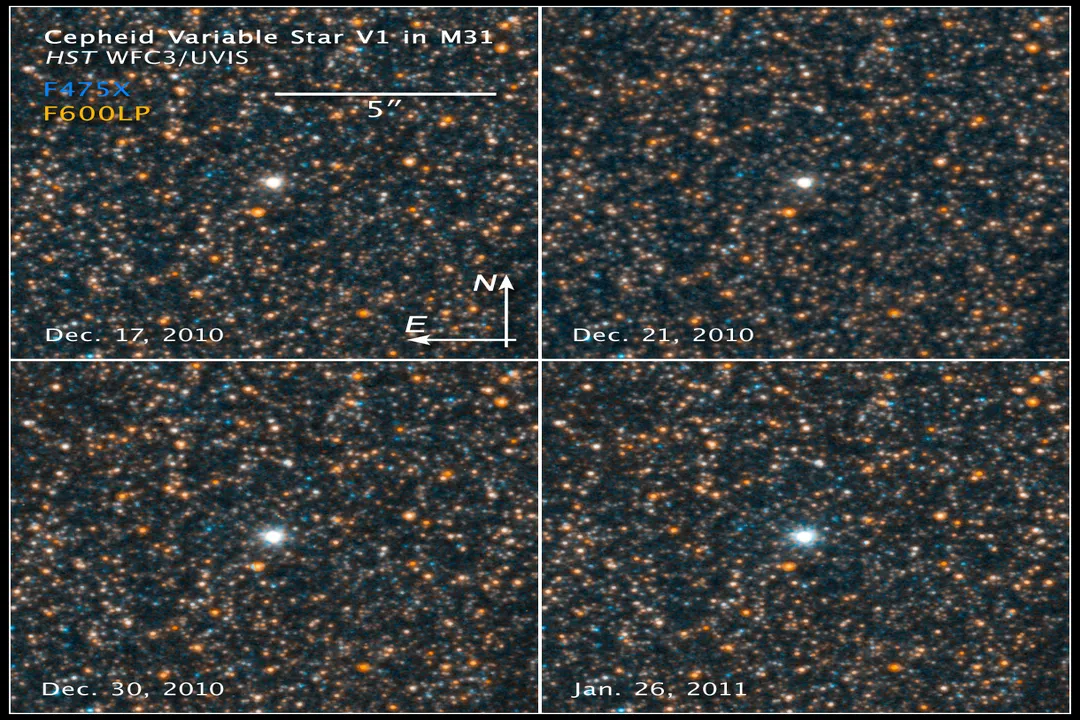
What instrument did Edwin Hubble utilize at Mount Wilson Observatory to resolve stars in the Andromeda Nebula?What specific stellar characteristic, measured by Henrietta Swan Leavitt, allowed Hubble to determine the intrinsic brightness of Cepheids?Why was simple trigonometric parallax inadequate for measuring the distance to the Andromeda Nebula (M31)?What was the designation given to the specific Cepheid variable star Hubble identified within the Andromeda Nebula in 1923?What were the two critical brightness measurements Hubble compared to solve the final distance to V1 using the inverse square law?According to Hubble's initial calculation, approximately how far away was the Andromeda Nebula from the Milky Way?What concept did the discovery of V1 confirm about the Andromeda Nebula (M31) relative to the Milky Way?Which astronomical entity was believed to encompass nearly the entirety of the known universe before Hubble's work resolved the spiral nebulae debate?What type of Cepheid stars were later found to be responsible for the initial underestimation of Andromeda's distance?What term describes standard celestial objects like Cepheids, whose intrinsic brightness is tied to a measurable timing property, used for gauging vast cosmic distances?