What concept did the discovery of V1 confirm about the Andromeda Nebula (M31) relative to the Milky Way?
Answer
It was an independent galaxy existing entirely outside our stellar system
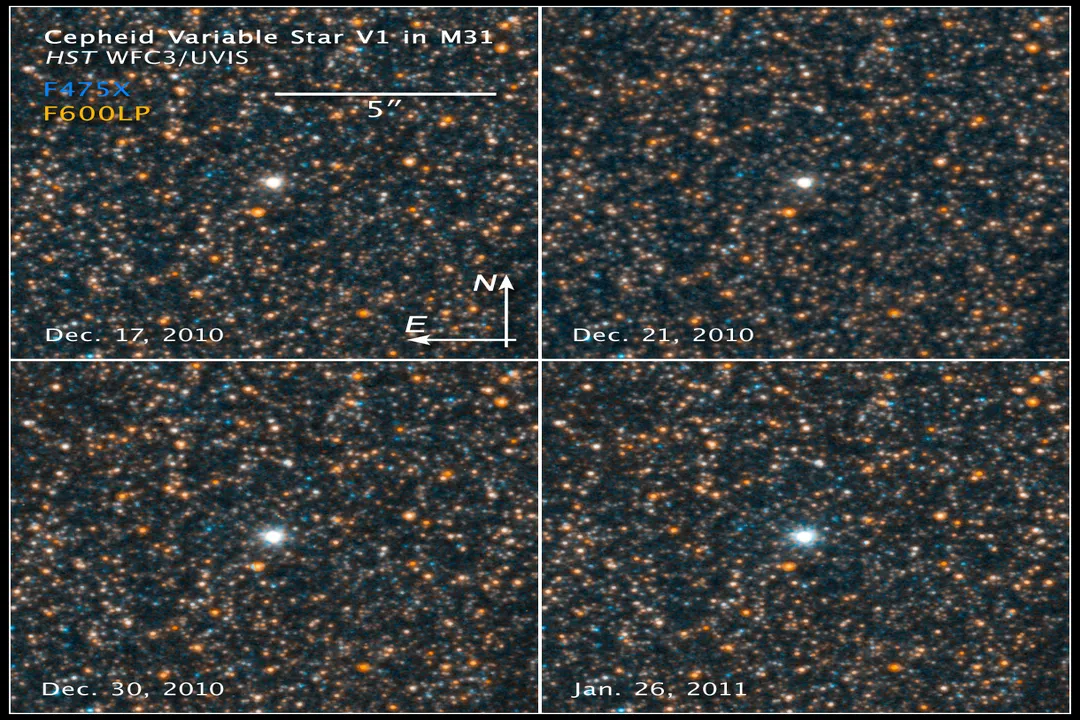
The successful identification of a Cepheid variable star within the Andromeda Nebula, coupled with the derived distance of 900,000 light-years, served as the decisive proof that the object was not merely a gas cloud situated within the Milky Way. Since the calculated distance far exceeded the known scale of our own galaxy, it demonstrated that Andromeda must be a massive, distinct collection of stars operating entirely separately in intergalactic space. This fundamentally altered the perception of the cosmos from a single island universe to a vast collection of such islands.
Related Questions
What instrument did Edwin Hubble utilize at Mount Wilson Observatory to resolve stars in the Andromeda Nebula?What specific stellar characteristic, measured by Henrietta Swan Leavitt, allowed Hubble to determine the intrinsic brightness of Cepheids?Why was simple trigonometric parallax inadequate for measuring the distance to the Andromeda Nebula (M31)?What was the designation given to the specific Cepheid variable star Hubble identified within the Andromeda Nebula in 1923?What were the two critical brightness measurements Hubble compared to solve the final distance to V1 using the inverse square law?According to Hubble's initial calculation, approximately how far away was the Andromeda Nebula from the Milky Way?What concept did the discovery of V1 confirm about the Andromeda Nebula (M31) relative to the Milky Way?Which astronomical entity was believed to encompass nearly the entirety of the known universe before Hubble's work resolved the spiral nebulae debate?What type of Cepheid stars were later found to be responsible for the initial underestimation of Andromeda's distance?What term describes standard celestial objects like Cepheids, whose intrinsic brightness is tied to a measurable timing property, used for gauging vast cosmic distances?