What two distinct physical phenomena can cause a galaxy to appear 'red' observationally?
Answer
High cosmological redshift and the intrinsic color dominated by older stars or dust absorption
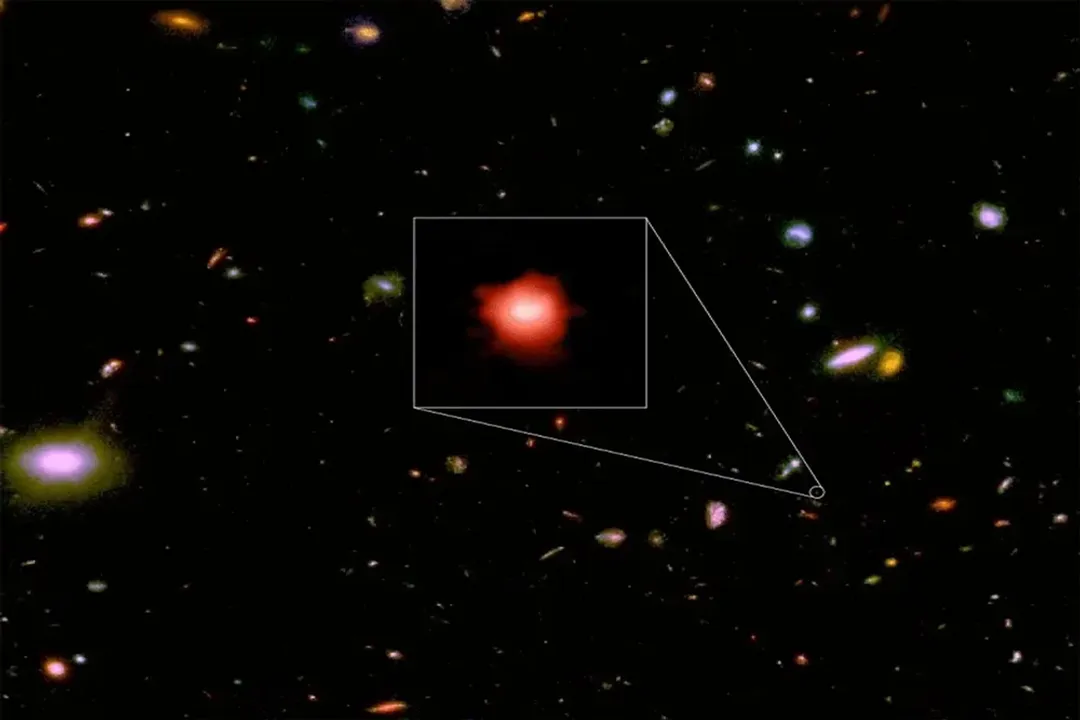
A galaxy can appear red due to the stretching of its light by cosmic expansion (cosmological redshift) or because its internal stellar population is dominated by older, cooler stars or is obscured by dust (intrinsic color).
Related Questions
What does the redshift observed in deep space primarily describe?What physical process stretches the light wave as it travels across billions of light-years toward Earth?If a galaxy were moving toward an observer, what spectral shift would its light exhibit?According to the principles discussed, how does the degree of redshift relate to a galaxy's distance?What fundamental relationship between redshift and distance did Edwin Hubble codify?Why is measuring redshift considered an immensely powerful technique for gauging cosmological distance?What common analogy is used to help explain the physics behind spectral shifting?What two distinct physical phenomena can cause a galaxy to appear 'red' observationally?In the context of very distant galaxies, what is the dominant cause of the observed spectral shift?What does observing a galaxy with a redshift ($z$) of $z=1.0$ imply regarding its light wavelength compared to $z=0.1$?When determining the furthest objects currently observable, what measurement is the definitive yardstick?