Why are far away galaxies red?
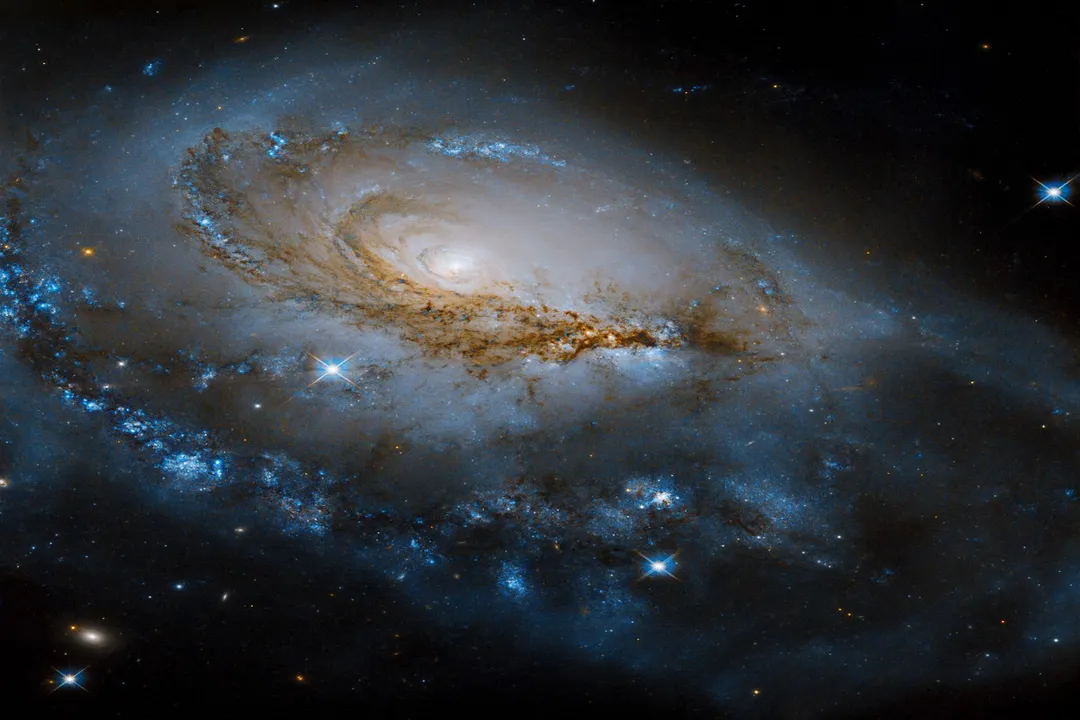
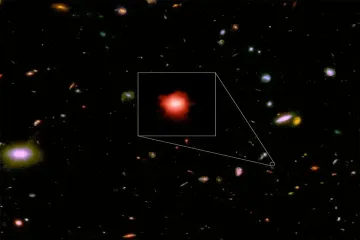
When we look at the night sky, we see points of light that have traveled millions or billions of years to reach our telescopes. While some stars appear white, blue, or yellow, many of the most distant galaxies in the universe appear shifted toward the red end of the light spectrum. This phenomenon, known as redshift, is not simply because these objects are "red" in the way a ruby or a fire engine is red. Instead, it is a fundamental consequence of how light travels through an expanding universe. [1][4]
Understanding why this happens requires looking at light not just as a color, but as a wave. Every color we see—from deep violet to vibrant red—corresponds to a specific wavelength. Violet light has short, tight waves, while red light has longer, stretched-out waves. When we observe light from a distant galaxy, the wavelength of that light has actually changed during its transit. [5]
# Light Behavior
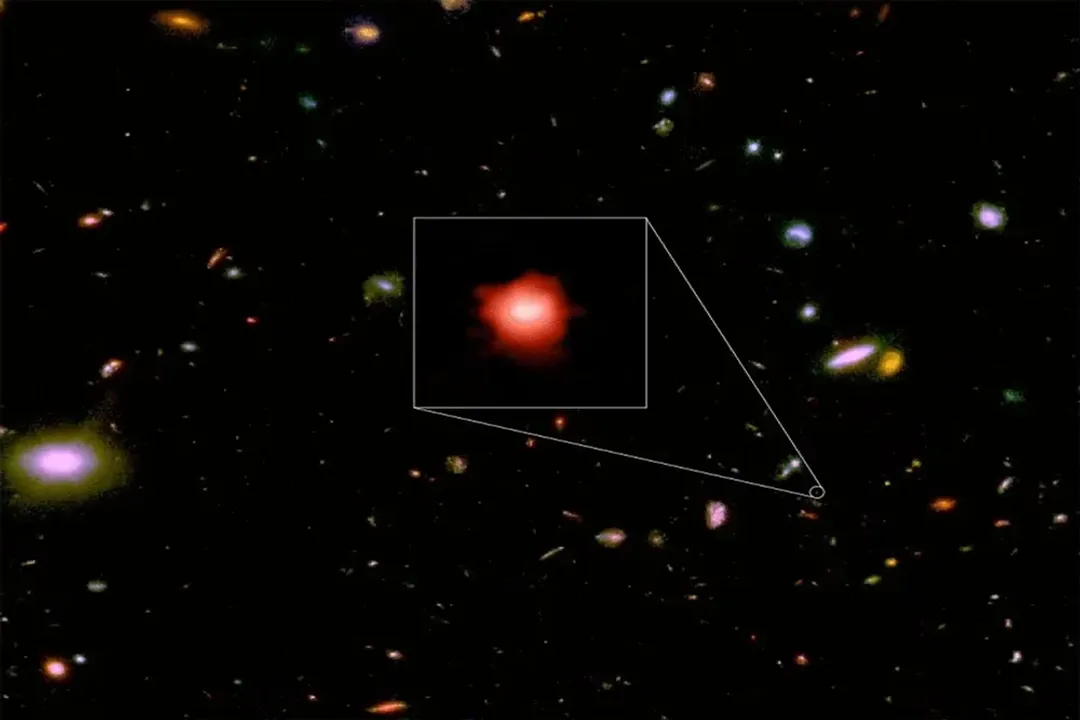
To grasp why galaxies appear red, we must first accept that light behaves like a wave. If you were to drop a stone in a pond, the ripples spread out in a regular pattern. Light does something similar. When an object emits light, it sends out waves at a specific frequency. The "color" of that light is determined by how close together those wave crests are. [9]
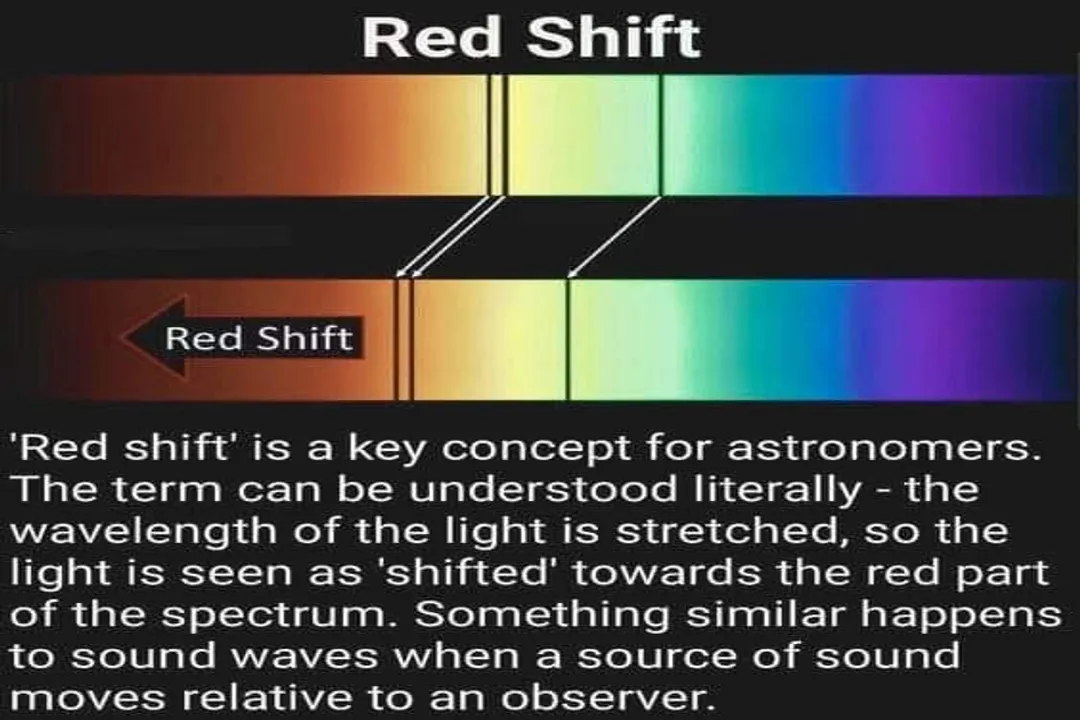
When an object is moving away from an observer, the waves it emits get stretched out. Think of an ambulance driving away from you. The siren’s sound waves are stretched as the vehicle recedes, lowering the pitch. This is the Doppler effect. Similarly, if a light source moves away from us, the light waves are stretched to longer, redder wavelengths. However, for distant galaxies, the cause is slightly more nuanced than simple movement through space. [1][5]
# Expanding Space
While the Doppler effect explains the redshift of nearby stars or galaxies moving through their local cluster, it is not the primary driver for the most distant objects we see. For galaxies millions or billions of light-years away, the "stretching" happens because the fabric of the universe itself is expanding. [4][9]
Imagine space as a piece of elastic fabric with galaxies drawn on it. As you pull the fabric, the space between the galaxies increases. The light traveling across that space is forced to stretch along with the fabric. As the universe expands, the distance between us and a distant galaxy grows, and the light waves traveling through that space grow longer. [3] By the time that light reaches our eyes, its wavelength has shifted toward the red end of the spectrum. It is not moving away through space; rather, the space carrying the light is enlarging. [8]
# Spectral Fingerprints
Astronomers do not simply look at a galaxy and guess its color. They use a technique called spectroscopy to analyze the light. Every chemical element, such as hydrogen, helium, or oxygen, absorbs and emits light at very specific wavelengths. These act like a "barcode" or fingerprint for the element. [2]
When astronomers look at a distant galaxy, they identify these familiar barcodes. If the galaxy were stationary, the hydrogen line would appear at a specific, known wavelength. However, in distant galaxies, these barcode lines are shifted toward the right—toward the red part of the spectrum. This shift tells us exactly how much the light has been stretched. This is how we know for certain that the redshift is caused by expansion rather than the object simply being a "red" star. [2]
The following table demonstrates how specific wavelengths shift, providing a standardized way for scientists to measure distance:
| Feature | Rest Wavelength | Redshifted Wavelength | Implication |
|---|---|---|---|
| Hydrogen-Alpha | 656 nm | 700+ nm | High recession speed |
| Oxygen III | 500 nm | 550+ nm | Distant source |
| Helium Line | 587 nm | 620+ nm | Observable expansion |
This data allows astronomers to calculate the "z-value" or redshift factor, which correlates directly with how fast the universe was expanding when the light was emitted. [4]
# Measurement Utility
The redshift factor is one of the most reliable tools we have for mapping the universe. Because the relationship between redshift and distance is consistent, astronomers use it to determine how far away an object is. The greater the redshift, the farther away the galaxy is and the faster it appears to be receding from us due to the expansion of space. [5][9]
This allows for a sort of "cosmic clock." By measuring the redshift of light from the early universe, we can effectively look back in time. Light from a galaxy with a massive redshift started its journey billions of years ago. By the time it arrives, we are seeing the galaxy as it existed when the universe was in its infancy. This gives us a window into the evolution of galaxies that we could not obtain through simple photography. [2][3]
# Common Myths
A common point of confusion is the idea that galaxies are "racing" away from us at extreme speeds. While it is true that they are separating from us, it is more accurate to view it as the universe growing larger. If you placed dots on a balloon and inflated it, the dots would move away from one another. No single dot is necessarily "moving" faster than its neighbor; rather, the space between them is increasing. [8]
Another frequent misconception is that these distant galaxies are only red because they contain old, cool, red stars. While it is true that elliptical galaxies often contain older star populations, this is distinct from cosmological redshift. Older stars are red because of their temperature, whereas cosmological redshift affects the light coming from all stars, gas, and dust within a galaxy, regardless of the star types present. [2][8]
# Practical Verification
If you are interested in verifying this yourself, you do not necessarily need a multi-million dollar telescope, though specialized equipment helps. Amateur astronomers often use spectroscopes attached to their telescopes to observe the shift in spectral lines for themselves. While capturing the redshift of a distant, faint galaxy requires significant light-gathering power, observing the Doppler shift in binary star systems or rotating galaxies provides a accessible way to see the principle of redshift in action. [6]
To effectively track or understand these measurements, consider the following checklist used in observational astronomy:
- Isolate the spectrum: Use a diffraction grating or prism to split the incoming light from a target.
- Identify landmarks: Look for known emission lines (like Hydrogen-Alpha, often found at 656.3 nanometers).
- Measure the delta: Compare the observed position of the line to the laboratory-measured rest position.
- Calculate the ratio: The difference between the observed wavelength and the rest wavelength provides the redshift (z).
- Verify distance: Use Hubble’s Law to estimate the distance based on the z-value.
By following these steps, scientists ensure they are not mistaking intrinsic color for expansion-driven redshift. This rigorous checking process confirms that the "redness" we see in the deepest reaches of the universe is a physical record of the growth of space-time itself. [4]
Ultimately, the red appearance of distant galaxies serves as a fundamental piece of evidence for the Big Bang theory. If the universe were static, we would not see this systematic shifting of light. The fact that the light is stretched consistently across the sky indicates that everything is moving away from everything else, proving that our universe is dynamic and ever-changing. [8]
Related Questions
#Citations
Why galaxies look redder, the further away they are
How do we know for sure that red-shift in distant galaxies / stars is ...
The red shine you glimpsed through your telescope might actually ...
Redshift - Wikipedia
Redshift - Las Cumbres Observatory
Why Distant Galaxies Are Red? Redshift In Astronomy - YouTube
I know why fast moving objects are red shifted, but why are far away ...
ESA - What is 'red shift'? - European Space Agency