What are the differences between the three types of galaxies?
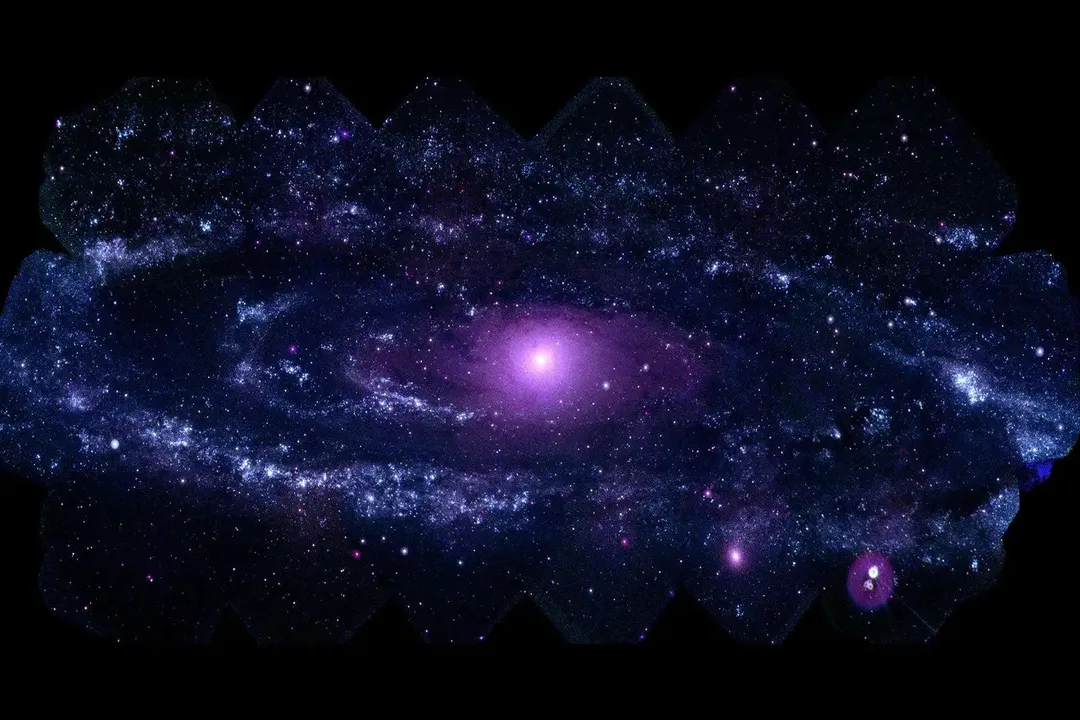
The universe presents an astounding variety of structures, but when astronomers look out into the deep field, they find that the vast majority of these structures—the galaxies—fall neatly into three main categories based primarily on their visual appearance. [1][3] These broad classifications provide a fundamental way to begin understanding the evolution, composition, and dynamics of cosmic islands of stars, gas, and dark matter. [4][10] We generally categorize them as spiral, elliptical, and irregular. [3][4]
# Spiral Forms
Perhaps the most iconic galactic shape is the spiral galaxy. [4] These systems are characterized by a distinct, flattened, rotating disk that surrounds a central bulge of stars. [1][4] The most defining feature, of course, is the spiral arms that wind outward from the center. [4] Our own Milky Way is a prime example of this type. [4]
Within the spiral family, there is an important division. Some spirals, like the Milky Way, possess a central bar structure made of stars that stretches across the nucleus before the arms begin to wind out. [7] These are termed barred spiral galaxies, while others lack this central bar. [4][7] The overall structure is highly organized, a consequence of angular momentum maintained within the spinning disk. [7]
The distribution of material within a spiral dictates its activity level. The disk is rich in interstellar gas and dust, which acts as the raw material for new stars. [1][4] Consequently, spiral galaxies are sites of ongoing, active star formation. [10] The spiral arms themselves often appear bluish because they contain many young, hot, luminous stars. [4] Conversely, the central bulge tends to have an older population of stars, giving it a yellowish or reddish hue. [4] While the disk is dynamic, the central bulge tends to be more spheroidal and less organized in its stellar motions. [7]
# Elliptic Shape
Moving away from the structured disks, we find elliptical galaxies. These systems look much smoother, ranging in shape from nearly perfectly spherical to highly elongated ovals. [1][5] Unlike spirals, they lack the prominent spiral arms, disks, or significant amounts of cool gas and dust. [4][5][10]
The overall structure of an elliptical galaxy is less about rotation and more about random, disordered stellar orbits, similar to a swarm of bees rather than a spinning whirlpool. [7] Because they contain very little cool gas and dust, the fuel necessary for creating new stars is largely absent. [1][5] This means that elliptical galaxies are generally dominated by older, redder stars, leading to a much lower current rate of star formation compared to spirals. [4][10] They are, in essence, cosmic collections of aged stellar populations. [5]
Ellipticals cover an enormous range in size. They can be relatively small dwarf ellipticals, or they can be the largest galaxies known, classified as giant ellipticals. [1][5] These massive giants are often found at the centers of galaxy clusters. [1] Interestingly, the distinction between a very flattened spiral viewed edge-on and a truly elliptical galaxy can sometimes be subtle from a distance, although their internal dynamics are fundamentally different. [4]

# Irregular Chaos
The third primary category is the irregular galaxy. [1][3] As the name suggests, these galaxies do not fit neatly into the spiral or elliptical molds because they possess no regular, symmetrical shape, bulge, or defined spiral structure. [4][10]
Irregular galaxies are often rich in gas and dust, similar to the disks of spiral galaxies, and this material often fuels vigorous new star formation, sometimes at a higher rate than in quiescent spiral arms. [4][10] They tend to have a patchy, chaotic appearance. [3] The reason for this disorder is frequently attributed to gravitational interactions or collisions with other galaxies. [4] These violent events can disrupt any pre-existing organized structure. [4] While the Milky Way and Andromeda are massive, spiral-shaped neighbors, there are countless smaller irregular galaxies scattered throughout the universe. [5]
# Comparing Stellar Birthplaces
A powerful way to distinguish these types is by looking at where stars are being born and what stars are living there. [4] If we consider the stellar population's age, spiral galaxies are dynamic environments where star birth is happening continuously in the arms, meaning they have a mix of young, bright blue stars and older, dimmer yellow/red stars. [4] Ellipticals, conversely, are like ancient stellar retirement homes, overwhelmingly populated by old, reddish stars because they ran out of their cold gas long ago. [5] Irregulars are the wild cards—they are actively assembling or undergoing demolition, leading to intense but perhaps short-lived bursts of new star creation driven by gravitational disturbances. [4] This difference in star formation history results in a discernible color difference across the sky when observing them through a telescope: spirals are often bluish-white overall, while large ellipticals appear distinctly yellowish or reddish. [4]
| Galaxy Type | Primary Shape Feature | Star Formation Rate | Gas/Dust Content | Stellar Population |
|---|---|---|---|---|
| Spiral | Flat disk with arms, central bulge | High, ongoing | High | Mixed (Young and Old) [1][4] |
| Elliptical | Smooth, oval to spherical | Very Low to None | Low | Predominantly Old [1][5] |
| Irregular | Chaotic, no defined structure | Often High (bursts) | High | Mixed, often dominated by young stars |
Observing a galaxy’s overall light profile offers a key clue: a high fraction of blue light signals active star formation, pointing toward a spiral or an irregular, while a dominance of red/yellow light suggests an older, gas-depleted elliptical. [4] This relationship between structure and star-forming fuel supply is a cornerstone of modern galactic study. [1]
# Classification Schemes
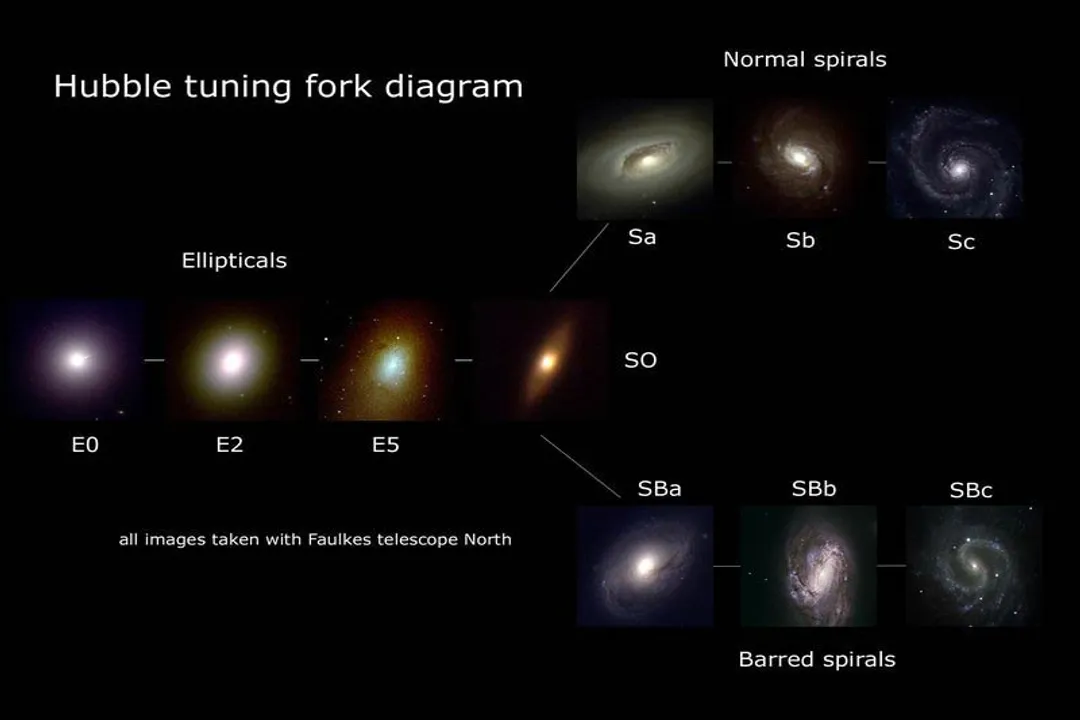
Astronomers use systems to place galaxies precisely within these categories. The most famous is the Hubble Tuning Fork diagram, developed by Edwin Hubble. [4][7] This diagram organizes galaxies based on morphology, showing how ellipticals (labeled E0 to E7 based on elongation) transition into spirals (S for standard spirals, SB for barred spirals), with the irregulars typically placed off to the side. [4][7]
The classification isn't always final, as galactic evolution is ongoing. For example, some astronomers classify galaxies based on their light profile using mathematical functions that describe the brightness distribution, rather than just the visual shape alone. [7] The Hubble scheme, while foundational, is primarily a visual guide, helping map the visible differences between these three basic blueprints. [4]
Thinking about these classifications locally can be instructive. When we look at images of nearby galactic groups, we see many small, faint structures that might seem like very tiny ellipticals, but some are likely the remnants of irregularly shaped galaxies that have been stripped of gas by the tidal forces of larger neighbors over billions of years. When you next look at high-resolution images of galaxy clusters, notice how often the largest, brightest galaxies are the smooth, centrally located ellipticals—a visual confirmation that mergers of smaller, gas-rich spirals or irregulars seem to be a frequent route to creating the largest, quiescent elliptical monsters in the universe. [1] The presence of these massive, old systems suggests that galaxy collisions are a necessary ingredient for building the largest structures we observe, consuming the gas in the process and effectively ending the star-forming phase of the resulting merged entity.
In essence, while the universe may seem infinite in its complexity, classifying its major components into these three fundamental shapes—the organized disk, the smooth sphere, and the chaotic blob—gives scientists a manageable starting point for charting the cosmos's vast history. [1][3]
#Videos
Types of Galaxies in Space - Spiral, Elliptical, Irregular plus more
Related Questions
#Citations
Galaxy Types - NASA Science
Three Shapes of Galaxies | Elliptical, Spiral, and Irregular | Britannica
The Three Types of Galaxies - Slooh
Galaxy Classification - Las Cumbres Observatory
Types of Galaxies in Space - Spiral, Elliptical, Irregular plus more
Galaxies are classified into three main types based on their shape ...
galaxy types: stage, family, and variety
Elliptical Galaxy | ESA/Hubble
Types of Galaxies | Galaxy Zoo
Types of Galaxies | NASA Space Place – NASA Science for Kids