Where is the most active region of star formation in our galaxy?
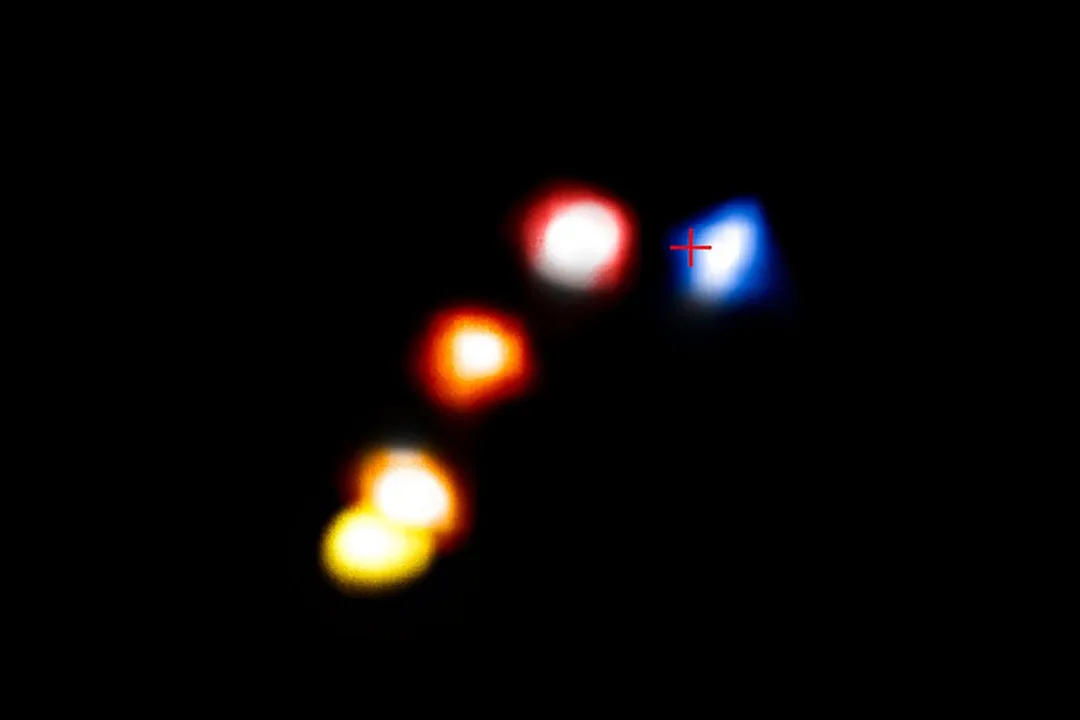
The most intense crucible of creation in our Milky Way galaxy is tucked away in a region incredibly distant from us, yet central to the structure of our entire stellar home. This powerhouse of star birth is not found in the familiar spiral arms where objects like our Sun reside, but rather deep within the Galactic Center, a region dense with gas, dust, and gravitational complexity. [7] Specifically, astronomers have focused intense scrutiny on a colossal molecular cloud complex known as Sagittarius B2 (). [1] This complex holds the title of being the largest known star-forming cloud within the Milky Way, [1] and its sheer scale and density mark it as perhaps the most active stellar nursery we can observe in our galaxy. [4]
# Galactic Heart
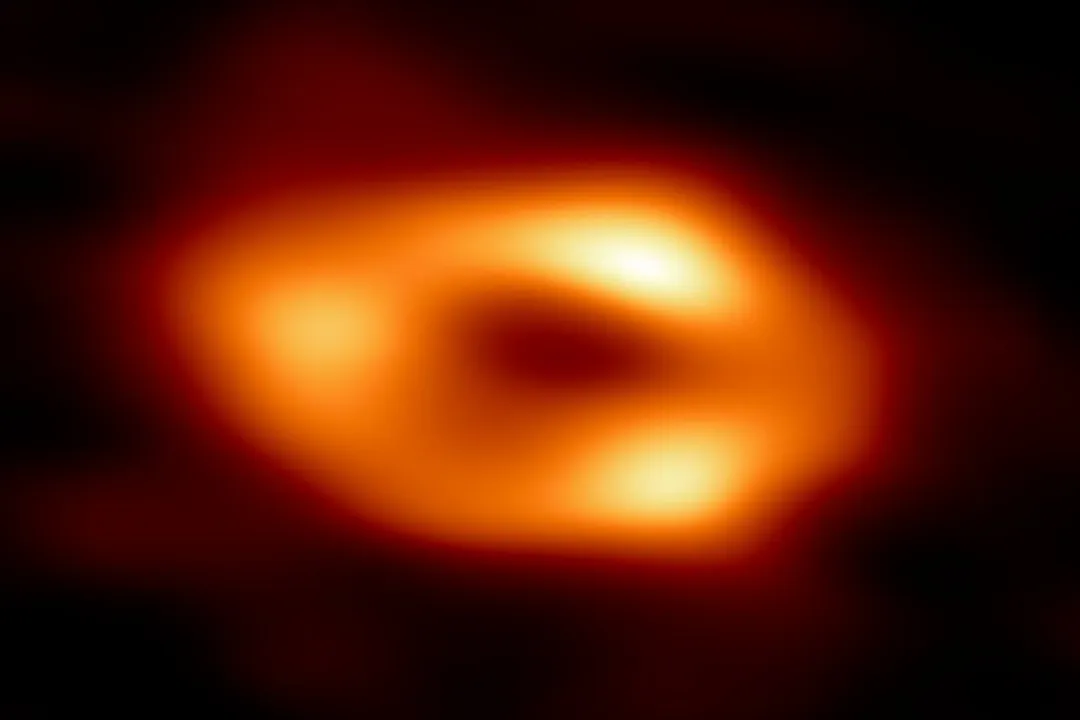
The entire Galactic Center region is a place of extremes. It is home to the supermassive black hole, Sagittarius A* (), which commands the gravitational environment of the inner galaxy. [6] is situated relatively close to this behemoth, positioned about 370 light-years away from . [6] While the black hole itself is not a direct source of new stars, its powerful gravitational presence, combined with the inherent concentration of material in the galaxy's central bulge, creates the perfect pressure cooker for star formation. [7]
The reason this area is so dynamic lies in the concentration of matter. [7] As gas and dust are drawn toward the galaxy's core by its immense gravity, they accumulate in greater quantities than in the sparser outer regions. [7] This massive reservoir of raw material—cold gas and molecular clouds—is the essential prerequisite for stellar birth, as gravity needs a sufficient mass to overcome internal pressure and initiate collapse. [7] represents the largest accumulation of this material in a location primed for collapse, leading to an extraordinarily high rate of stellar production compared to other regions within the Milky Way. [1]
# Massive Cloud
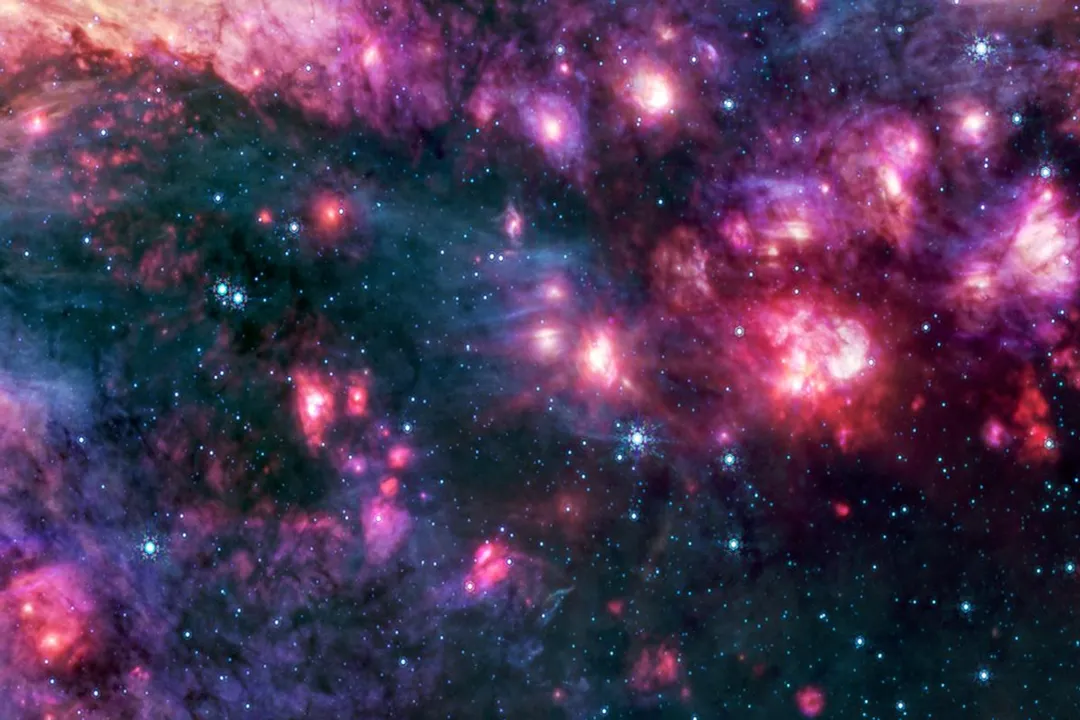
is not just large; it is characterized by intense activity. Observations have targeted this region specifically because it represents the heart of ongoing stellar production. [5] The cloud complex is so vast and opaque in visible light that dedicated, sensitive instruments are required to reveal the processes occurring within. [1] When telescopes peer into this area, they reveal structures characteristic of intense collapse and the immediate aftermath of massive star births. [2]
Studying allows researchers to witness the entire lifecycle of massive stars being born in a single, concentrated location. [5] Unlike smaller, more localized stellar nurseries, provides a view of a galactic engine running at full throttle, continuously replenishing the interstellar medium with the products of fusion and, eventually, supernovae. [1] The sheer volume of gas and dust means that the process is sustained over a much longer period and at a higher overall rate than in more quiescent parts of the galaxy. [7]
# Peering Through Dust
The central regions of the Milky Way are notoriously difficult to observe from Earth. The thick blankets of interstellar dust that permeate our galaxy obscure visible light, making direct optical viewing of nearly impossible. [1] This is where advanced infrared astronomy becomes indispensable. Telescopes like the James Webb Space Telescope () are specifically designed to observe light in the infrared spectrum, which can penetrate these obscuring clouds. [1][5]
The has been directed toward to map out the internal structures of the forming stars and the surrounding molecular environment. [1][2] Infrared observations allow scientists to detect the heat emitted by warm dust grains and the light from newly formed stars that is redshifted out of the visible range. [5] By capturing these infrared signatures, astronomers can determine the temperatures, chemical compositions, and velocity fields of the gas and dust, painting a picture of the ongoing collapse that leads to new stars. [2] These efforts require long periods of exposure, sometimes exceeding twenty-four hours, just to gather enough faint signal from this distant, dusty heart of our galaxy. [3][4]
# Formation Drivers
The underlying physics driving the activity in offers an important lesson in galactic dynamics: density dictates destiny. In the galactic outskirts, the density of molecular clouds is too low for sustained, massive star formation over large areas. [7] Stars form when a region of a cloud accumulates enough mass that its self-gravity overcomes the outward pressure from thermal motion and turbulence. [7]
In the Galactic Center, this condition is met on a grand scale. The tidal forces and the sheer gravitational crowding near compress the gas more effectively, leading to faster and more vigorous collapse. [7] While the environment is chaotic—possibly leading to different outcomes for planet formation than our local solar system experienced—the fundamental requirement of high density is met perfectly at . [7] This high-pressure environment ensures a continuous supply of protostars, often resulting in the birth of very massive stars that dictate the evolution of the surrounding material through their intense radiation. [1]
# Local Comparison
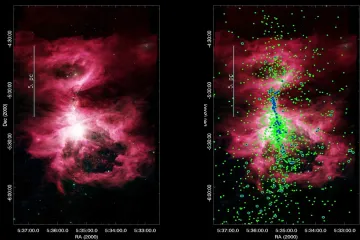
While represents the peak of galactic star formation, it is instructive to compare it with a more familiar, yet still active, stellar nursery, such as the Orion Nebula. Orion is close enough for detailed optical study and serves as a benchmark for how star formation looks in the Milky Way's quieter spiral arms. [9] The Orion Nebula is a vibrant region, undeniably producing stars, and it is relatively accessible for ground-based and visible-light studies. [9] However, the rate and total mass locked up in active formation within likely dwarfs that of Orion. The difference is akin to comparing a bustling neighborhood construction site (Orion) with an entire industrial metropolis being built simultaneously (the complex). The Orion region shows us the process up close, while shows us the cumulative, large-scale product of that process at the galactic center. [1] Understanding the processes in Orion helps interpret the data we gather from the obscured , but the scale of activity is fundamentally different.
# Long Exposures
Observing such a distant, faint, and dusty target like demands patience from the observers, translating into the extreme exposure times mentioned in various reports. [3][4] From our position within the Orion Arm, looking toward the Galactic Center means looking through the entire disc of the galaxy, which includes our own molecular clouds and those closer to the core. [6] This means that any photons we detect from have traveled an immense distance, constantly being absorbed and re-emitted by intervening matter. [5]
This necessity for extremely long integration times—sometimes lasting over an entire day—highlights a practical aspect of modern astrophysics. The signal-to-noise ratio improves with the square root of the exposure time. To pull out the fine details of protostars or subtle chemical signatures from light that has traveled tens of thousands of light-years through a crowded medium, instruments must collect light almost continuously. This technique effectively builds up an image pixel by pixel from the faintest possible signals, allowing us to confirm that this remote region remains the most active hub of stellar generation in the galaxy, despite its distance and obstruction. [4] The technical skill involved in processing these massive datasets is as critical as the telescope mirror itself in bringing these hidden stellar births to light. [1]
The exploration of by instruments like is not just an academic exercise; it is the study of our galaxy's continuous self-renewal mechanism operating at maximum capacity. By mapping this intense activity near the core, scientists gain essential context for understanding how spiral galaxies maintain their stellar populations over billions of years, relying on these massive, central crucibles to fuel the ongoing production of new suns. [5][7]
Related Questions
#Citations
NASA's Webb Explores Largest Star-Forming Cloud in Milky Way
Unprecedented views of largest star-forming region in our galaxy ...
What's the most active star-forming region in our galaxy? - Facebook
Over 24 hours of exposure on the most active star forming region ...
James Webb Space Telescope peers deep into the heart of star ...
Sagittarius A* - Wikipedia
Why is most of the star formation that goes on in the milky way ...
The most massive star forming region in the Milky Way ... - YouTube
Where Are Stars Made? NASA's Spitzer Spies a Hot Spot