What is the mechanism of star formation?
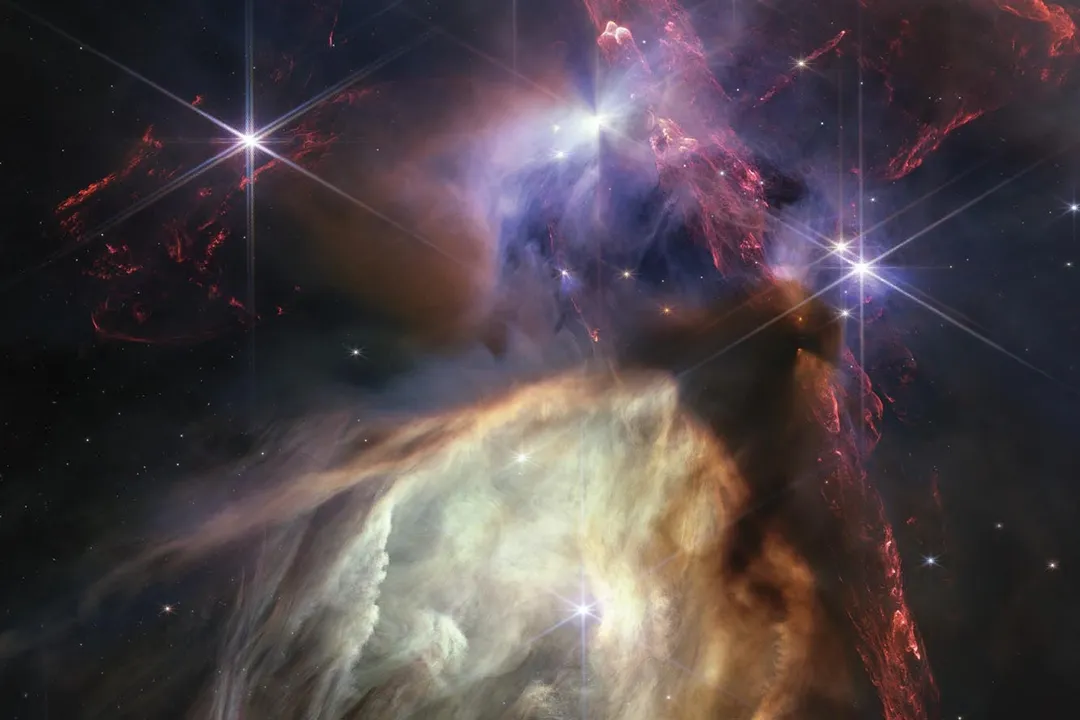
Stars are born in dramatic fashion, emerging from the coldest, darkest reaches of space through a relentless battle between the inward pull of gravity and the outward push of gas pressure. This process, known as star formation, transforms diffuse interstellar gas into brilliant, self-luminous spheres. [2][1] It is a mechanism that begins on scales larger than entire solar systems, deep within what astronomers call Giant Molecular Clouds (GMCs). [1][9]
# Molecular Nurseries
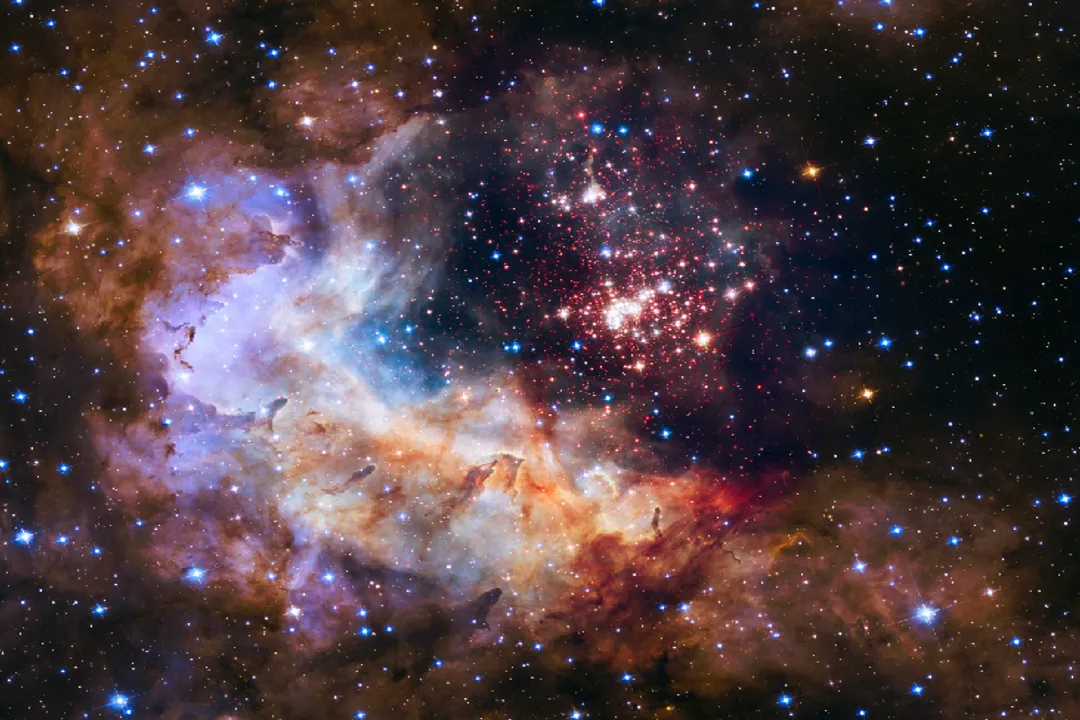
These cosmic clouds represent the primary material reservoir for star creation. [1] GMCs are vast, sprawling structures, often stretching across tens or even hundreds of light-years. [2] They are incredibly cold, with temperatures hovering around ten to twenty Kelvin, only slightly above absolute zero. [2] The composition is predominantly molecular hydrogen gas, interspersed with traces of heavier elements and tiny particles of cosmic dust. [1][7] This extreme cold is essential because it keeps the gas pressure low, allowing gravity a fighting chance to begin its work. [2]
# Gravity Wins
The initial stages of star formation are governed by a critical balance of forces. [1] For a section of a molecular cloud to begin collapsing and form a star, it must overcome its internal resistance—the turbulence and pressure that tries to keep it dispersed. [8] This threshold condition is defined by the Jeans mass; if a region's mass is greater than its local Jeans mass, gravity inevitably dominates, causing the clump to contract. [1][8]
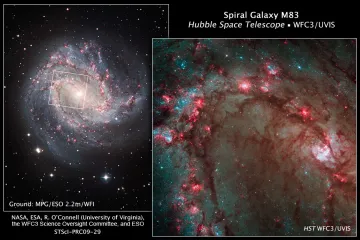
This process is often triggered externally. A massive, dense cloud may simply exist near its collapse point, but an external disturbance can provide the necessary compression to tip the scales. [6] Potential triggers include the shockwave propagating from a nearby supernova explosion, which compresses the gas, or even the pressure exerted as the cloud passes through the dense spiral arms of a galaxy. [6][5] Even for young readers, understanding that a catastrophic death elsewhere can seed the birth of a new solar system highlights the interconnectedness of the cosmos. [7]
# Core Density
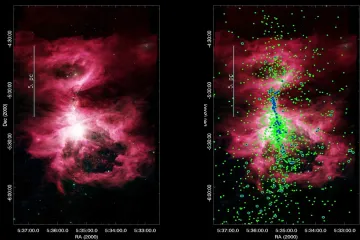
When a large region of a GMC begins to collapse, it rarely forms one single star; rather, the cloud fragments into numerous smaller, gravitationally bound clumps. [1][9] Each of these collapsing clumps is destined to form a star or a small system of stars. [1] As a dense core shrinks under its own weight, the conservation of angular momentum becomes increasingly apparent. [1][9] Because no external torque acts significantly on the core, its rotation speeds up dramatically as its radius decreases, similar to how an ice skater spins faster when they pull their arms in tightly. [1]
It’s interesting to consider the scale change. If we imagine a typical GMC spanning many light-years, the initial clumps that become individual stars might only be the size of our solar system, or even smaller at the very densest stage. This fragmentation means star formation is inherently a cluster process, not just an isolated event, which explains why stars like our Sun are almost always found with siblings born from the same initial cloud complex. [1]
# Protostar Ignition
The very center of the dense, collapsing core eventually becomes opaque to its own radiation due to the increasing density, trapping heat and causing the temperature to rise rapidly. [1] This hot, dense central object is the protostar. [9] During this phase, the protostar is not yet a true star because it derives all its energy from gravitational contraction—the energy released as surrounding material falls onto it, a process called accretion. [1]
This accretion is not a smooth shower of material. Instead, as gas orbits the protostar, it flattens into a rotating protoplanetary disk. [1][2][9] This disk feeds the star, but it also serves as the birthplace of future planets. [9] Simultaneously, magnetic fields channel some of the infalling material into incredibly focused, fast-moving streams that shoot out perpendicular to the disk, known as bipolar jets. [1][2][9] These jets and associated outflows are crucial, as they help shed angular momentum and prevent the star from spinning itself apart, while also beginning to clear away the thick envelope of dust and gas that initially obscured the process from view. [2]
# Main Sequence
The protostar continues to gather mass and contract until the temperature and pressure in its core reach approximately . [1] At this critical point, the conditions are sufficient to initiate sustained thermonuclear fusion, specifically the conversion of hydrogen into helium. [1][2] This ignition generates an enormous outward pressure that finally halts the gravitational collapse. [1] When this outward pressure perfectly balances the inward pull of gravity, the star achieves hydrostatic equilibrium and officially joins the main sequence, where it will spend the vast majority of its life generating light and heat. [1]
Before settling onto the main sequence, a young star, especially one with a mass similar to the Sun's, is often classified as a T Tauri star. [5] These objects are still somewhat unstable, displaying strong stellar winds and variability as they finalize their accretion and shed their natal cocoons. [5]
The efficiency of this entire conversion process from cloud material to a luminous main-sequence star is surprisingly low. While the original GMC may have many solar masses of material, only a small fraction—often less than 10%—actually ends up in the final star system; the rest is blown away by those powerful jets, lost to interstellar space, or remains in the surrounding disk material that eventually disperses. This 'waste' highlights the violent, energetic nature of stellar birth, where feedback mechanisms are as important as the initial collapse. [2]
# Seeing Birth
Because the initial stages of star formation occur behind thick veils of dust and gas, traditional optical telescopes cannot see the protostars directly. [2] Astronomers must rely on instruments that can observe longer wavelengths, such as infrared and radio waves, which can penetrate these obscuring clouds. [3] Observatories like the ALMA (Atacama Large Millimeter/submillimeter Array) are specifically engineered to observe the faint millimeter and submillimeter light emitted by the cold dust and gas. [3] ALMA provides the necessary resolution to map the fine structures of the protoplanetary disks and observe the kinematics of the gas as it spirals inward toward the nascent star. [3]
The goal of these observations is to understand the environmental factors that determine the final stellar product. [1] For instance, the initial mass of the core dictates the star's fate; cores that fail to reach the fusion threshold—those below about $0.08$ times the Sun's mass—become brown dwarfs, often termed failed stars. [1][2] Future large telescopes, such as the Thirty Meter Telescope (TMT), are designed to push observational limits further, aiming to capture even higher-resolution snapshots of planets forming within these disks around young stars. [9] The continuous study of these obscured environments allows astronomers to piece together the full chronological sequence, from an amorphous cloud fragment to a stable, shining star. [5]
Related Questions
#Citations
Star formation - Wikipedia
Star Basics - NASA Science
Star and planet formation | ALMA Observatory
Star Formation | Center for Astrophysics | Harvard & Smithsonian
Story of Star Formation
A shocking beginning to star formation - Physics Today
How Do Stars Form? - Frontiers for Young Minds
21.1: Star Formation - Physics LibreTexts
Formation of Stars and Planets - TMT International Observatory