How do stars contribute to the formation of planets?

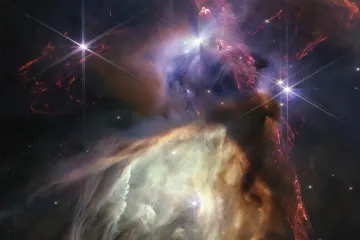
The birth of a star and the subsequent emergence of planets orbiting it are deeply interconnected cosmic events, starting from the vast, cold reaches of interstellar space. Stars do not simply appear; they condense from immense clouds of gas and dust, known as molecular clouds. These clouds are the stellar nurseries of the galaxy, regions primarily composed of hydrogen and helium, but crucially, they also contain trace amounts of heavier elements, the cosmic debris from previous stellar generations.
The initial step toward star and planet creation is triggered by a disturbance within these clouds—perhaps the shockwave from a nearby supernova or the gravitational influence of a passing star. This disturbance causes a patch of the cloud to become unstable and begin collapsing under its own immense self-gravity. As this material contracts, the center of the collapsing mass begins to heat up and spin faster due to the conservation of angular momentum, much like a figure skater pulling their arms in. This central, dense, and hot core is the protostar, the infant sun in this scenario.
# Disk Creation

As the material falls inward toward the forming star, not all of it can directly impact the center. Because the original cloud possessed some rotation, the infalling matter flattens into a spinning structure surrounding the protostar. This flattened, rotating structure is the protoplanetary disk. Think of it as a massive cosmic pizza dough spinning before it’s fully baked, with the rising heat concentrated at the center.
The disk is heterogeneous, meaning its composition varies significantly from the center outward. Close to the young star, temperatures are incredibly high. Lighter elements, such as water and methane, are vaporized and driven outward, leaving behind only rocky and metallic materials that can withstand the heat to condense into solids. Farther out, beyond what astronomers call the "snow line" or "frost line," temperatures drop low enough for volatile compounds like water ice, ammonia, and methane to solidify. This temperature gradient is fundamental, dictating what kind of planets can form in different regions of the system.
This initial structure—the central star and its surrounding disk of leftover material—is the direct nursery for the planets. The star provides the gravitational anchor and the energy source, while the disk provides the raw building blocks. The star’s mass acquisition from this disk is a defining moment, marking the transition from protostar to a true star when the core temperature and pressure ignite sustained nuclear fusion.
# Planet Growth

Planet formation within this disk is a gradual, bottom-up process driven by accretion. It begins with microscopic dust grains in the disk sticking together through electrostatic forces, similar to how dust bunnies form under a bed. As these clumps grow into pebble-sized objects, gravity starts to play a more significant role, though collisions remain frequent.
The critical next stage involves the growth of planetesimals, bodies perhaps a kilometer or more in size. Once they reach this scale, their self-gravity becomes strong enough to actively attract surrounding material, leading to runaway growth where larger bodies sweep up smaller ones. This stage dictates whether you end up with a small, rocky world or a massive gas giant.
In the hotter, inner regions of the disk—inside the frost line—only rock and metal can solidify. Planetesimals here grow into terrestrial planets like Earth or Mars. This process is relatively straightforward but requires time for the materials to clump together without being vaporized by the young star or flung into space by chaotic interactions.
Out in the colder, outer regions beyond the frost line, the presence of abundant ice significantly increases the amount of solid material available. This abundance allows planetary cores to grow much faster and larger, reaching masses perhaps ten times that of Earth. Once a core is massive enough—around ten times Earth's mass—its gravity is powerful enough to rapidly capture vast envelopes of the abundant hydrogen and helium gas still present in the surrounding disk. This is how the gas giants like Jupiter and Saturn form. The entire process of building a solar system, from the initial collapse to the final sweep-up of debris, can take tens of millions of years.
# Stellar Death Enrichment
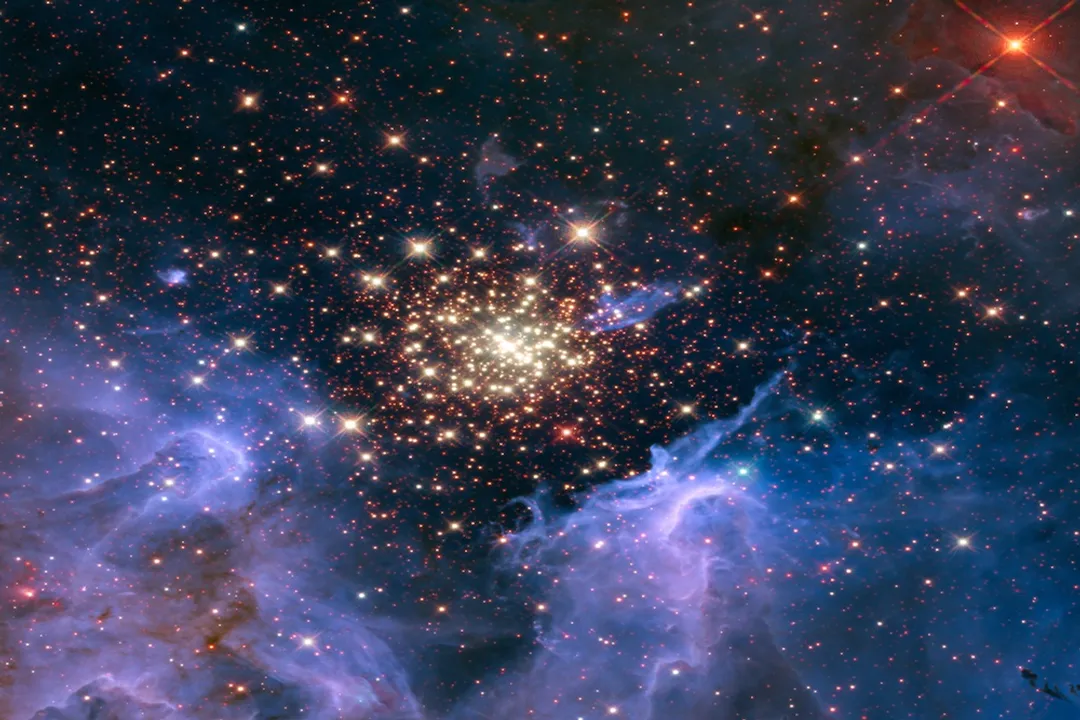
While the star’s initial formation sets the stage for its planetary system, the later life and death of other stars contribute the essential ingredients for the rocky planets we see today. Early stars, the very first generation, were composed almost entirely of hydrogen and helium because, at the time of their formation, heavier elements—what astronomers term "metals"—had not yet been forged.
The periodic table of elements shows that only hydrogen and helium existed before the first stars ignited. Elements heavier than helium, such as carbon, oxygen, silicon, and iron—the very stuff that makes up rocky planets and life—are synthesized deep within stars through nuclear fusion or violently ejected during stellar death events.
When a massive star exhausts its nuclear fuel, it can explode as a supernova. This explosion is an incredible factory for heavy elements, forging elements heavier than iron and blasting all of these newly created materials out into the interstellar medium. In a different end-of-life scenario, lower-mass stars like our Sun eventually shed their outer layers, forming a planetary nebula that also releases processed, enriched gas back into space.
These enriched clouds mix with existing gas, eventually becoming part of new molecular clouds from which the next generation of stars and planets forms. A star like our Sun, which hosts rocky planets, exists only because previous generations of massive stars lived and died, providing the necessary heavy elements (or "metals") required to form anything denser than a gas giant.
It is fascinating to consider that the iron in our blood and the silicon in the rocks beneath our feet were literally forged in the fires of long-dead stars and scattered across the galaxy by cosmic explosions. This chemical inheritance provides a crucial data point for astronomers: the age of a star system is strongly correlated with the metallicity of its parent star, as older stars formed from less-enriched gas clouds.
# System Maturity
A key distinction often made in astrophysics is how the host star's properties influence the resulting planetary architecture. For instance, the rate at which a star forms and clears its disk dictates the available time for planet building. A very massive star burns through its fuel quickly and has a relatively short lifespan, meaning its protoplanetary disk must coalesce into planets rapidly before the intense stellar winds blow the gas away entirely. This time constraint likely favors the formation of the largest possible cores that can accrete gas before the window closes.
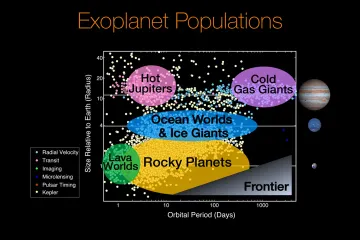
Conversely, a low-mass star like a red dwarf has a lifespan trillions of years long, allowing planet formation to proceed slowly over extended timescales. However, the total mass available in the disk around a low-mass star is often smaller, potentially limiting the final size of the planets that can form, though observations show that many exoplanets orbiting small stars are still quite large, suggesting the accretion mechanisms are incredibly efficient when given enough time.
To put this into perspective regarding chemical requirements, if we examine a star with a high "metallicity" (meaning a higher percentage of elements heavier than hydrogen and helium), that star likely formed from material recently recycled through several supernova events. Such a star provides a disk richer in the solids necessary for building terrestrial planets, which explains the observed prevalence of rocky exoplanets around metal-rich stars compared to metal-poor stars.
| Element Type | Origin Source | Importance for Planets |
|---|---|---|
| Hydrogen/Helium | Big Bang | Bulk mass of gas giants |
| Carbon/Oxygen | Massive Star Fusion/Supernovae | Volatiles, water, atmosphere components |
| Iron/Nickel/Silicon | Core Collapse/Supernovae | Core material for rocky worlds |
This table illustrates that while the star itself dictates the gravitational environment, the history of stellar evolution determines the raw materials available for planet construction.
# Long-Term Evolution
The contribution of the star doesn't end once the planets are formed; the star’s evolution continues to influence the entire system's long-term fate. As a star ages, its luminosity and size change, which affects the temperature profile of the orbits where planets reside. For instance, when our Sun eventually transitions into a red giant phase, it will expand dramatically, likely engulfing Mercury and Venus, and rendering Earth uninhabitable even before it is physically consumed.
Furthermore, the stellar wind—the continuous stream of charged particles emitted by the star—plays a continuous role in eroding planetary atmospheres. A young, active star can produce incredibly powerful flares and winds that strip away lighter gases from newly formed planets before they have fully stabilized their atmospheres. The stability and eventual fate of an atmosphere, even for a planet that has survived the initial formation chaos, depend heavily on the long-term magnetic activity and radiative output of its host star.
The star, therefore, acts as the gravitational core, the primary energy source, and the ultimate environmental shaper for its entire planetary system across billions of years. Its initial mass determines its life span, and its eventual death seeds the cosmos for the next generation of stars and planets, closing the cosmic cycle of stellar creation and destruction. This constant recycling of matter, where previous planetary building blocks are repurposed in subsequent systems, highlights an enduring connection between stellar mortality and cosmic fecundity.
#Videos
Planetary Formation - How Planets Are Born From Stars - YouTube
Related Questions
#Citations
How do stars and planets form and evolve? | Center for Astrophysics
How Do Planets Form? - NASA Science
How do planets and stars form? - Royal Society Te Apārangi
How do dying stars contribute to the formation of planets? - Wyzant
Formation of Stars and Planets - TMT International Observatory
Formation of stars and planets : r/askscience - Reddit
Planetary Formation - How Planets Are Born From Stars - YouTube
Star Formation - | The Schools' Observatory