What rotating structure flattens out around a protostar, feeding it mass and simultaneously serving as the birthplace for future planets?
Answer
Protoplanetary disk
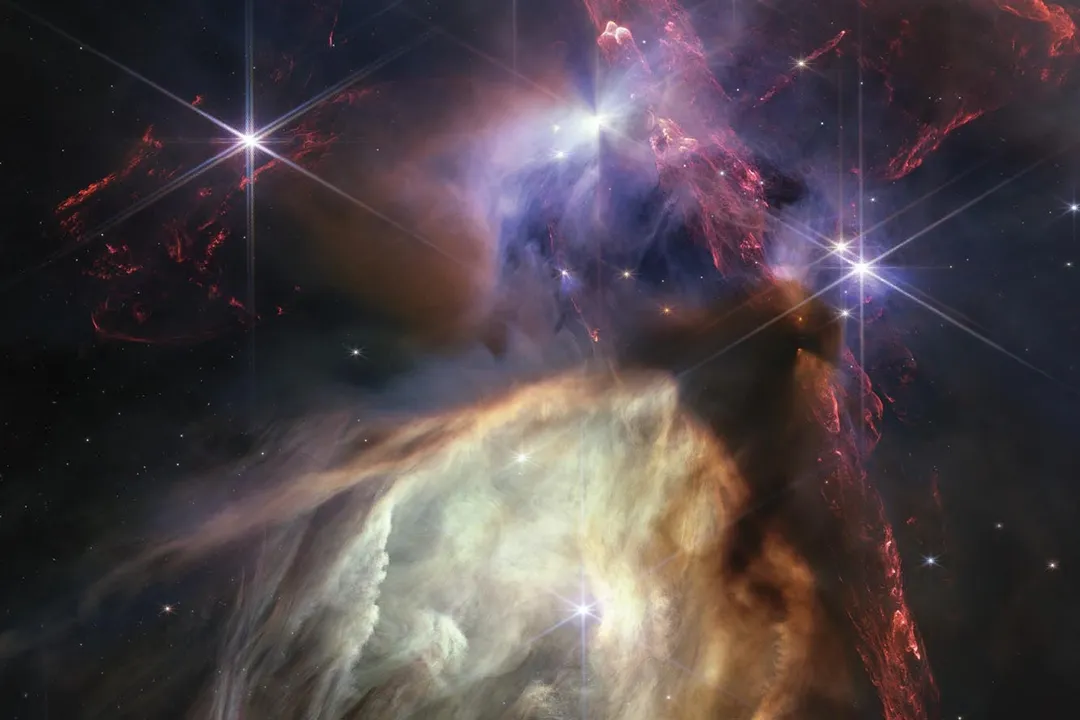
As gas and dust continuously spiral inward toward the rapidly shrinking protostar through accretion, the conservation of angular momentum causes the material that does not fall directly onto the center to flatten into a rotating structure. This structure is the protoplanetary disk. This disk serves a dual crucial role in stellar birth: first, it acts as the primary conduit, feeding the remaining necessary mass onto the central protostar; second, the leftover material within this flattened plane is precisely where the process of planet formation begins, allowing small particles to aggregate into larger bodies around the young star.
Related Questions
What is the typical temperature range found in Giant Molecular Clouds (GMCs) that serve as stellar nurseries?What physical condition defines the threshold for gravitational dominance and subsequent collapse in a molecular cloud region?What energy source exclusively powers a dense Protostar before sustained thermonuclear fusion begins in its core?What rotating structure flattens out around a protostar, feeding it mass and simultaneously serving as the birthplace for future planets?What approximate core temperature must a collapsing star reach to initiate sustained thermonuclear fusion, converting hydrogen into helium?What state is achieved when the immense outward pressure generated by core fusion perfectly balances the inward gravitational collapse of a star?Which large-scale observing instrument is specifically engineered to capture the faint millimeter and submillimeter light emitted by cold dust in stellar nurseries?What classification is given to stellar cores that accumulate mass but fail to ignite sustained hydrogen fusion, remaining below 0.08 solar masses?What crucial role do the focused, fast-moving streams perpendicular to the protoplanetary disk, known as bipolar jets, play in stellar birth?Why is star formation inherently considered a cluster process rather than an isolated event based on cloud fragmentation?