What is the approximate duration of a galactic year for a typical star in the disk?
Answer
Roughly 240 million years
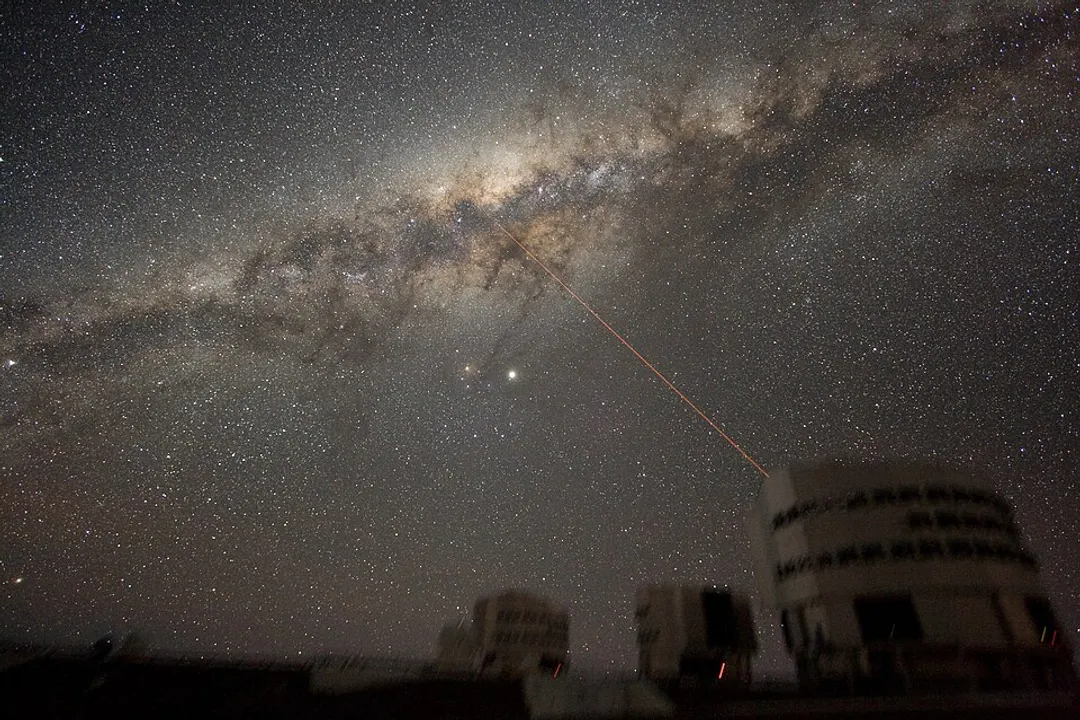
A typical star orbiting the center of the Milky Way takes roughly $240$ million years to complete one full revolution around the Galactic Center. This period is used to define what is referred to as a galactic year. This duration emphasizes the massive timescales involved in galactic dynamics. During this time, the star is engaged in a delicate, continuous orbital dance, perfectly balancing its outward inertia—a result of its high orbital velocity, such as the Sun's $220 ext{ km/s}$—against the continuous, substantial inward gravitational tether provided by the galaxy's mass distribution, particularly the dark matter halo.
Related Questions
What fundamental interaction keeps the Milky Way from flying apart due to centrifugal force?What is the approximate escape velocity at the Sun’s position within the Milky Way disk?How is the Milky Way classified architecturally among other galaxies?What dynamic role do the spiral arms play regarding gas clouds in the disk?What phenomenon invalidates the idea that visible matter alone holds the Milky Way together?Where is the massive, invisible component known as dark matter primarily distributed?What is the estimated mass of the supermassive black hole, Sagittarius A* ($ ext{Sgr A}^*$)?What role does the central bar structure play in organizing gas flow within the galaxy?What is the approximate duration of a galactic year for a typical star in the disk?What happens to gas clouds when they slow down in the denser regions formed by spiral arms?