What hypothesis explains how our solar system was first created?
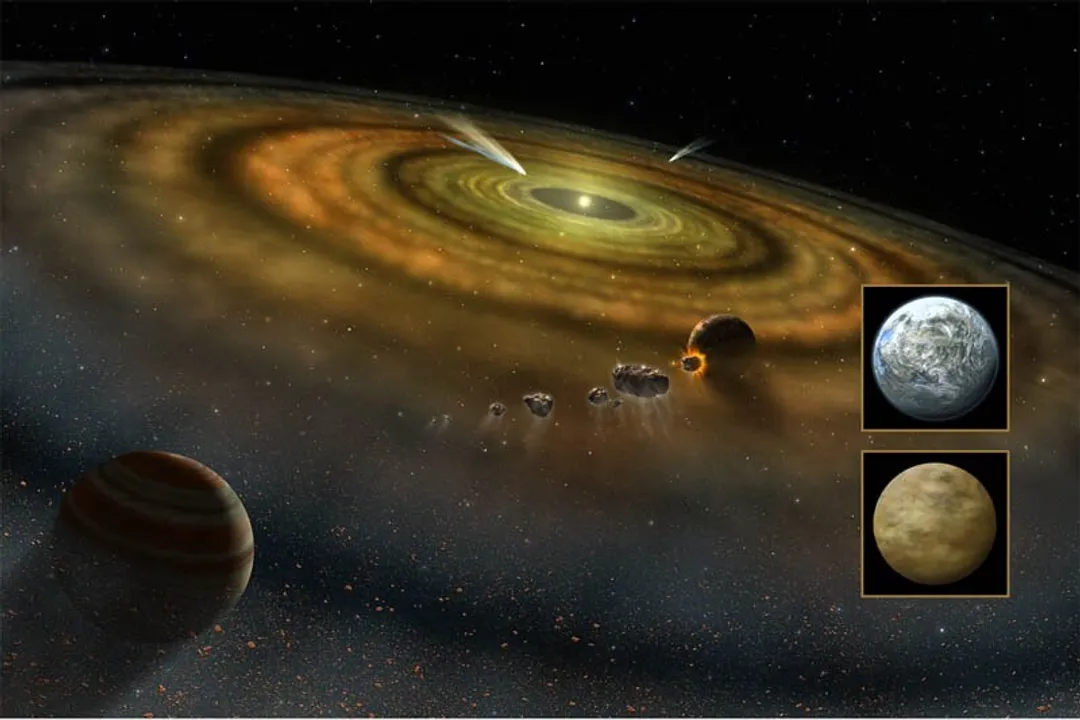
The leading explanation for the birth of our solar system, a concept refined over centuries, centers on the Nebular Hypothesis. This model posits that the Sun, the planets, and everything else orbiting them originated from a massive, spinning cloud of interstellar gas and dust, often called the solar nebula, which existed billions of years ago. [2][3] This is the most widely accepted scientific model for cosmogony regarding planetary systems across the universe. [4]
# Ancient Ideas
The idea is not new; initial thoughts tracing back to the late 1600s gained traction after the acceptance of the heliocentric model and Newton’s work on gravitation. The specific concept of a rotating, collapsing nebula was first brought forward by Emanuel Swedenborg and then formally developed by Immanuel Kant in his 1755 publication, Universal Natural History and Theory of the Heavens. [2][7] Kant suggested that these gaseous clouds, or nebulae, would slowly rotate, gradually collapsing and flattening under gravity to yield both stars and planets. [2][4][7]
Pierre-Simon Laplace independently advanced this framework in 1796 with his Exposition du systeme du monde. [2][4][7] Laplace expanded the model, envisioning a cooling and contracting protosolar cloud that flattened into a disk, with planets condensing from rings of material shed as the cloud spun faster. [2][4] Although this Laplacian model dominated for a time, it encountered significant difficulties when physics was rigorously applied, particularly regarding the distribution of angular momentum. [4][7] In a puzzling observation, the planets hold 98% of the solar system’s total angular momentum, while the Sun, containing over 99% of the mass, holds only about 2%. [4][7] This discrepancy caused many scientists to favor alternative models in the early 20th century. [4][7]
# Nebula Ignition
The modern iteration, the Solar Nebular Disk Model (SNDM), gained prominence through the work of Soviet astronomer Victor Safronov in the late 1960s and early 1970s. [2][7] This refined theory successfully addresses many early issues. [4]
The process began within a Giant Molecular Cloud (GMC), a vast region composed mostly of hydrogen and helium, enriched with heavier elements forged in preceding stellar generations and dispersed via supernovae. [4] For our solar system to begin forming, this immense cloud needed a trigger to initiate gravitational collapse, as the initial state was generally stable. [2] Possible catalysts include shock waves from a nearby supernova explosion or the cloud passing through a density wave in the Milky Way’s spiral arms, which compresses the gas. [2][3]
Once a region began collapsing, conservation of angular momentum dictated that the rotation must accelerate as the cloud shrank. [4][5] This rotational force resisted the direct gravitational pull toward the center, causing the material that couldn't fall inward to spread out into a flat, spinning structure known as the protoplanetary disk around the central mass, the protosun. [2][3][4][5] The Sun itself formed when the pressure and temperature in this central core became high enough to ignite sustained thermonuclear fusion, turning hydrogen into helium—the moment it became a main-sequence star. [3][5][7] This entire process, from collapse to stellar ignition, is thought to take only about 100,000 years for a Sun-like star. [4]

# Elemental Zoning
The temperature gradient across the newly formed protoplanetary disk was crucial in determining what materials could exist in solid form where, directly impacting the nature of the future planets. [5] This temperature distribution created distinct chemical zones separated by the frost line, or snow line. [3]
In the hot inner regions, closest to the nascent Sun, only materials with high melting points could condense into solid grains. These were primarily metals and silicate minerals (rock). [3][5] Because metallic and silicate materials made up only a small fraction of the nebula’s total mass, the planets that formed here remained relatively small and dense—these are the terrestrial worlds: Mercury, Venus, Earth, and Mars. [3][5]
Beyond the frost line, the temperature dropped sufficiently for volatile compounds like water, methane, and ammonia to freeze into solid ices. [3][5] Since ices were far more abundant in the nebula than rock and metal, planetary cores beyond this boundary could grow much larger, much faster. [5] This is a key factor in understanding scale disparity: the inner solar system was built from scarce materials, while the outer system had access to vast quantities of ice, which significantly boosted the mass of the forming cores. [5] Once these icy cores reached a critical mass—estimated at 5 to 10 Earth masses—their gravity became strong enough to rapidly sweep up the remaining, incredibly abundant, hydrogen and helium gas from the disk, creating the gas giants like Jupiter and Saturn. [2][4] Uranus and Neptune, the ice giants, are thought to have formed later, perhaps missing the critical window before the disk gas was dispersed, leaving them with smaller gas envelopes but still significant ice content. [2][4]
# Accretion Steps
Planet formation relies on the process of accretion, where dust particles collided and stuck together. [6] This process unfolds in several stages within the protoplanetary disk: [4]
- Dust Coagulation: Small dust grains, perhaps aided by electrostatic forces or slight stickiness near melting points, began to aggregate into larger bodies, growing to centimeter sizes. [4]
- Planetesimal Formation: The mechanism for growing from centimeter-sized dust to kilometer-sized planetesimals remains one of the model’s significant challenges; one proposed solution involves gravitational instability in a thin, dense mid-plane layer of solids. [4] These planetesimals are the foundational building blocks of planets. [2][5]
- Runaway Growth: Once planetesimals reached a certain size, their mass allowed gravity to dominate the sticking process. Larger bodies grew disproportionately fast by gravitationally sweeping up smaller neighbors, a phase called runaway accretion. [4][5]
- Oligarchic Growth: As the largest bodies (oligarchs) cleared their immediate neighborhoods, the growth rate slowed. They continued to accrete remaining planetesimals more slowly until the material in their zone was largely exhausted, resulting in Moon- to Mars-sized planetary embryos. [4]
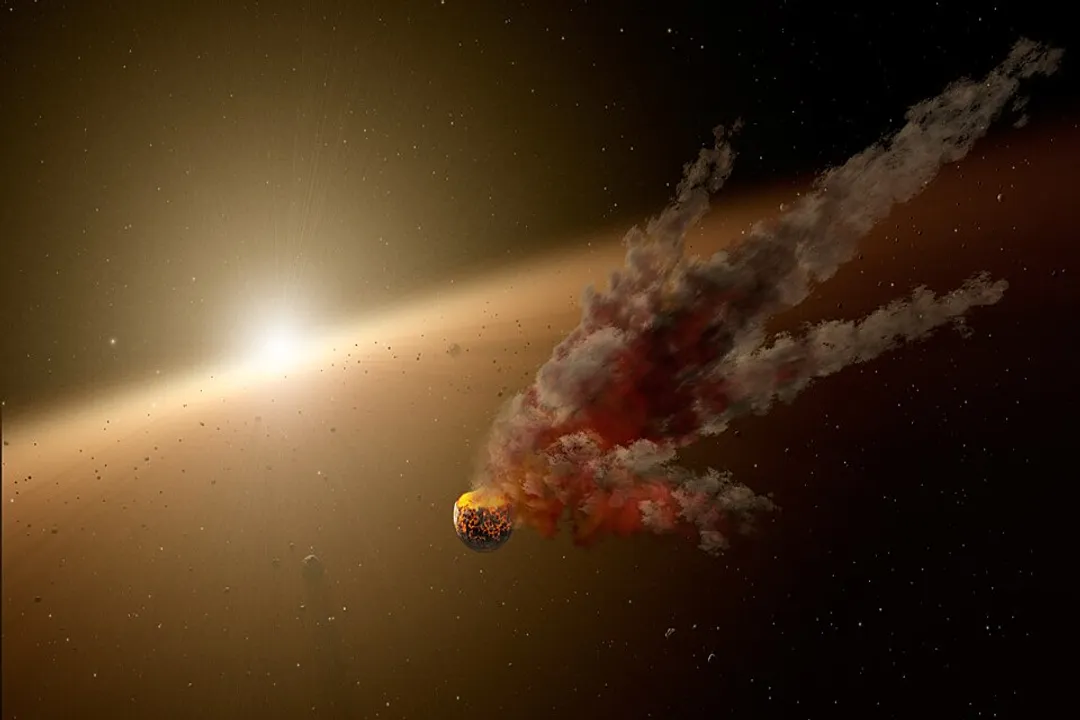
- Merger Stage: The final phase for the inner planets involved chaotic orbital interactions between these large embryos, leading to violent collisions and mergers. This process, which lasted tens of millions of years, sculpted the final count of terrestrial planets we see today. [2][4]
Debris that failed to form a planet—either because collisions were too destructive or because a large body like Jupiter interfered—remained behind, forming structures like the Asteroid Belt between Mars and Jupiter. [3][5] Objects in the distant, colder outer reaches formed the Kuiper Belt and the Oort Cloud, consisting primarily of ice. [5]
# Model Evolution
The scientific community’s understanding of solar system genesis has always evolved, often in response to unresolved observational conflicts. [4] The early Laplacian model failed to explain the observed angular momentum distribution: why did the massive Sun barely spin relative to its planets? [4][7] The modern SNDM offers crucial, though not entirely certain, physical mechanisms to account for this transfer. One leading idea is magnetic braking, where the magnetic field of the young Sun interacts with the ionized gas in the inner disk, transferring angular momentum outward. [4] Another contribution is believed to come from the early, energetic solar wind, which swept away remaining gas and dust, effectively halting accretion and carrying away residual momentum. [3] The fact that the modern model incorporates these complex magnetic and dynamic processes, rather than just relying on simple gravitational shedding, is what gives the SNDM its current authority, even as it continues to be tested against new exoplanet data. [4]
# Current Puzzles
Despite its explanatory power regarding the overall structure—the coplanar orbits and the division between rocky inner worlds and massive outer worlds—the Nebular Hypothesis still contends with certain anomalies. [4]
One major issue involves the large difference in axial tilts. The initial smooth collapse of the nebula suggested all planets should have rotational axes nearly perpendicular to the orbital plane. [4][7] However, Uranus has an extreme tilt of nearly 98 degrees, and Venus rotates backward very slowly. [4] Scientists now attribute these dramatic deviations to off-center impacts by large protoplanets during that final, violent merger stage. [4] Similarly, the tilted and eccentric orbits observed in some exoplanetary systems suggest that gravitational scattering and encounters between large bodies remain a vital, if destructive, part of the late formation process. [4]
Furthermore, the existence of "hot Jupiters"—gas giants orbiting extremely close to their stars—presents a puzzle for in situ formation, suggesting these massive worlds migrated inward significantly after forming beyond the frost line. [2][4] While migration models explain these outliers, the precise physics governing that migration and the initial rapid growth of core accretion beyond the frost line are still areas of intense investigation. [2][4] The model must not only explain our familiar system but also account for the surprising diversity of planetary architecture found orbiting other stars.
Related Questions
#Citations
Nebular hypothesis
8.2: Origin of the Solar System—The Nebular Hypothesis
How Was the Solar System Formed? - The Nebular ...
Origins of the Solar System | Research Starters
Nebular hypothesis | The Solar System Wiki - Fandom
Model How the Solar System Formed – Science Project
Nebular Theory | Definition, Development & Problems