Which unit is used in astronomy?

Measuring the cosmos is a task that quickly renders familiar units like the kilometer or the mile utterly useless. The distances between celestial bodies are so immense that working with them requires adopting a specialized vocabulary of measurement. Astronomers rely on a tiered system of units, each perfectly scaled for the specific domain they are investigating, whether it’s the scale of our local planetary neighborhood or the vast expanse between galaxies. [5]
# Solar System Measure
For mapping distances within our solar system, the standard, go-to unit is the Astronomical Unit, abbreviated as AU. [5][8] Historically and conceptually, the AU represents the average distance between the center of the Earth and the center of the Sun. [1][4][7] This unit anchors our understanding of orbital scales for the planets we know best. [7]
Before 2012, the AU was determined by observing Earth’s orbit, which is slightly elliptical, meaning the distance constantly changed throughout the year. [1] However, for precision in modern science, the International Astronomical Union (IAU) established an exact, fixed definition in 2012. [1][6] Now, one AU is officially defined as precisely $149,597,870,700$ meters. [1][6]
To put that precise number into perspective using more familiar, though less accurate, figures, the AU is approximately $150$ million kilometers or about $93$ million miles. [4][7] For a quick, handy reference when dealing with the outer planets or minor bodies, using is often sufficient. [4][8] For instance, if a probe is sent to Jupiter, its distance is measured in AU because the resulting number is much cleaner than calculating millions of kilometers. Pluto, for example, orbits at a mean distance of about $39.5$ AU from the Sun. [1]
# Scaling Up Distances
When astronomers turn their gaze beyond the relatively cozy confines of our Sun’s influence and begin measuring the separation between stars, the AU becomes too small, and the parsec and light-year take over. [5]
# Light Years
The Light Year (LY) is perhaps the most commonly known unit outside of scientific circles. It defines distance based on time and the universal speed limit: it is the distance light travels in one Earth year. [3] Because light moves incredibly fast—approximately $300,000$ kilometers per second—the distance encompassed by one light-year is enormous. [3] This unit is essential for expressing interstellar distances, such as the separation between stars in the Milky Way galaxy. [5]
# Parsecs
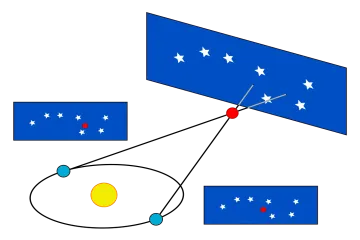
A more technically defined unit often preferred by professional astronomers, especially when dealing with stellar parallax measurements, is the Parsec (pc). [3] The name itself is a contraction of parallax second. [3] A parsec is defined as the distance at which one astronomical unit subtends an angle of one arcsecond when viewed from that distance. [3] This definition ties the unit directly to observational geometry, making it highly useful for mapping stellar positions. [3]
When comparing these interstellar units, the relationships are staggering. One parsec is equivalent to about $3.26$ light-years. [3] Furthermore, in terms of the solar system’s primary measure, one parsec translates to roughly $206,265$ AU. [3] This mathematical relationship underscores why the AU is unsuitable for galactic scales; Mars’s orbit is measured in single-digit AU, while the nearest star system is measured in multiple light-years or parsecs.
# Unit Conversions Summary
The practical challenge in astronomy lies in switching between these scales smoothly. The difference in definition logic between the AU and the Parsec offers an interesting point of contrast for those new to the field. The AU is fundamentally tied to a physical, orbital measurement (though now fixed to a specific meter count), providing a tangible, human-centric scale for our local neighborhood. In contrast, the parsec is defined purely by a geometric relationship derived from observation (parallax), making it a better fit for catalogue work where angular measurements are primary. [3]
Here is a summary of the key conversions:
| Unit | Approx. Kilometers | Approx. AU | Approx. Light Years |
|---|---|---|---|
| 1 AU | 1 | $0.0000158$ | |
| 1 Light-Year | $63,241$ | 1 | |
| 1 Parsec | $206,265$ | $3.26$ |
# Auxiliary Metrics
While AU, LY, and pc handle the bulk of solar system and stellar measurement, context sometimes demands smaller or even larger subdivisions of distance, which often relate back to the speed of light. [6]
For missions within the solar system, or for describing light-travel time between Earth and spacecraft, smaller units based on the speed of light are sometimes utilized, such as the light-second, light-minute, and light-hour. [6] For example, light takes roughly $8.3$ minutes to travel from the Sun to Earth, meaning the Sun is about $8.3$ light-minutes away. [6] This approach helps visualize communication delays and real-time observations.
If we wanted to think about our solar system in terms of light travel, the distance to Pluto (about $40$ AU) is roughly $5.5$ light-hours. [1][6] This conversion capability is crucial for understanding the delay in observation, which is a different, yet related, piece of data than just the physical separation. If we use the exact definition of the AU () and the speed of light (), we can calculate that one AU is equal to about $499$ light-seconds, which confirms that $8.3$ light-minutes for the Earth-Sun distance is accurate, as . [1][6]
# Context and Practicality
The adoption of these specific units speaks volumes about the nature of astronomical work. When studying the structure of a planetary system, working in AU is akin to measuring distances on Earth in meters or yards—it keeps the numbers manageable and relevant to the system's dynamics. [7] When you read that a newly discovered exoplanet orbits its star at $0.5$ AU, you immediately grasp that it resides well inside the orbit of Mars, even if you cannot picture the exact kilometer distance. [1]
Conversely, the parsec offers an immediate indicator of stellar proximity relative to our viewpoint on Earth. If a star is $10$ parsecs away, an observer knows that its measured parallax angle would be $0.1$ arcseconds, a value easily measurable by ground-based or space telescopes. [3] This inherent link to observability is what grants the parsec its authority in stellar distance catalogues.
Understanding which unit to use is less about rigid rules and more about context. Using a light-year to measure the distance between the Earth and Mars is technically correct but incredibly cumbersome; it would be nearly $0.000016$ light-years. Think of it like reporting the distance between two cities in millimeters—while accurate, it obscures the practical scale. [2] The system works precisely because it provides a natural scale factor for each observational regime.
# Standardization Through Time
The move to fix the AU in 2012 was a significant step in maintaining scientific authority and precision in astronomical measurement. [1][6] Before this date, the AU varied slightly depending on the Earth's actual position in its orbit at the time of measurement, which introduced minor uncertainties when comparing older observational data with newer models. [1] By assigning a static, defined metric value, the IAU ensured that future calculations of orbits and planetary positions remain consistent and traceable to a fundamental constant of nature, rather than a variable historical observation. [6] This standardization ensures that whether a scientist today or fifty years from now looks up the mean distance between Earth and Sun, they are referencing the exact same length, boosting the reliability of our cosmic measurements. [1]
#Videos
Units in Astronomy: Explained! - YouTube
Related Questions
#Citations
Astronomical unit - Wikipedia
Astronomy Unit (Earth Science) Flashcards - Quizlet
Units for Distance and Size in the Universe
Astronomical unit (AU, or au) | Definition, Conversion, & Facts
Basics of Spaceflight: Units of Measure - NASA Science
What is an Astronomical Unit? | Cool Cosmos
Astronomical unit | McGraw Hill's AccessScience
Units in Astronomy: Explained! - YouTube