Which is the largest unit used in astronomy?
Measuring the immense distances in the cosmos presents a genuine challenge for science. To put the scale of the universe into context, simple metrics like kilometers or miles quickly become cumbersome strings of digits that are impractical for daily astronomical calculations. [6] When observing objects outside our solar system, astronomers rely on specialized units designed to manage these staggering numbers gracefully. [6] The primary yardsticks for this cosmic accounting are the Astronomical Unit (AU), the light-year (ly), and the parsec (pc). [2][5][7] While the light-year is perhaps the most famous, when comparing the three fundamental definitions, the parsec stands out as the largest of the three base units used professionally in distance measurement. [3][7]
# Cosmic Scales

The sheer emptiness between celestial bodies necessitates this specialized vocabulary. We measure distances inside our own Solar System using the AU, but once we step out into the realm of stars and galaxies, the numbers quickly necessitate a bigger measure. [6] The AU provides a manageable scale for planetary orbits, but crossing interstellar space requires units defined by the speed of light or geometric triangulation. [2][6]
# Solar Distance
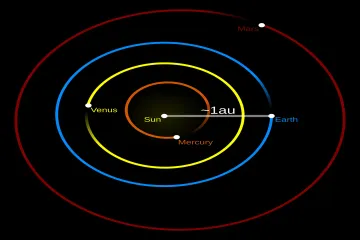
The Astronomical Unit, abbreviated as AU, serves as the foundational reference point for mapping distances within our own stellar neighborhood. [6] By definition, one AU is the average distance between the center of the Earth and the center of the Sun. [2][9] This distance is quantified as approximately $149.6$ million kilometers or about $93$ million miles. [2][6][9] Using the AU, the distance to Jupiter is roughly $5.2$ AU, and Neptune orbits at about $30$ AU. [6] It is an extremely practical measure when discussing the immediate vicinity of our Sun but becomes insignificant when discussing other stars. [6]
# Light Travel
For interstellar measurements, the light-year becomes the unit of choice. This term measures the distance that light travels in a vacuum over the course of one Julian year. [2][9] It is vital to remember that the light-year is strictly a measure of distance, not time, despite the inclusion of the word "year". [5] To grasp the magnitude, one light-year equates to nearly $9.46$ trillion kilometers or approximately $5.88$ trillion miles. [2][6][9] The nearest star system to our own, Alpha Centauri, lies about $4.37$ light-years away. [6] The popularity of the light-year stems from its intuitive connection to the speed of light, a universal constant that astronomers already employ daily. [5]
# Parallax Basis
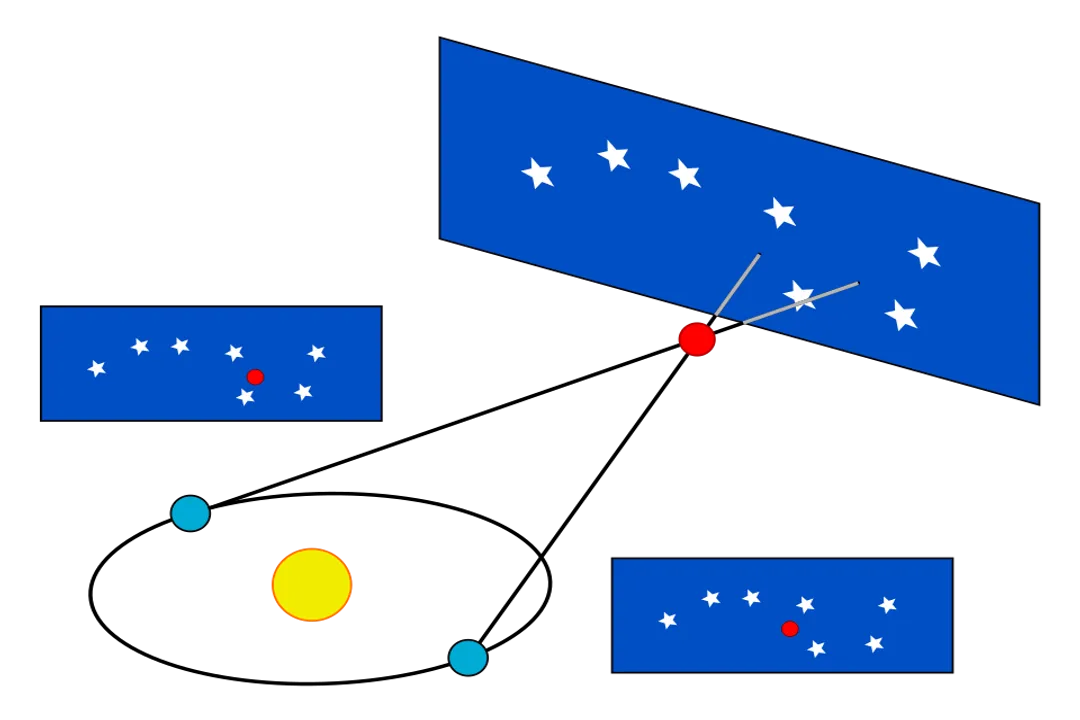
The parsec, short for parallax second, has a definition rooted entirely in geometry and observation rather than speed or time. [1][7] It is defined as the distance at which one astronomical unit subtends an angle of exactly one arcsecond. [1][7] Think of it this way: if you look at a star from two opposite sides of Earth's orbit (a baseline of $2$ AU), and that star appears to shift its position by exactly one arcsecond against the background of much more distant stars, then that star is located one parsec away. [1][7] This method, known as trigonometric parallax, is a key observational technique for determining the distances to nearby stars. [1][7]

# Size Comparison
When putting these three common units side-by-side, a clear hierarchy emerges: the parsec is the largest of the trio. [3][7][9]
The conversion rates clearly demonstrate this:
| Unit | Conversion to Light-Years (ly) | Conversion to Astronomical Units (AU) |
|---|---|---|
| 1 Light-year (ly) | ||
| 1 Parsec (pc) |
As the figures show, one parsec is equivalent to about $3.26$ light-years. [3][7][9] Therefore, the parsec is significantly larger than the light-year, and vastly larger than the AU. [7] For example, if we consider the distance to Proxima Centauri at roughly $4.24$ light-years, that converts neatly to about $1.3$ parsecs. [3][7] This illustrates how the parsec compresses the measured distances to nearby stars, yielding smaller, more manageable numbers for those objects closest to us, making professional cataloging easier. [1]
# Unit Rationale
The choice between light-years and parsecs often depends on the context and the specific astronomical task at hand. [7] While the light-year provides a strong connection to the time it takes for light to reach us, which is easy for the general public to grasp, astronomers often prefer the parsec for formal distance reporting. [7] This preference is pragmatic; since the parsec is directly derived from the parallax measurement method—the most direct technique for measuring stellar distances—it links the result immediately to the observation. [7] When an astronomer measures a parallax angle of $0.5$ arcseconds, the distance is automatically parsecs. [1] This geometric underpinning lends the parsec a foundational authority in professional literature. [7]

# Vast Measure
The question of the "largest unit" does not end with the base parsec, however. Just as we use thousands of kilometers to describe distances on Earth, astronomers use multiples of the parsec to map the galaxy and the observable universe. [1][7]
When measuring structures within our own Milky Way galaxy, the kiloparsec () is employed. One equals $1,000$ parsecs. [1] The Milky Way galaxy itself is estimated to be around $30$ kiloparsecs in diameter. [1]
To describe distances between galaxies, even larger units are necessary, such as the megaparsec (), which is one million parsecs. [1][7] Distances to nearby galaxy clusters are commonly expressed in megaparsecs.
For the grandest scales—the structure of the universe itself and the extent of the observable cosmos—astronomers use the gigaparsec (), representing one billion parsecs. [1][7] The diameter of the observable universe is currently estimated to be around $93$ billion light-years, which translates to roughly or . [1]
Therefore, while the parsec is the largest fundamental base unit among the three commonly cited (AU, ly, pc) due to its conversion factor being $3.26$ times the light-year, the practical largest unit used in modern cosmology is the gigaparsec. [1][7] It represents the highest level of scale needed to quantify the entire observable cosmos in a readable form. [1]
Related Questions
#Citations
Parsec - Wikipedia
Which one is the largest astronomical unit, a light year or a parsec?
The largest unit to measure distance is a light year
[Solved] Which is the largest unit to measure distance? - Testbook
Astronomy 101: Astronomical distances
ELI5: Why do Astronomers use units such as Parsec and ... - Reddit
Astronomical Distances - Redshift Sky
Units for Distance and Size in the Universe
Astronomy Unit (Earth Science) Flashcards - Quizlet