What are SI units in astronomy?

The immensity of the cosmos presents a fundamental challenge for science: how do we effectively measure distances spanning billions of kilometers and time periods stretching back eons? While everyday life uses units like kilometers and hours, the scales involved in studying planets, stars, and galaxies render those measurements cumbersome and often meaningless. This is where the International System of Units (SI) steps in as the bedrock, supplemented by specialized astronomical units designed to make cosmic accounting practical and intuitive.
# SI Bedrock

At its heart, the SI system provides the seven base units from which nearly all other scientific measurements are derived. For astronomy, three of these base units are instantly recognizable and critical: the meter for length, the second for time, and the kilogram for mass. These definitions are maintained with extraordinary precision by international standards bodies, ensuring that when an astronomer in Tokyo measures a distance, it corresponds exactly to a measurement taken by an engineer in Houston.
The meter serves as the fundamental unit of length in the SI system. When we discuss objects within our own solar system, using the meter or its multiples (like kilometers) is feasible, though perhaps still a bit tedious for interplanetary travel calculations. For instance, the distance between the Earth and the Moon is routinely measured in meters, but once we move past Neptune, the numbers begin to look overwhelming.
# Scaling Cosmic Distances

The need for specialized units arises directly from the sheer scale of astronomical phenomena. Imagine writing the distance to the nearest star, Proxima Centauri, in meters—it would be a number with thirteen zeros after the decimal point before the first significant digit appeared. Such large numbers are prone to error and difficult to grasp conceptually.
To handle this, astronomers adopt units that are appropriately sized for the phenomena being studied. Think of it as choosing the right tool for the job: you wouldn't use a stopwatch to measure the age of a mountain range, and you wouldn't use a meter stick to measure the distance to another galaxy. While the meter remains the official SI foundation, the practical application demands scale-specific terminology.
# The Astronomical Unit
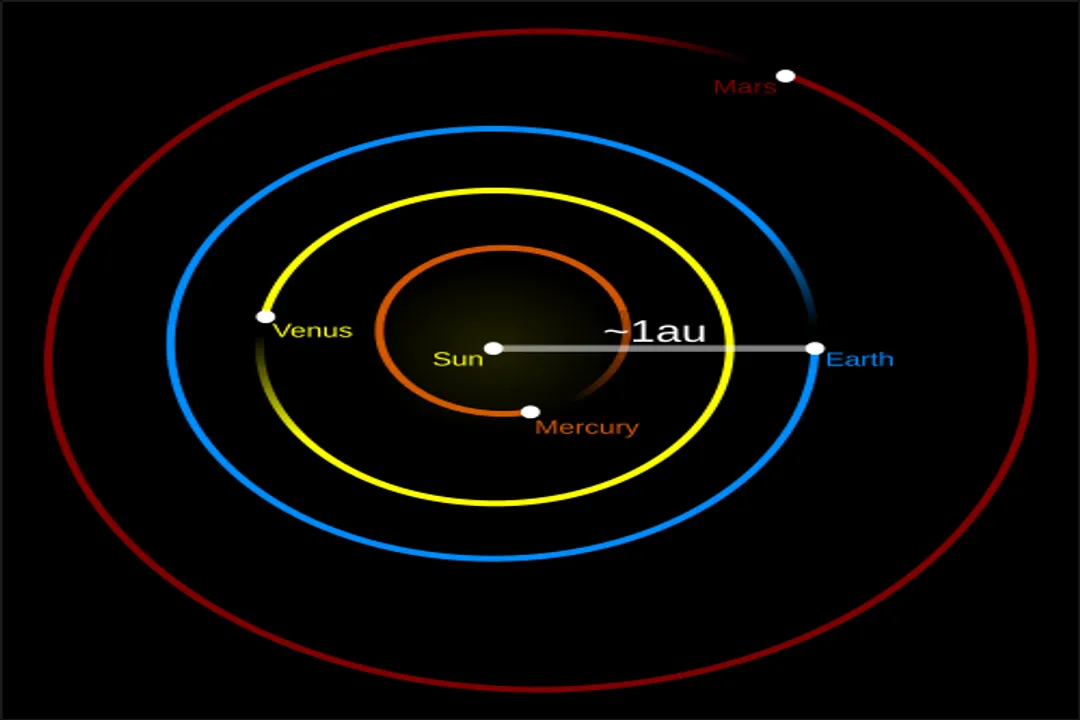
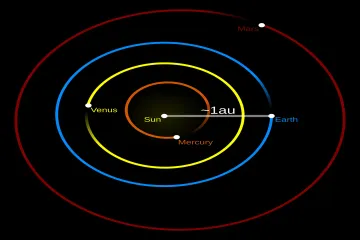
Perhaps the most commonly referenced specialized unit within our immediate cosmic neighborhood is the Astronomical Unit (AU). Historically, the AU was defined simply as the average distance between the Earth and the Sun, derived from painstaking observations over centuries. This provided a perfect, naturally occurring baseline for measuring the architecture of our own Solar System.
Today, however, the definition has been fixed to an exact SI value. Since $2012$, one AU is defined as exactly $149,597,870,700$ meters. This fixes the AU firmly to the SI definition of the meter, though it retains its historical identity.
The utility of the AU is immense when discussing planetary science. For example, Jupiter orbits at about $5.2$ AU, and Pluto, at its farthest, can reach nearly $50$ AU from the Sun. Working in AU allows scientists and students alike to compare planetary distances with straightforward, manageable numbers. If we consider the relative orbital distances, one can easily see the vast gaps between the outer planets compared to the tight clustering of the inner rocky worlds, a comparison that becomes murky when expressed purely in kilometers.
# Parsecs and Light-Years
Moving beyond the Solar System, we enter the realm of interstellar and intergalactic measurement, where the AU itself becomes too small for convenient use. Here, two other units take precedence: the light-year and the parsec.
The light-year is deceptively simple: it is the distance that light travels in one Julian year. Because the speed of light () is defined by SI units (meters per second), the light-year is inherently a distance derived directly from SI standards, even though it is expressed as a time-based quantity. One light-year translates to approximately meters. It is an intuitive unit for understanding cosmic time delays—when we look at a star $100$ light-years away, we are seeing it as it was $100$ years ago.
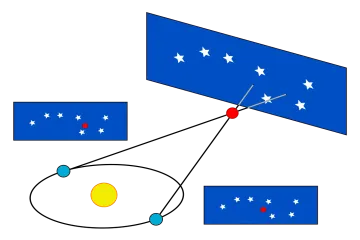
The parsec (parallax second) is the unit favored by professional astronomers for mapping the structure of the galaxy and beyond. It is defined using trigonometry based on the Earth's orbit. A parsec is the distance at which one astronomical unit subtends an angle of one arcsecond. This definition connects it back to the AU, which itself is tied to the meter.
Comparing these units reveals a clear hierarchy of scale:
- AU: Solar System distances (e.g., Earth to Sun, or planet to planet).
- Light-Year: Interstellar distances (e.g., distance to nearby stars).
- Parsec: Galactic and extragalactic scales.
For context, one parsec is equivalent to about meters, making it larger than a light-year. Specifically, one parsec equals approximately $3.26$ light-years. While the light-year appeals to the public imagination because of its connection to time, the parsec is often preferred by researchers because its definition links directly to the trigonometric methods used to measure stellar parallax.
# Practical Conversion Habits
It is common to see NASA and other space agencies shift between these units depending on the context of their communication or engineering need. When designing a probe traveling to Mars, engineers work with meters and seconds for trajectory calculations, but the mission planners might report its travel time in terms of AU covered per day. Conversely, when discussing the Milky Way's diameter, light-years or kiloparsecs are indispensable.
Understanding how these units interlock is key to appreciating astronomical data. For instance, if you are working with a published mass for a distant star in kilograms (the SI base unit for mass), but its distance is given in parsecs, you must be prepared to convert that distance into light-years or meters before calculating its luminosity relative to our Sun's standard solar units.
To put the SI connection into sharp focus, consider the speed of light, , which is approximately $299,792,458$ meters per second. If we multiply this SI velocity by the number of seconds in a standard year, we arrive precisely at the SI equivalent of one light-year in meters. This direct mathematical relationship underscores that the specialized units are simply convenient shortcuts built upon the immutable foundation of the SI system.
# Beyond Base Units
While length, time, and mass are foundational, astronomy also frequently relies on derived SI units. For measuring energy, temperature, and flux, we turn to units built from the base set.
For temperature, the SI unit is the Kelvin (K). Unlike Celsius, the Kelvin scale is an absolute thermodynamic scale, meaning represents absolute zero—the point where particle motion ceases. This makes it essential for modeling stellar interiors or the cold vacuum of space, as it avoids the arbitrary zero point of other scales.
When discussing the brightness or energy output of celestial objects, astronomers use Watts (W), which is the SI unit of power (Joules per second). When discussing the total energy emitted across a surface area, units like the Jansky (Jy), which relates to spectral flux density and is derived from SI units, are employed, particularly in radio astronomy.
This adherence to the SI system, even when using derived units like the Watt or Kelvin, ensures that theoretical models—from general relativity calculations to black hole thermodynamics—can be tested and verified globally against a single, consistent mathematical language. The system is a testament to international scientific agreement, allowing astronomers to use the AU to describe Mars's orbit while simultaneously using the Kelvin to model the core temperature of a distant quasar, all traceable back to the meter, second, and kilogram.
#Videos
Units in Astronomy: Explained! - YouTube
Related Questions
#Citations
Astronomical system of units - Wikipedia
Units in Astronomy: Explained! - YouTube
Basics of Spaceflight: Units of Measure - NASA Science
SI units - NPL - National Physical Laboratory
Using SI Units in Astronomy - NASA ADS
SI Units | COSMOS - Centre for Astrophysics and Supercomputing
0.3: Special Units Used in Astronomy - Physics LibreTexts
What's the layman definitions for the SI units? : r/askscience - Reddit