How do astronomers determine the size of a planet using the transit technique?
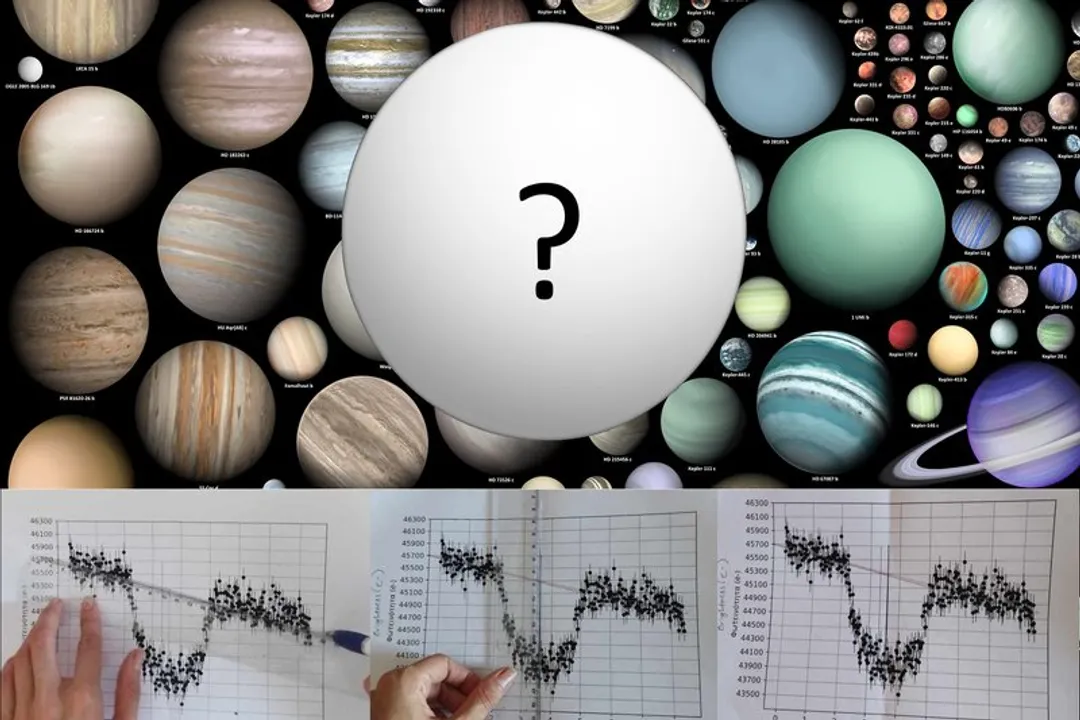
When astronomers want to figure out just how big an alien world is, especially one orbiting a distant star, they often turn to a clever trick involving timing and shadows: the transit method. This technique doesn't involve giant rulers, but rather incredibly precise measurements of light. Essentially, it relies on waiting for a planet to cross directly in front of its host star, temporarily blocking a tiny fraction of the starlight from reaching our telescopes. [1][3]
This momentary dimming, or transit, is the key measurement. Think of it like holding a small coin in front of a bright lamp; the amount of light you block depends entirely on the size of the coin relative to the lamp, assuming you hold the coin perfectly centered and close to the lamp. [4] Translating this simple analogy to the cosmos requires astronomical levels of precision, but the underlying geometry remains the same.
# Measuring Dimming
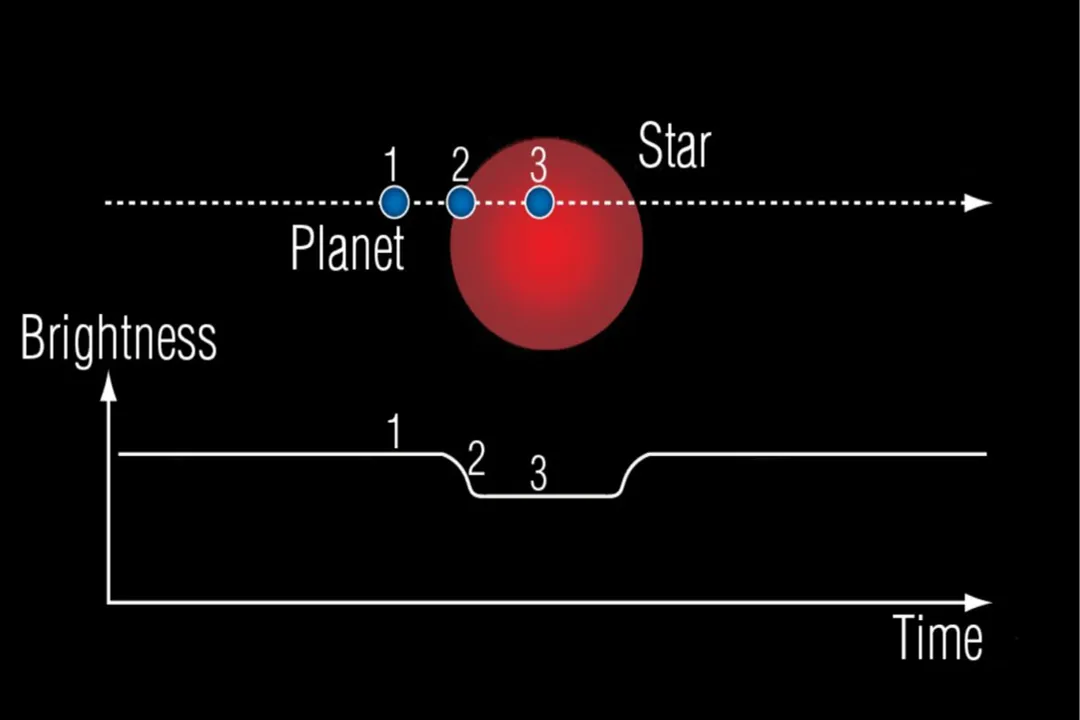
The actual detection of an exoplanet via transit relies on photometry, the measurement of light intensity. [2] Astronomers monitor the brightness of a star continuously over days, weeks, or even years, creating a graph of brightness over time known as a light curve. [5]
When a planet passes across the face of its star, the observed light dips slightly and then returns to normal once the planet moves away. [3] The depth of this dip—how much the star's brightness drops—is directly related to the surface areas of the objects involved. [4] Specifically, the fractional amount of light blocked is proportional to the square of the ratio of the planet's radius () to the star's radius (). [7] Mathematically, the relative drop in flux () is often approximated by the ratio of the areas: . [4]
The challenge is that these dips are incredibly faint. A Jupiter-sized planet orbiting a Sun-like star causes a brightness drop of just over 1 percent. [4] For an Earth-sized planet orbiting a similar star, that dip plummets to about $0.008$ percent, or about 80 parts per million. [7] This scale of precision demands the most sensitive instruments available, like those flown on missions such as Kepler or TESS. [2][5] The process requires accumulating a great deal of data from multiple, well-timed transits to ensure the dip isn't just stellar noise or a temporary starspot behaving unusually. [4]
# Star Size Context
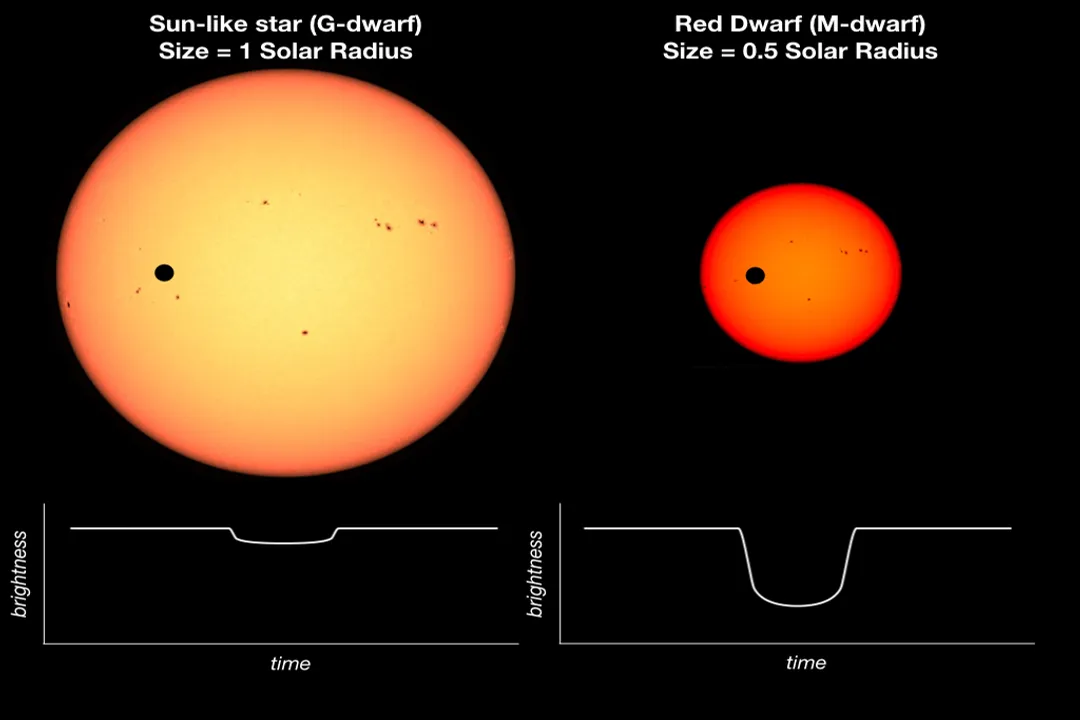
Here is where the method hits its first major hurdle for determining absolute size. While the transit depth () tells us the ratio of the planet's size to the star's size, it does not, by itself, tell us the actual radius of the planet in kilometers or Earth radii. [4][7] If the dip is $0.1$ percent, we know the planet is small compared to the star, but we don't know how small until we know the star's actual size.
To convert that ratio into a concrete measurement, astronomers must first have an independent, reliable measurement of the host star's radius (). [4] Determining stellar radius is complex, relying on models of stellar structure, which often use other measurements like the star's mass, temperature, and luminosity—properties that might have been derived from other observational techniques, such as radial velocity measurements. [4] If the star is an average main-sequence star, astronomers can estimate its radius based on its spectral type and brightness. For a more unusual star, this estimation carries a larger inherent uncertainty, which propagates directly into the final planet size calculation. [7]
If you have a star twice the size of the Sun, a transit that causes a $0.2$ percent dip would mean the planet is twice the radius of Jupiter, even though the ratio to the star is the same as a Jupiter-sized planet around a Sun-sized star. This need for external stellar characterization highlights a critical dependency in transit science: the planet's size measurement is only as good as the star's size measurement. [4]
# Refining the Light Curve
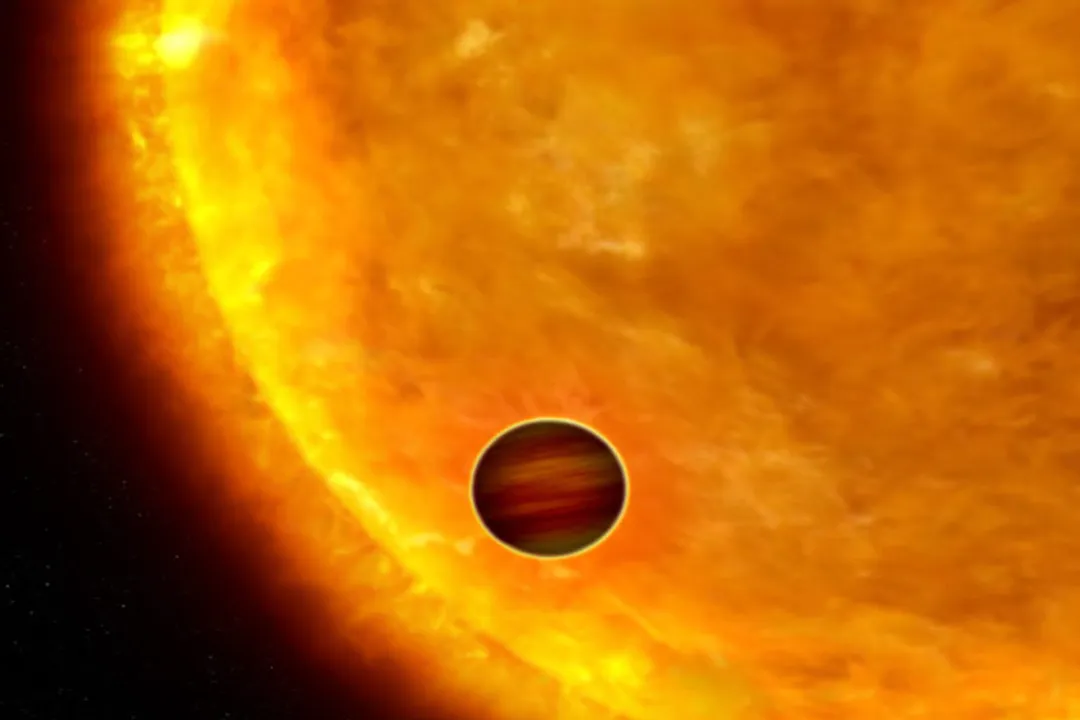
The light curve produced by a single transit is rarely a perfect, clean U-shape or V-shape. Real stellar surfaces are not uniform; they have bright spots and darker, cooler regions called starspots. [4] When a planet passes over a dark starspot, the dimming effect is actually less pronounced than if it passed over a bright region, leading to slight distortions in the curve. Conversely, if the planet passes right over a bright spot, the dip might appear shallower than expected. [4]
Astronomers must create sophisticated mathematical models of the light curve that account for these stellar imperfections, including limb darkening. [4][7] Limb darkening is the phenomenon where the edge (or limb) of a star appears dimmer than its center because we are looking through less of the star's atmosphere when viewing the edge tangentially. As the planet moves across the disk, the amount of light blocked changes continuously, not just based on area, but on where it crosses the disk. A transit that passes near the limb of the star will appear shallower than one passing directly across the center, even if the planet size is identical. [7] Modeling these effects, often requiring iterative computational fitting, helps isolate the signal purely due to the planet's physical obstruction.
One way to add confidence to the size measurement, which seems intuitive but is vital, is repeated observation. Each time the planet transits, it provides an independent data point confirming the transit depth. For instance, observing the same planet around a star for ten separate transits allows scientists to average out random noise and spot systematic errors, resulting in a much tighter constraint on the transit depth parameter—and thus a better planetary radius estimate—than a single transit ever could. [4]
# Geometry of Transit Events
While the depth determines the size ratio, the geometry of the system dictates whether a transit is even possible or observable. For a planet to transit, its orbit must be perfectly aligned with our line of sight—a configuration astronomers call an edge-on orbit. [1][3] If the orbital plane is tilted even slightly away from being edge-on, the planet will pass above or below the star from our perspective, and we will never see a transit. [1] This geometric requirement is why the transit method is inherently biased towards finding planets in small, tight orbits around their stars, as these are the configurations most likely to align with Earth. [3]
Consider this: if a star is significantly larger, say a bright giant star, the area across which the planet can transit while still being visible to us—the maximum acceptable orbital inclination angle—is much wider than for a small red dwarf star. For a small star, the planet's orbit must be almost perfectly aligned to produce a measurable dip. For a larger star, a planet can have a slightly more inclined orbit and still produce a visible transit. This difference in alignment tolerance means that transit surveys often find planets around smaller, dimmer stars because the geometry is easier to achieve for them, even though the absolute size measurement then depends on knowing the smaller star's radius accurately. [4]
# Calculating Radius: A Sample Scenario
To illustrate the process clearly, let's imagine a hypothetical scenario where we have successfully characterized our star. Suppose we determine through spectroscopy and stellar modeling that our host star has a radius of $1.0$ solar radii (). We then measure the transit depth () using our high-precision photometer and find it to be $0.0099$ (or $0.99$ percent light blocked). [4][7]
We use the relationship: .
Plugging in our hypothetical numbers:
Since the Sun's radius is about 695,700 km, this yields a physical radius for the planet of approximately $69,220$ km. Comparing this to Jupiter ($142,984$ km), we see that this hypothetical planet is about half the radius of Jupiter. This concrete result, derived entirely from the transit depth and the independently determined stellar radius, is the final output astronomers aim for. If the star were instead a large red giant, the same $0.99%$ dip would yield a vastly larger planet, demonstrating the critical nature of the stellar size input. [4]
# Beyond Size Characterization
While the primary goal is radius determination, the transit technique, when combined with other methods, can unlock more secrets about the planet. For instance, observing the transit using different wavelengths of light (spectroscopy during transit) can reveal atmospheric composition. [8] If the planet has a substantial atmosphere, the measured radius effectively increases slightly depending on which wavelength of light is observed, as longer wavelengths penetrate deeper into the atmosphere before being blocked. [8] This subtle difference, known as transmission spectroscopy, allows researchers to look for atmospheric signatures like water vapor or methane in the light that filters through the planet's tenuous outer layers. [8]
The transit method is a powerful demonstration of how a simple geometric event, repeated and measured with exquisite care, can yield fundamental physical properties for worlds light-years away. It transforms a mere shadow into a measurable dimension, providing the crucial first step in characterizing the actual physical nature of an exoplanet. [2][5]
#Videos
How Does the Transit Method Detect Exoplanets? - YouTube
Related Questions
#Citations
Transit Method - Las Cumbres Observatory
Down in Front!: The Transit Photometry Method | The Planetary Society
The Transit Method of Detecting Exoplanets | PBS LearningMedia
Transit Light Curve Tutorial - Andrew Vanderburg
Explained: Transiting exoplanets | MIT News
Measuring an exoplanet - astroEDU
How Does the Transit Method Detect Exoplanets? - YouTube
Week 4: 3.1 Measuring a transit | OpenLearn - The Open University
ESA - How to characterise an exoplanet - European Space Agency