How many planets have been discovered using astrometry?
The sheer number of exoplanets now confirmed—well over six thousand—often obscures the tremendous difficulty of proving a planet exists around another star. While detection methods like the transit technique pull in thousands of finds, one of the oldest and most demanding techniques, astrometry, has historically yielded a much smaller harvest. This method relies on observing the subtle, gravitational dance between a star and its unseen companion.
# Measuring Wobble
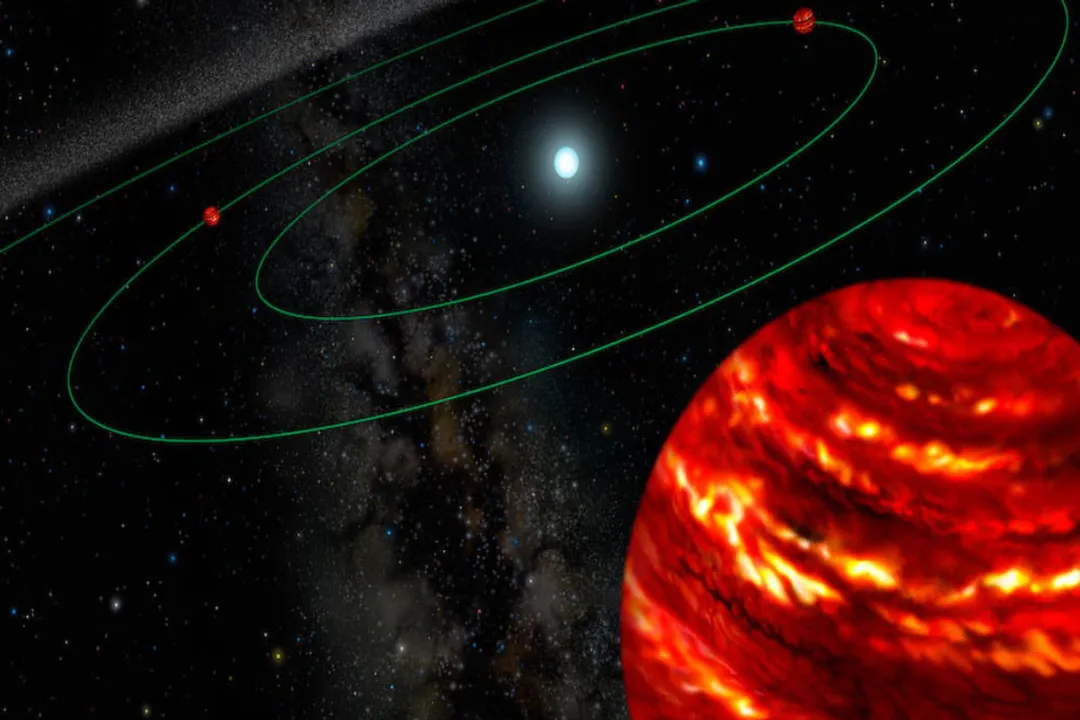
Astrometry, in the context of planet hunting, is essentially the science of precision measurement of stellar locations in the sky. [3] The fundamental principle is that an orbiting planet gravitationally tugs on its host star, causing the star itself to move slightly in a tiny orbit around the system's common center of mass. [1][3] While the planet itself remains invisible to this specific technique, this back-and-forth tug results in a minute, regular, periodic shift in the star's proper motion—its apparent movement across the sky over time. [2][3]
Detecting this positional wobble is technologically demanding. It requires instruments capable of measuring angles with extreme accuracy, down to the level of microarcseconds. [1] For context, one microarcsecond is equivalent to the apparent size of a euro coin viewed from the Moon. [1] If the orbital plane is perfectly face-on relative to Earth, the displacement is maximized and easier to measure astrometrically. Conversely, the radial velocity method, which looks for the star moving toward or away from us via spectral shifts, works best when the orbit is edge-on. [1]
# Historical Confirmation
The astrometric hunt is fraught with challenges that have historically led to high rates of unconfirmed claims. As far back as 1943, claims were made based on meticulous, decades-long observations from ground-based observatories like Sproul. [3] However, many of these early, highly anticipated results—including those involving stars like 61 Cygni and Barnard’s Star—were later cast into serious doubt or deemed unproven. [3]
This historical difficulty explains why, looking at ground-based efforts prior to major space missions, the confirmed count was very low. One summary noted that, up to a recent period, less than a handful of exoplanets had been confirmed using this method based on ground-based astrometry alone. [1] Even one notable early confirmation, DENIS-P J082303.1-491201b (also known as VB 10b), cited on the NASA exoplanet archive as an astrometric discovery around 2020, did not pass subsequent follow-up radial-velocity checks, leading most researchers to label it a false positive. [3]
# The Current Confirmed Count
The list of planets confirmed unambiguously and primarily via astrometric measurements is short when compared to the thousands found by observing transits or stellar velocity changes. [2] However, the precision offered by modern tools, particularly space-based missions, has begun to yield concrete results that stand today.
By examining lists dedicated specifically to these findings, we see a distinct, though small, number of confirmed worlds whose primary detection relied on measuring the stellar shift. [2] This list evolves as new data is processed, with confirmed discoveries spanning recent years, including several reported in the 2022–2025 timeframe, such as EQ Pegasi Ab and Gaia-4 b. [2] When reviewing the dedicated catalog as of the most recent updates reflected in those databases, the number of confirmed, pure astrometric discoveries is approximately a dozen, though it must be noted that these systems often involve larger, more massive planets than those found by other means. [2]
It is worth noting that the challenges of verification mean this number remains small. While this technique may uncover thousands of candidates—one paper reported seeing nearly 9,700 candidates detected via astrometry [2]—confirming the subtle wobble as planetary and not instrumental noise, stellar spots, or background star contamination requires extensive observation, sometimes spanning the planet's entire orbital period, which can take years or even decades. [3]
A crucial contextual insight here is the difference between detection and confirmation. The sheer volume of candidates identified by astrometric surveys strongly suggests that the method is incredibly sensitive, but its inherent weakness lies in the long-term validation needed to rule out every other possibility, a bottleneck that dramatically limits the final confirmed count reported by official archives.
# Astrometry’s Unique Mass Advantage
While the confirmed count might seem underwhelming compared to the thousands found via transit photometry, astrometry possesses a distinct advantage that makes it indispensable for certain types of scientific inquiry: it determines the planet's true mass. [1][3]
Methods like radial velocity only provide a minimum mass because they cannot definitively measure the inclination—the tilt—of the orbit relative to our line of sight. [3] If we view an orbit nearly edge-on, the observed velocity change is close to the true orbital velocity. If we view it face-on, the star appears to move very little toward or away from us, leading to an underestimation of the planet's mass. [1] Astrometry, by measuring the sideways wobble, is sensitive to the other component of the motion. When combined with radial velocity data, astrometry can solve for the inclination, yielding the planet’s actual mass. [1] This is vital for distinguishing between a genuine, low-mass planet and a heavier brown dwarf companion that might cause a similar signal in other detection techniques. [2]
# The Gaia Mission Factor
The landscape of astrometry is being dramatically reshaped by the European Space Agency’s Gaia mission. [1] Gaia is not just making incremental improvements; it is constructing the largest, most precise three-dimensional map of the Milky Way ever created, observing over a billion stars. [1]
The precision targeted by Gaia—eventually reaching about 10 microarcseconds for its brightest stars based on cumulative data—is expected to revolutionize this discovery method. [1] Scientists forecast that this capability will allow the detection of some tens of thousands of exoplanets within about 1,600 light-years of the Sun by measuring their astrometric wobble. [1] Furthermore, Gaia data is already proving essential for refining the orbital parameters of systems discovered using other means. [1]
This massive influx of high-quality data also means that planets with very long periods, which would require decades of continuous ground observation to confirm, might be revealed by Gaia's multi-year survey scan. [3]
A key analysis stemming from this data collection strategy is how astrometry complements the search for smaller, more distant worlds. While transit surveys favor hot, short-period Jupiters because they transit frequently, astrometry's sensitivity actually increases with the planet's orbital distance from its star. Therefore, Gaia is positioned to uncover cooler, more widely orbiting worlds that are physically inaccessible to transit monitoring, potentially bringing the search for distant, Earth-like analogs closer to fruition in the next era of astronomy. [1]
In summary, while the final, verified tally of planets discovered solely through the exacting art of astrometry remains small—a testament to the difficulty of measuring minuscule positional shifts—the method is far from obsolete. It serves as the indispensable tool for accurately weighing exoplanets, and the high-precision measurements from missions like Gaia promise to inflate this unique catalog substantially in the coming years.
Related Questions
#Citations
List of exoplanets discovered via astrometry - Wikipedia
ESA Science & Technology - Exoplanets
Wobbly Stars: The Astrometry Method | The Planetary Society