What is the actual shape of our universe?
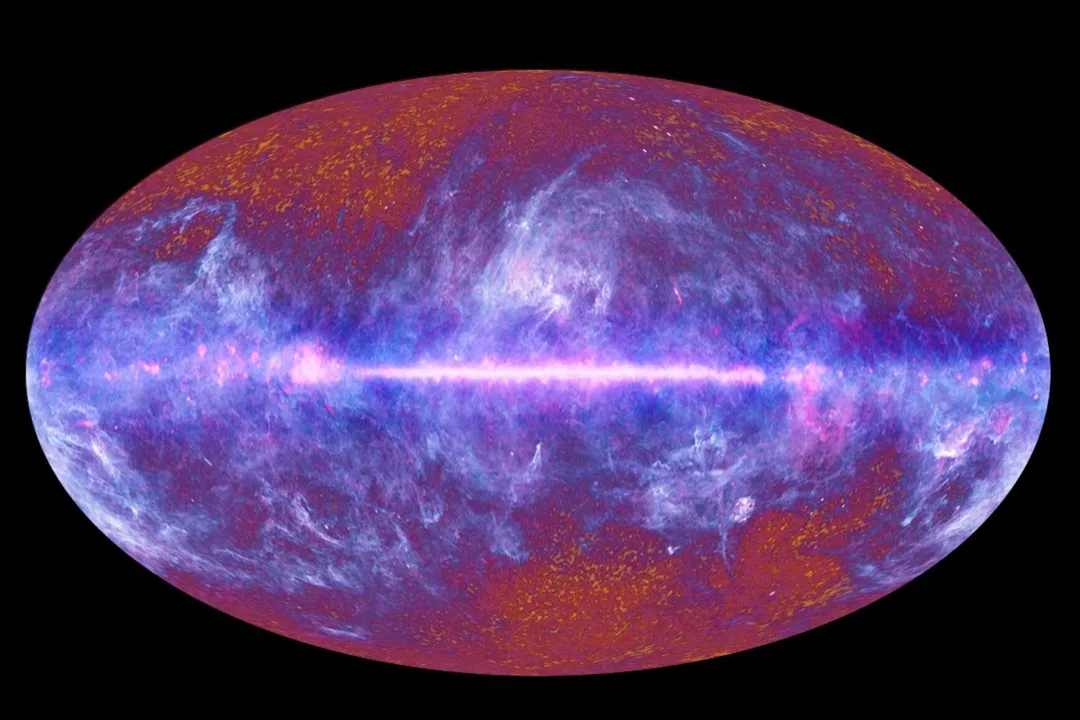
The geometry of everything we observe—from the distance between galaxies to the path of light rays crossing cosmic voids—is fundamentally tied to the overall shape of the universe. For centuries, thinkers and astronomers have wrestled with this grand question, moving from abstract philosophical musings to precise, data-driven measurements. The concept of shape isn't just about whether the universe is shaped like a ball or a saddle; it delves into concepts of curvature and topology, which dictate whether the cosmos is finite or stretches out forever. [3][5] Scientists investigate this by looking at the Cosmic Microwave Background (CMB), the faint afterglow of the Big Bang, as its subtle patterns hold the key to the universe's large-scale structure. [5][8]
# Curvature Types
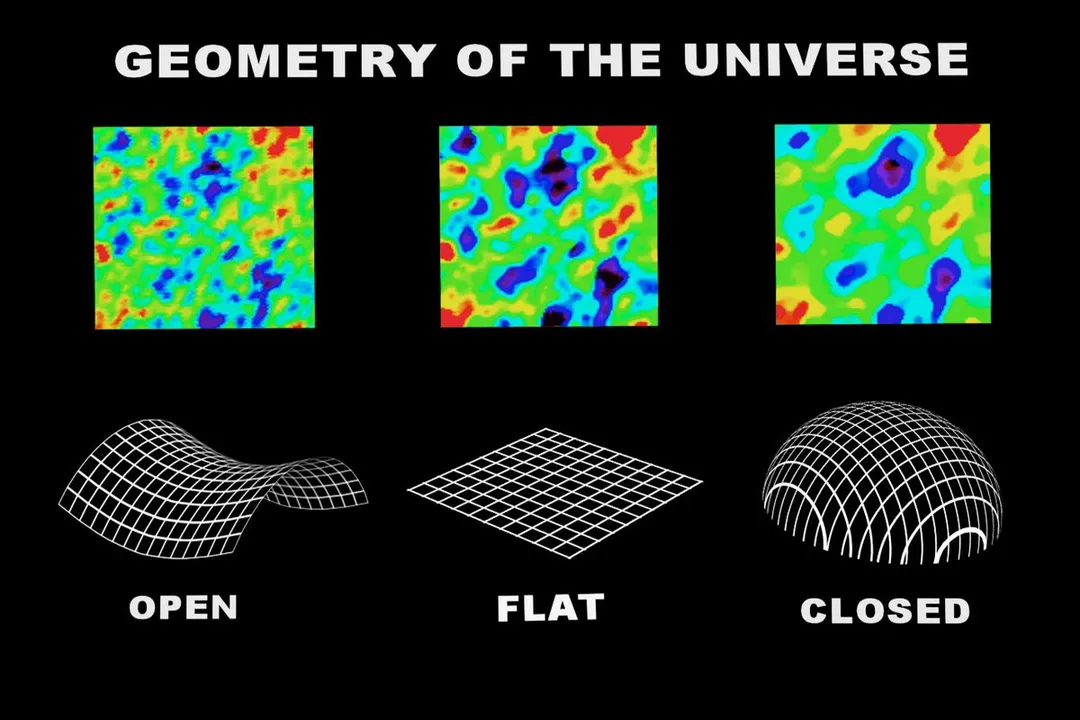
Cosmologists primarily classify the universe's overall geometry based on its curvature, which is determined by the total amount of mass and energy contained within it, often expressed through the density parameter, . [2][3] There are three main geometrical possibilities, each having distinct consequences for the universe's volume and its eventual fate. [3]
The first possibility is a flat universe, which corresponds to the critical density where is exactly equal to 1. [2][3] In this scenario, the geometry is Euclidean, meaning that the familiar rules of flat space apply: parallel lines never meet, and the internal angles of a large triangle drawn across space add up to exactly 180 degrees. [2][5] Observations from missions like the Planck satellite strongly suggest that the universe is incredibly close to being flat. [5]
The second type is a closed universe, possessing positive curvature, much like the surface of a sphere. [2][3] If the actual density of the universe () is greater than 1, gravity is strong enough to curve space back on itself. [3] A positively curved universe is finite in volume, meaning if you could travel in a straight line long enough, you would eventually return to your starting point, similar to circumnavigating the Earth. [2][3]
Conversely, the third possibility is an open universe, which has negative curvature, analogous to the surface of a saddle or a trumpet flare. [2][3] This occurs if the density parameter is less than 1. [3] An open universe would be infinite in extent, and parallel lines would diverge from each other over distance. [2]
To visualize how these geometries affect light, consider the sum of angles in a triangle formed by distant objects, like the paths of light rays emitted from three widely separated points in the CMB. [2] In a flat universe, the angles sum to ; in a closed universe, they sum to more than ; and in an open universe, they sum to less than . [2] The measurements taken by analyzing the angular size of the acoustic peaks in the CMB power spectrum have determined that the universe is very nearly flat, with current best estimates placing extremely close to 1. [5][8]
| Geometry | Density Parameter () | Curvature | Implied Volume |
|---|---|---|---|
| Flat | Zero | Infinite (unless topology suggests otherwise) | |
| Closed | Positive (Sphere-like) | Finite | |
| Open | Negative (Saddle-like) | Infinite |
This table summarizes the geometric possibilities based on the universe's total energy density, which dictates the curvature of spacetime. [3]
# Geometry Versus Topology
While curvature defines the local geometry—how triangles behave and how distances are measured—the topology describes the universe's overall connectivity and whether it is finite or infinite. [1][9] This distinction is crucial because a universe can be flat geometrically but still be finite topologically.
A simple closed universe (like a sphere) is finite both geometrically and topologically. However, a flat universe, which standard Euclidean geometry suggests should be infinite, could actually be finite if its topology "wraps around" itself. [9] The most commonly cited example of this is a torus, or a doughnut shape. [1][9] In a toroidal universe, space connects back on itself in multiple dimensions—imagine an old arcade game where exiting the right side of the screen deposits you on the left, and exiting the top deposits you at the bottom. [9] If the universe had this topology, we might see repeating patterns in the sky from different directions, as light from a distant galaxy could have traveled around the universe multiple times to reach us. [9][1]
If the universe is flat and topologically simple (infinite), then every galaxy we see is the only instance of that galaxy. If it is flat but topologically complex (like a torus), we might see multiple images of the same galaxy, one for each "wrap" the light has taken. [1] The search for these repeating patterns in the CMB is one of the ways cosmologists attempt to probe the topology of the universe, looking for circles in the temperature fluctuations that are smaller than the current observable horizon. [1] So far, no convincing evidence for such self-connections has been found, which either implies the universe is infinite or that its finite size is so large that any potential "wrap-around" structure is much larger than the portion we can currently observe. [1][5]
# Probing the Cosmic Fabric
Determining the shape requires observing the universe on the largest possible scales, as local gravitational effects obscure the global geometry. [5] The primary tool for this is the analysis of the CMB, the radiation left over from when the universe was only about 380,000 years old. [8]
When scientists study the angular size of the "hot and cold spots"—the acoustic peaks—in the CMB map, they are essentially using these known physical sizes as cosmic yardsticks. [2][5] If the universe were positively curved (closed), these spots would appear magnified, appearing larger than expected on the sky map. If it were negatively curved (open), they would appear smaller. [2] The fact that the observed size of these fluctuations matches theoretical predictions for a flat geometry, given the known physics of the early universe, is why the flat model is the leading contender. [5] The uncertainty margin is incredibly small, suggesting that if the universe is curved, the radius of curvature must be at least several hundred times larger than the diameter of the observable universe. [2][5]
Another line of evidence comes from looking at the angular diameter distance to distant objects, such as supernovae or quasars, though these methods are generally less precise than the CMB analysis for determining global shape. [3] If we consider light bending, a closed universe would cause light from a distant source to bend inward (like light passing through a lens), whereas an open universe would cause it to bend outward. [3]
It is important to remember the distinction between the entire universe and the observable universe. [2] Our observable bubble is limited by how far light has had time to travel since the Big Bang—about 46.5 billion light-years in radius, due to cosmic expansion. [2] If the entire universe is indeed flat, it is likely infinite. However, if it has a spherical or hyperbolic geometry, it is still far larger than the part we can see, even if it is technically finite. [2]
# Implications of Flatness
The current best fit—a flat universe—carries significant implications that are often counterintuitive. If space is flat and infinite, it means that everything that can happen will happen an infinite number of times across the expanse of space. [1] This isn't about finding a duplicate Earth around the corner, but rather that, given infinite volume in a flat space, the number of ways particles can arrange themselves must eventually repeat, implying an infinite number of Hubble volumes identical to ours. [1]
From a practical perspective for any imaginable future astronomer, the implication is much simpler: the universe appears spatially infinite to us. [5] While mathematically a torus is finite and flat, the scale required for such a wrap-around to remain undetected is so immense that, for all intents and purposes, we must treat the cosmos as an eternally extending, zero-curvature expanse. [2] The precision with which the CMB data has constrained the flatness—a deviation of less than $0.4%$ from perfect flatness—means that any significant global curvature is beyond our current observational horizon. The data simply doesn't require the added complexity of a closed or open geometry for an accurate model of reality as we can measure it. [5]
For those who enjoy thought experiments about cosmic scales, consider this: if the universe is truly flat, its volume is genuinely infinite. To put this in perspective with local measurements, if we could somehow map a perfect cube of space with sides only one meter long, that cube would still only be an infinitesimal speck in the total cosmic volume, even if the universe were just slightly curved, with a radius of curvature perhaps only a million times the observable universe's size. The sheer scale difference between our measurable patch and the whole implies that for the foreseeable future, our models will operate as if we inhabit an infinite plane, regardless of the true, unprovable global topology. [2] This measured flatness underpins our standard cosmological model, the CDM model, which currently provides the most accurate picture of cosmic evolution and structure formation. [8]
#Videos
The Bizarre Shape Of The Universe - YouTube
Related Questions
#Citations
Shape of the Universe? : r/cosmology - Reddit
What shape is the universe? - Astronomy Magazine
The Shape of the Universe: Ten Possibilities | American Scientist
The Bizarre Shape Of The Universe - YouTube
What is the shape of the universe? - Space
Is the Universe a sphere? If not, which shape it is? How do we know ...
The Shape of the Universe: Flat or Curved? - Facebook
Shape of the Universe - WMAP - NASA
scientists wonder if the universe is like a doughnut | Space