What is the large scale structure (LSS)?
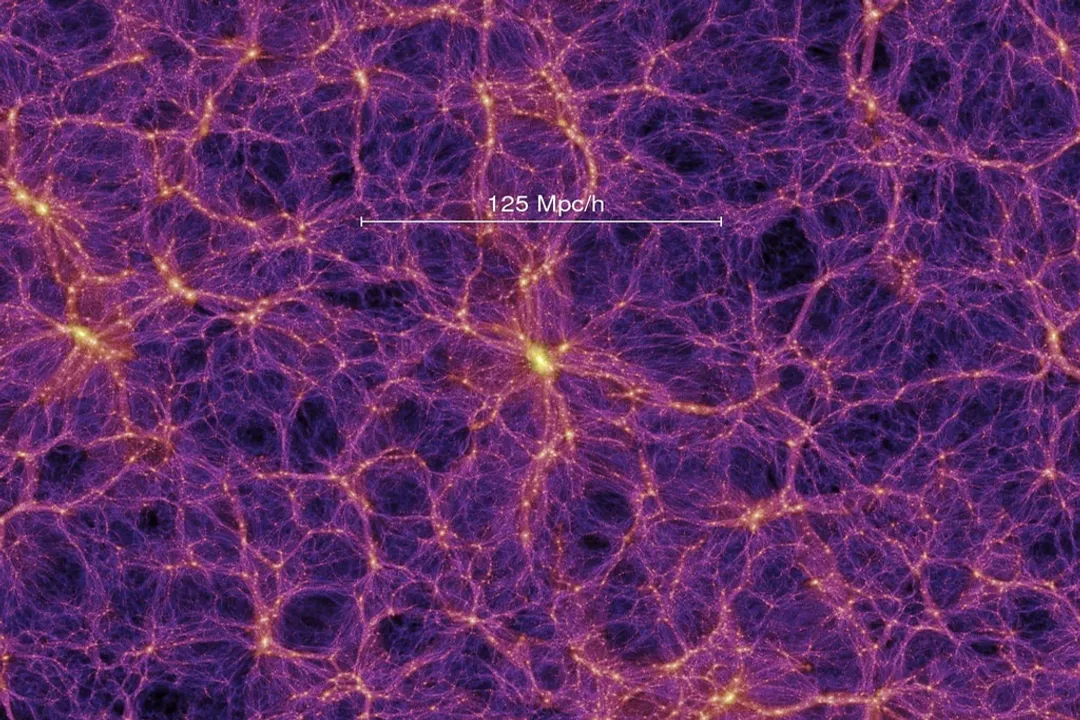
The universe on the largest observable scales is far from uniform; instead, matter is arranged in a distinct, interconnected pattern known as the Large-Scale Structure (LSS) of the Universe. [2][3] This structure isn't just a collection of galaxies scattered randomly through space; rather, it organizes itself into a complex, three-dimensional arrangement that resembles a vast cosmic web, or perhaps a cosmic sponge. [1][2] When cosmologists study the LSS, they are essentially creating a giant census map, tracking the distribution of galaxy clusters and superclusters across billions of light-years. [3]
# Web Voids
This intricate cosmic web is defined by its major components: filaments, walls, sheets, dense knots of galaxy clusters, and, perhaps most strikingly, enormous empty regions called voids. [6] The term "large-scale structure" applies to these features that span hundreds of millions of light-years. [6] The architecture suggests that galaxies preferentially congregate along long, thread-like structures, or filaments, which intersect at massive nodes where superclusters reside. [1] Surrounding these filaments and nodes are the voids, which are huge areas where the density of galaxies is significantly lower than the cosmic average. [1][3]
Observing these structures reveals a fundamental truth about our cosmos: it is inhomogeneous on smaller scales, even though the universe approaches a smooth, homogeneous state when averaged over scales larger than about 300 million light-years. [6] Thinking about these voids offers a concrete way to appreciate the scale involved. If you were traveling along one of these vast, dark intergalactic highways—the filaments—you might cross a void spanning perhaps 100 million light-years. Considering that light travels about 300,000 kilometers per second, this emptiness means that for most of that travel distance, you would see virtually nothing new emerging from that direction, representing an observationally challenging region for mapping efforts. [1] This contrast between the dense, bright knots and the dark, sprawling voids is what gives the LSS its characteristic appearance. [2]
# Formation Gravity
The existence and shape of the LSS are direct consequences of the physics governing the early Universe and the subsequent action of gravity over cosmic time. [5] The process begins with minute density fluctuations present shortly after the Big Bang. [5] While the Universe seemed incredibly smooth initially, these tiny variations provided the seeds for everything we see today. These initial seeds were then amplified by gravity. [5]
The key driver in sculpting this web is dark matter. [4] Because dark matter does not interact strongly with light, it could begin clumping together earlier than normal matter, which was held back by the pressure of radiation in the early Universe. [4] Dark matter essentially built the gravitational scaffolding, or skeleton, upon which visible baryonic matter—the stuff that makes up stars and galaxies—later fell, eventually forming the luminous structures we map today. [1][4] This process is known as structure formation, and it demonstrates how initial quantum fluctuations evolved into the largest structures in the cosmos. [5]
# Mapping Surveys
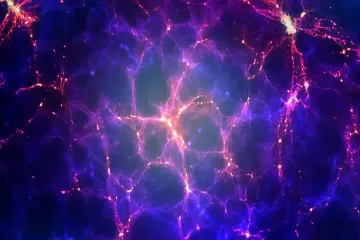
To actually see this structure, scientists rely on large-scale galaxy surveys, which are painstaking efforts to measure the precise three-dimensional locations of millions of galaxies. [5] Surveys like the Dark Energy Survey (DES) or projects like the Sloan Digital Sky Survey (SDSS) are essential data-gathering missions. [1][5] Researchers measure the redshift of distant galaxies—the stretching of light caused by the expansion of the Universe—to determine their distance, allowing them to reconstruct the structure in 3D space. [5]
These surveys are critical because they map out the observable Universe, allowing scientists to test cosmological models against reality. [4] The data gathered isn't just a pretty picture; it is a highly quantitative set of coordinates used to derive statistical properties of the structure. [4] While visually compelling, the raw data is messy, containing biases related to observational limits and the way specific telescopes or instruments capture light. [5] Therefore, extracting the underlying physics requires sophisticated modeling that accounts for these observational effects. [1]
# Statistical Measures
While the visual representation of filaments and voids is intuitive, the rigorous study of the LSS relies on mathematical descriptions that quantify the clustering tendency. [4][8] Two primary statistical tools used to analyze this structure are the power spectrum and the correlation function. [4][8]
The correlation function measures how likely it is to find two galaxies separated by a certain distance, providing a direct quantification of how "clumpy" the Universe is on different scales. [8] Conversely, the power spectrum analyzes the same information but in Fourier space, essentially describing the amplitude of density fluctuations at different characteristic wavelengths. [4] Analyzing these spectra allows cosmologists to place firm constraints on fundamental parameters of the Universe, such as the density of dark matter and the nature of dark energy. [4] Moreover, newer analytical techniques, such as applying concepts from graph theory, treat galaxies as nodes in a network, allowing researchers to define structural characteristics like "connectedness" or "clique sizes" within the cosmic web itself. [8] This shift from purely spatial analysis to network analysis offers a different lens through which to quantify the architecture. [8]
# Dark Energy
The primary scientific motivation for mapping the LSS with such precision is to understand the two dominant, yet mysterious, components of the Universe: dark matter and dark energy. [4] While dark matter helped build the structure, dark energy is now stretching the space between those structures, causing the expansion of the Universe to accelerate. [1]
By measuring the current pattern of the LSS—how big the clumps are and how far apart the voids are—and comparing it to predictions based on the physics of the early Universe, scientists can deduce the properties of dark energy. [4] If dark energy has remained constant (the cosmological constant), the structure's growth rate over time should match that prediction. Any deviation in the growth rate measured across vast cosmic distances can place important limitations on alternative theories of cosmic acceleration. [9] By combining LSS measurements with data from the Cosmic Microwave Background (CMB), which shows the Universe shortly after the Big Bang, researchers can cross-correlate two different epochs of cosmic history to tightly constrain the parameters that describe the Universe's evolution. [9] This triangulation of data sets—early Universe radiation (CMB) and modern structure distribution (galaxy surveys)—is where the strongest constraints on dark energy models emerge. [9]
Related Questions
#Citations
Large-Scale Structure - Dark Energy Survey
Large Scale Structures - NASA Science
Large-scale structure of the Universe - Simple Wikipedia
Large Scale Structure - Dunlap Institute - University of Toronto
Large-scale structure surveys - Observational Cosmology
Large Scale Structure
Large Scale Structures - ILL Neutrons for Society
Cosmic Graphs: the Language of Large-Scale Structure
Investigating ultra-large large-scale structures: potential implications ...