What is the difference between a Local Group and a supercluster?

The universe presents an astonishing hierarchy of structure, a cosmic nesting doll where smaller collections of matter aggregate into ever-larger formations. Just as stars form galaxies, those galaxies themselves rarely exist in isolation; they congregate into groups and clusters, which, in turn, are the building blocks of something far grander: the supercluster. [3][4] Understanding the difference between a structure as familiar as our Local Group and something as immense as a Supercluster reveals a great deal about the dynamics governing the cosmos on vast scales.
# Neighborhood Scale
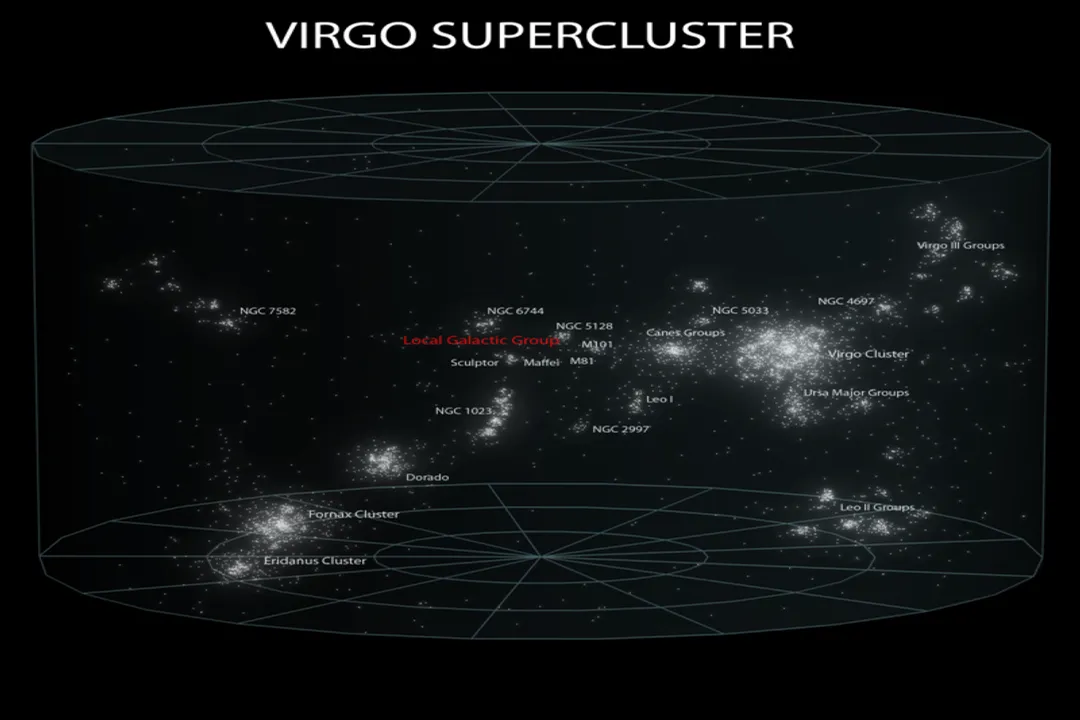
Our own galactic home, the Milky Way, belongs to the Local Group, which can be thought of as our immediate, gravitationally bound neighborhood. [4][6] This is a small collection of galaxies, unlike the giant associations found elsewhere in space. [4] Estimates suggest the Local Group contains about 54 galaxies in total, though this number is not absolutely fixed as many members are faint dwarf ellipticals or irregulars that are difficult to detect. [1][4]
The three largest residents dominate this local association. [6] Our Milky Way is the second largest, with the Andromeda Galaxy (M31) being the largest member. [4][6] The third significant galaxy is the Triangulum Galaxy (M33). [6] The remaining members are much smaller, comprised mostly of dwarf galaxies. [6]
In terms of sheer volume, the Local Group is compact. It spans a diameter of roughly 10 million light-years of space around us, [6] or perhaps an extent of almost 6 million light-years in total. [3] Crucially, the galaxies within this volume are gravitationally bound to one another, meaning the structure maintains its integrity against the general expansion of the universe. [1][4] The center of mass for the entire Local Group actually lies somewhere between our Milky Way and the Andromeda Galaxy. [4][6]
# Larger Aggregations
To properly contrast the Local Group with a supercluster, we must first acknowledge the intermediate step: the galaxy cluster. A galaxy cluster is a larger structure, often containing hundreds or even thousands of galaxies, making it much more massive than a typical galaxy group. [3][4] The Local Group is generally categorized as a poor cluster because it has fewer than a thousand members, whereas rich clusters can hold over a thousand galaxies and measure several megaparsecs (Mpc) across. [4] The nearest significant example to us is the Virgo Cluster, which is home to over 2,000 galaxies and sits near the center of our local supercluster. [8] The Virgo Cluster is located approximately 50 million light-years away from the Milky Way.
# Colossal Structures

If the Local Group is a small town, a supercluster is a sprawling, multi-city metropolitan area spanning hundreds of millions of light-years. [2] A supercluster is defined as a massive assembly composed of smaller galaxy clusters and galaxy groups. [2][4] These are among the largest structures recognized in the observable universe. [2][4]
The structure they form is far from neat; maps of the large-scale universe show superclusters creating a vast, "spongy" or "bubbly" architecture interwoven with enormous, empty regions known as voids. [4] Superclusters themselves arrange into elongated filaments, walls, or sheets. [2] Some estimates suggest these colossal formations can stretch between several hundred million light-years up to 10 billion light-years in length, covering more than 5% of the observable universe. [2]
We, within the Local Group, are part of a local supercluster historically known as the Virgo Supercluster, named for the dominant Virgo Cluster it contains. [8] The Virgo Supercluster is said to span about 110 million light-years in diameter and contains our Local Group along with at least 100 other groups and clusters. [6][8]
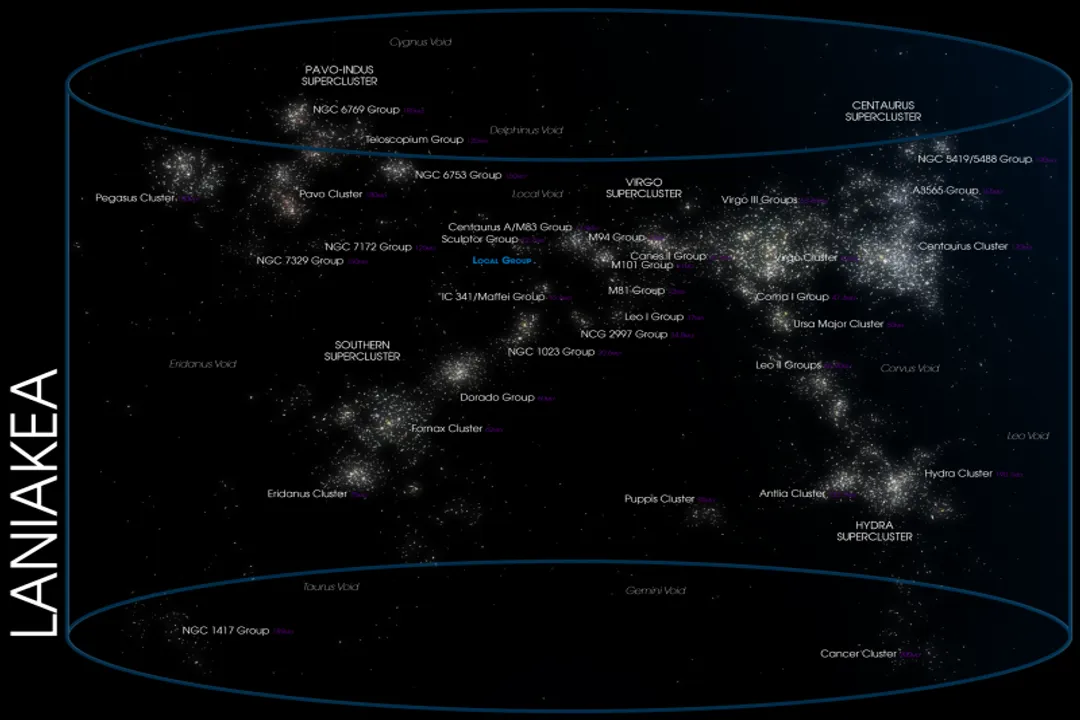
However, the boundaries and definitions in this ultra-large scale have evolved. Modern mapping of galactic motions has revealed that the Virgo Supercluster is merely a component, or a lobe, of an even more extensive structure called the Laniakea Supercluster. [2][6][8] Laniakea is described as stretching over some 500 million light-years and may contain around 100,000 galaxies. [6] The Milky Way, the Local Group, and the Virgo Cluster are all gravitationally flowing toward the center of this Laniakea structure. [2][6]
# Binding Versus Expansion
The primary physical difference between the Local Group and the supercluster it belongs to lies in their stability and their relationship with the Hubble expansion of the universe. [2]
The Local Group is a gravitationally bound system. [1][4] The mutual gravitational attraction between its member galaxies is strong enough to keep the entire group together, resisting the expansion of space on this relatively small scale. [4][8] We are, quite literally, tied to our immediate neighbors by gravity.
In striking contrast, most superclusters, due to their immense size and lower density, are not gravitationally bound structures. [2] They are better described as collections of clusters and groups that happen to be close to each other in the universe at the present moment. [8] This means that while the individual groups and clusters within a supercluster feel each other's pull, the structure as a whole tends to expand along with the universe’s ongoing accelerated expansion, much like raisins in bread dough that is rising. [2]
The historical designation of the Virgo/Local Supercluster as a single entity stemmed from earlier observations that suggested a rotating "supergalaxy". [8] Modern dynamic studies, however, which measure peculiar velocities—the motion beyond the general Hubble expansion—have shown that the structure is more of a vast arrangement caught in a larger gravitational current, such as the flow toward the Great Attractor, which centers the Laniakea Supercluster. [8] Therefore, while the Local Group is an island of self-gravitation, the supercluster is more like a current or flow within the cosmic structure. [8]
When we consider the masses involved, the difference in binding is telling. Even within a rich cluster like Virgo, the visible galaxies are just a fraction of the total mass. The structure must contain about ten times that mass in hot, X-ray-emitting gas, and another ten times that amount in dark matter to keep the fast-moving galaxies from flying apart. [4] This binding is clear on the cluster scale. When we scale up to the supercluster level, the sheer distances mean that the overall gravitational domination shifts away from internal binding forces and toward the large-scale flow dictated by the universe’s expansion. [8]
To put this scale difference into perspective, consider the measurements. If the diameter of the Local Group is about 10 million light-years, the Virgo Supercluster containing it spans around 110 million light-years. [6] That means the supercluster is roughly 11 times wider than our Local Group. [6] If we then look at the Laniakea Supercluster, which contains the Virgo Supercluster and spans about 500 million light-years, we see the progression continue—Laniakea is nearly five times wider than the Virgo Supercluster. [6] This escalating scale suggests that the structures we call "superclusters" represent the limit of what gravity can hold together locally before the expansion of space takes over as the dominant organizing force on the largest observable scales. [4]
# Cosmic Address
The cosmic address system provides a clear sequence illustrating the relationship between these two structures:
- Solar System Milky Way Galaxy [7]
- Milky Way Galaxy Local Group (a small, bound group) [7]
- Local Group Virgo Supercluster (the immediate, larger local structure, sometimes called the Local Supercluster) [6][8]
- Virgo Supercluster Laniakea Supercluster (the even grander structure defined by common gravitational flow) [2][7]
Thus, the Local Group is not just near the Virgo Supercluster; it is a confirmed constituent of it. [2] While the Local Group holds together due to its own internal gravitational budget, the Virgo Supercluster—and Laniakea beyond it—is better viewed as a region where galaxy groups and clusters are congregated and moving together in a general direction, a massive overdensity in the cosmic web. [8] The study of these motions, which requires carefully subtracting the overall effect of cosmic expansion (the Hubble flow) to isolate the peculiar velocities, is precisely what allowed astronomers to map the larger flows and define structures like Laniakea based on where everything is truly moving. [8]
The structures we observe at the supercluster level, like the vast filaments and walls, offer profound clues about the conditions of the early universe when these structures first coalesced from initial inhomogeneities. [2] While a galaxy group is defined by a tight, stable gravitational relationship, a supercluster is defined by being a large-scale feature in the cosmic distribution map, separated from other superclusters by the great voids. [4] The Local Group is a single, definable, gravitationally stable entity; the supercluster is the immense scaffolding upon which many such entities reside.
#Videos
Groups and Clusters of Galaxies - YouTube
Related Questions
#Citations
Learn about galaxy clusters, superclusters, and the Local Group
Supercluster - Wikipedia
Lecture 34: Clusters and Superclusters
I have a question about the classification of galactic structures. - Reddit
Groups and Clusters of Galaxies - YouTube
The Local Group is our galactic neighborhood - EarthSky
eSky: Galaxy Cluster - Glyph Web
All about the Virgo Supercluster - Astronomy Magazine