What is the center of the Local Group?
Our Galactic Home
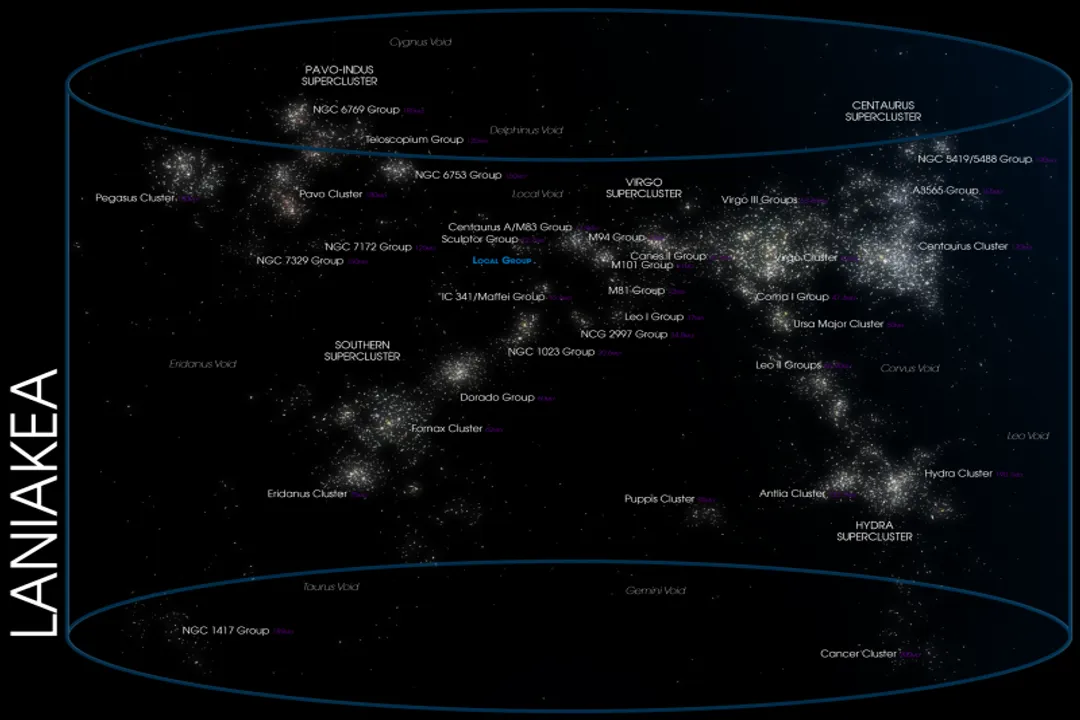
Every galaxy we observe in the night sky belongs to some larger structure, a cosmic hierarchy extending across the universe. Our own Milky Way is no exception; we reside within a collection of galaxies known as the Local Group. [4] This is our immediate galactic neighborhood, a collection held together by the mutual pull of gravity, vastly smaller in scale than the superclusters that surround it. While the universe teems with countless galaxies stretching billions of light-years away, the Local Group encompasses those relatively close to us, spanning a diameter of approximately $10$ million light-years, or about $3$ megaparsecs. [2]
The Local Group is not a simple, spherical collection of neighbors. Instead, it possesses a structure often described as "dumbbell-shaped," defined by two primary gravitational concentrations. [2][4] Our Milky Way galaxy and its entourage of smaller companions form one lobe of this structure, while the much larger Andromeda Galaxy (M31) and its own set of orbiting dwarfs form the other. [2]
# Major Players Defined
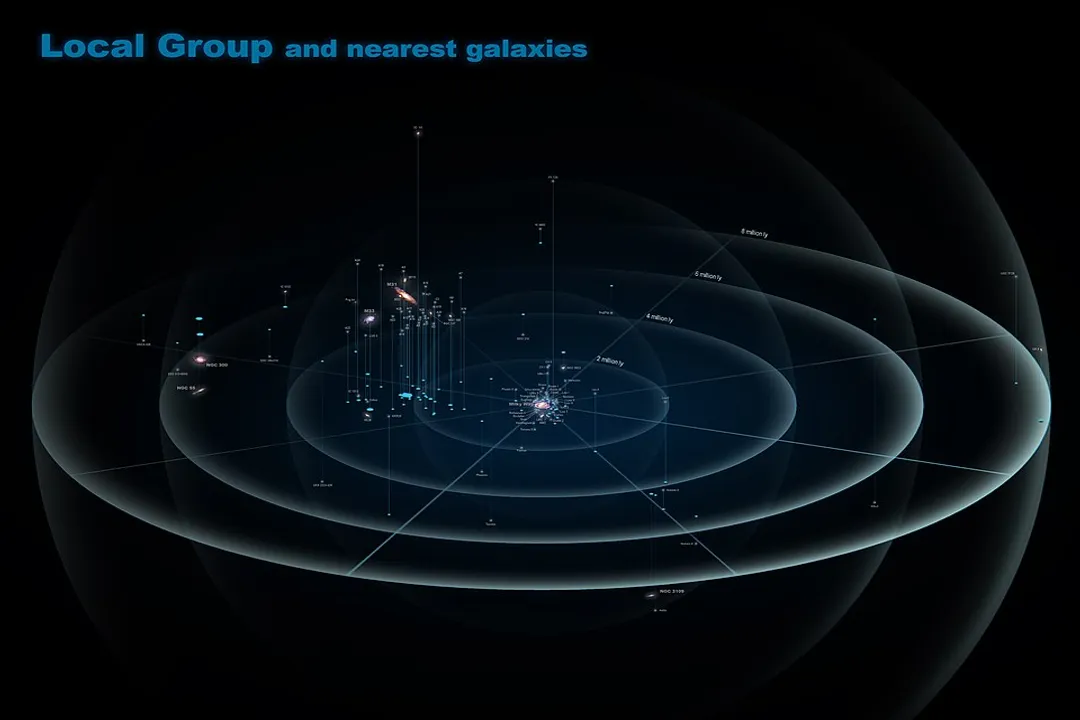
Within this group, only three galaxies qualify as major players—the giants that dictate the overall gravitational landscape. The largest and most massive galaxy is the Andromeda Galaxy (M31). Following closely in size and mass is our own Milky Way. [4] The third significant member is the Triangulum Galaxy (M33), which is a spiral galaxy, though considerably less massive than its two larger siblings, possessing a mass around . [4]
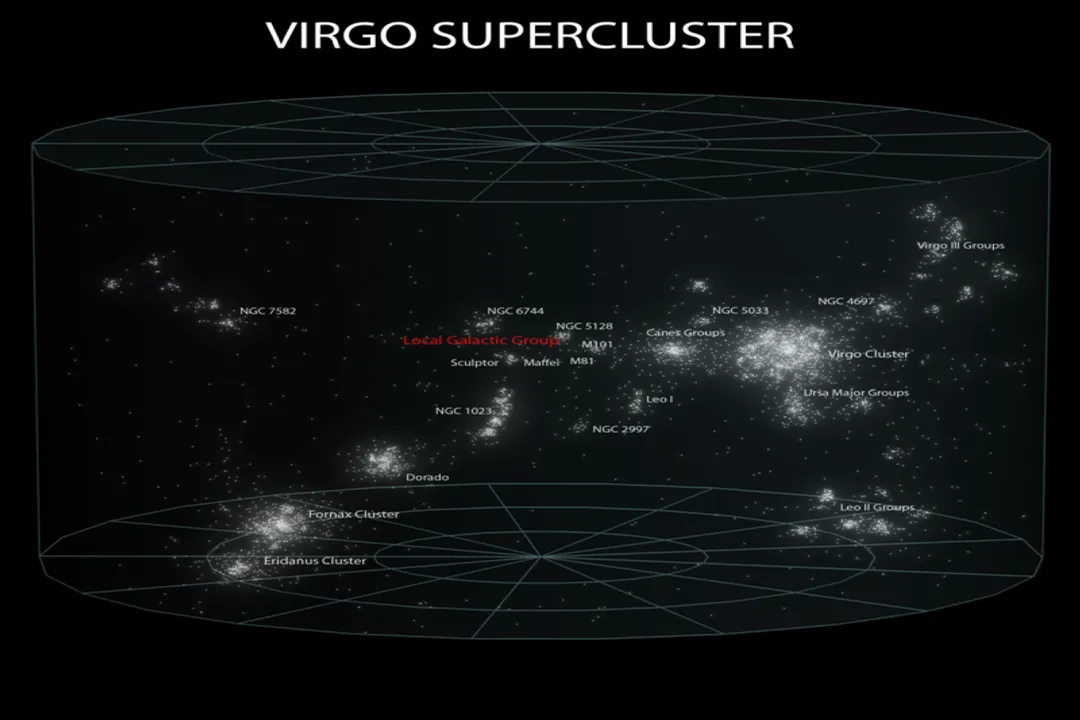
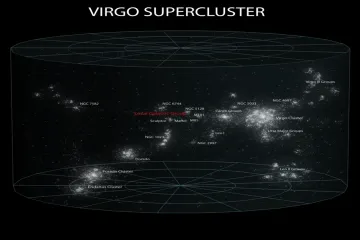
The remaining membership count is dominated by much smaller systems. While the exact inventory is fluid due to obscuration by dust within the Milky Way, astronomers have confirmed at least $120$ to $134$ members, the vast majority of which are dwarf galaxies. [2][4] These dwarfs—like the Large and Small Magellanic Clouds accompanying the Milky Way, or Messier 32 orbiting Andromeda—are bound by the immense gravity of the two spiral titans. [2] The entire Local Group, in turn, sits on the outskirts of the much larger Virgo Supercluster, which itself is a component of the even more extensive Laniakea Supercluster. [2]
# Center Concept
When considering a cluster of objects gravitationally bound together, like planets orbiting a star or moons orbiting a planet, the concept of a center of gravity is intuitive. However, what happens when the two largest components are comparable in mass? In the case of the Earth and the Moon, the center of mass, or barycenter, lies about from Earth's center, remaining within the body of the Earth. [5] But if the two orbiting bodies have similar masses, the barycenter shifts to a point located between them in open space, with both objects tracing paths around that empty spot. [5] The Pluto-Charon system is a classic astronomical example where the barycenter is outside Pluto itself. [5]
This dynamic helps explain the center of the Local Group. Since the Milky Way and Andromeda are both massive spiral galaxies, each estimated to have a mass around solar masses, [4] they are not simply orbiting a central, unseen object. Instead, they are orbiting their mutual center of mass. [5] This center is not a physical, tangible object, but rather a precisely calculated location where the combined gravitational pulls of all members balance out. [5]

# Barycenter Location
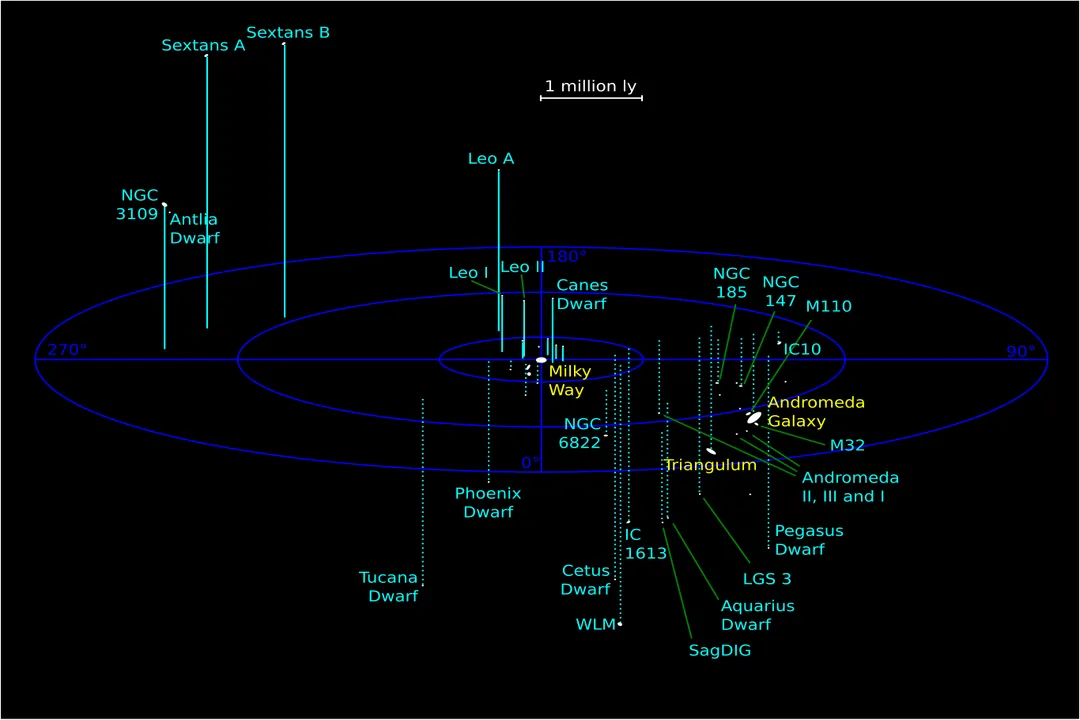
The crucial question then becomes: where exactly is this balancing point located? Astronomical observations place the gravitational center of the Local Group squarely in the vast expanse of space situated between the Milky Way and the Andromeda Galaxy. [4][5]
More specifically, measurements indicate the barycenter lies approximately () away from the center of the Milky Way. [4] Because the two galaxies are separated by about (), [4] this position means the barycenter is slightly closer to Andromeda, by roughly (). [4]
This slight offset is significant because it provides a measurable constraint on the relative gravitational dominance within the Local Group. If we accept the distances and the calculated barycenter location as accurate representations of the mass distribution, the center's position favors Andromeda as having a slightly larger total mass than the Milky Way. [4] While their visible stellar masses are almost equal, this offset strongly implies that Andromeda's dark matter halo—the unseen mass component that dominates galaxy gravity—is slightly more substantial than our own. [5] To put this into perspective, if one were to model the entire Local Group as a single, complex physical system, the gravitational influence from the Milky Way, Andromeda, and all their satellites would sum up to zero net force at that calculated point between them. [5]
# Orbital Dynamics
The two major galaxies, Andromeda and the Milky Way, are not static relative to this barycenter; they are actively moving. They are currently approaching one another at a relative velocity of about $110$ to . [2][4] This movement is the dance around the common center of mass. Over timescales spanning tens of billions of years, this gravitational attraction is expected to cause the two main spirals to merge, eventually forming a single, larger elliptical galaxy. [4]
Imagine the two main galaxies as anchors in space, with the barycenter acting as a fixed, albeit empty, reference point around which they swing. Any third body—like a dwarf galaxy—will have its trajectory influenced by the combined gravitational vectors of both M31 and the Milky Way, as if their masses were concentrated at that single balancing point. [5] The complexity arises because the Local Group is not a simple two-body problem; it is an -body problem, where is over 100, making the precise calculation of every galaxy's path extremely intricate, which is why the three-body problem itself cannot always be solved with a simple closed-form equation. [5]
The concept of the barycenter being in empty space can be difficult to internalize. A helpful analogy involves throwing two objects of equal mass, connected by a cord, while rotating them. They will orbit the knot at the cord's center, even though that spot is empty. [5] In the Local Group, gravity replaces the cord, providing the necessary inward pull to maintain the orbit around the common center of mass. [5]
# Group Boundaries
Understanding the center is intrinsically linked to understanding where the Local Group ends. As mentioned, gravity has an infinite range, meaning every galaxy exerts some minuscule pull on every other galaxy, even across vast distances. To define the Local Group as a bound structure, astronomers rely on concepts like the zero-velocity surface. [4] This theoretical boundary separates galaxies that are permanently falling toward the group's center from those that are receding due to the general expansion of the universe, or those that are truly independent entities. [4]
The fact that the barycenter is slightly skewed toward Andromeda—meaning the Milky Way is slightly further from the center than Andromeda is—suggests that the Milky Way is currently moving toward Andromeda because of this gravitational imbalance. [4] If the Milky Way were the most massive object, the barycenter would be pulled closer to us, and Andromeda would be the one crossing the divide. This measurable offset, even if small compared to the total mass, is a direct consequence of the mass difference between the two primary contributors to the Local Group's gravity. [4]
Considering the scale, the mass distribution, and the future merger, pinpointing the barycenter is more than an academic exercise; it is the single best empirical tool we have to compare the total gravitational masses of the Milky Way and Andromeda, including their dark matter components, simply by observing their current paths around the local gravitational core. [4]
Related Questions
#Citations
Local Group - Wikipedia
Question about the gravity centre of our local group : r/space - Reddit
Local Group | Space Wiki | Fandom
The Local Group is our galactic neighborhood - EarthSky
The Local Group - Pablo Carlos Budassi