Which group of constellations fall along the ecliptic?

The path the Sun appears to take across the celestial sphere throughout the year is central to how we map the sky and understand our immediate cosmic neighborhood. This imaginary line, known as the ecliptic, serves as the backbone for one of the most famous groupings of stars: the constellations of the Zodiac. [1][5] While the Sun itself moves along this track, it is the specific constellations that happen to lie directly in the Sun's projected path that form this unique celestial band, visible to observers on Earth. [2]
# Sun's Track
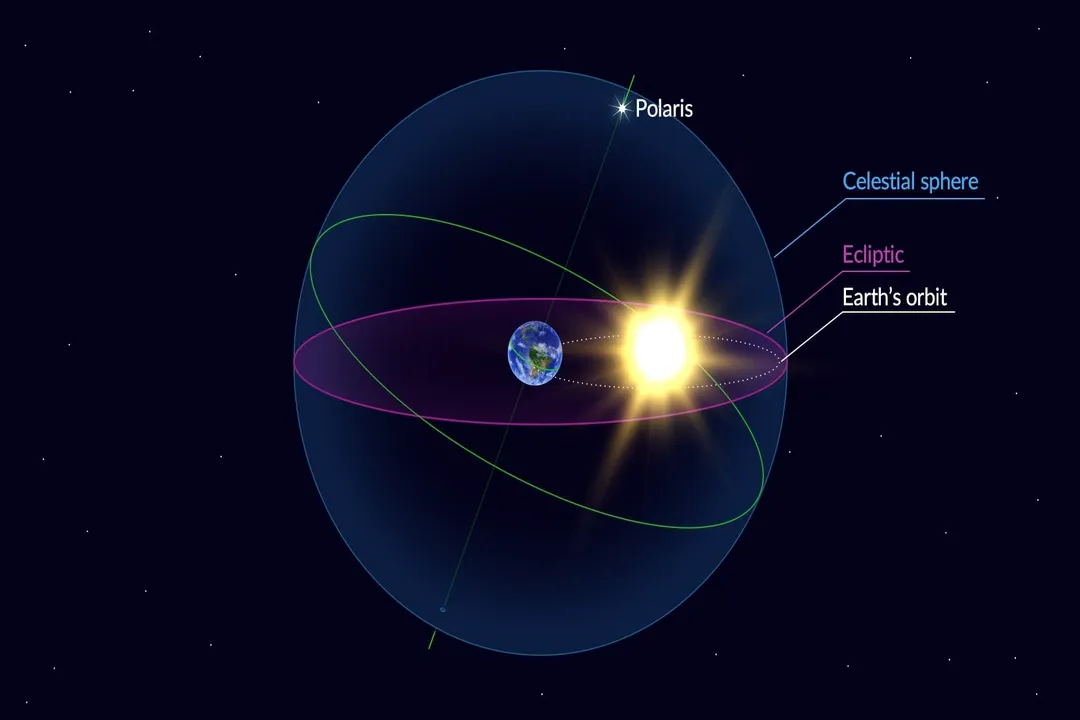
Fundamentally, the ecliptic is defined as the plane of Earth’s orbit around the Sun projected onto the sky. [1] It is not a fixed line of stars, but rather a projection that helps map celestial motions. [5] Because the Moon and all the major planets in our solar system orbit the Sun in roughly the same plane as the Earth, these bodies also appear to travel along or very close to the ecliptic line. [2][7] This makes the ecliptic an invaluable reference line for locating these solar system objects. [5] The apparent yearly motion of the Sun dictates where the constellations must lie to be considered part of this special group. [1]
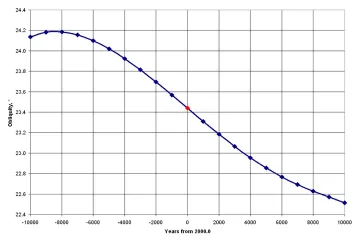
The ecliptic intersects the celestial sphere at two points, called the ecliptic longitudes of and , which correspond to the vernal (spring) and autumnal equinoxes, respectively, based on the Earth's axial tilt. [1] This tilt, approximately , is why we have seasons and why the Sun appears to travel north and south of the celestial equator throughout the year, crossing it twice annually. [1]
# Celestial Neighbors

The group of constellations that fall along this projection of our orbital path is known universally as the constellations of the Zodiac. [7][9] When ancient civilizations tracked the Sun, they named the constellations that the Sun entered during specific months of the year. [7] While there are eighty-eight constellations recognized today, the Zodiacal band contains a specific subset whose boundaries cross the ecliptic. [6]
These constellations serve as the backdrop against which the major actors of our solar system—the Sun, Moon, and planets—perform their yearly dance. [2] It is important to note that being a Zodiacal constellation means its boundary crosses the ecliptic, not necessarily that the brightest or most famous stars within it lie precisely on the line itself. [6]
The traditionally recognized group consists of twelve constellations: [9]
- Aries (The Ram)
- Taurus (The Bull)
- Gemini (The Twins)
- Cancer (The Crab)
- Leo (The Lion)
- Virgo (The Maiden)
- Libra (The Scales)
- Scorpius (The Scorpion)
- Sagittarius (The Archer)
- Capricornus (The Sea-Goat)
- Aquarius (The Water Bearer)
- Pisces (The Fish) [6][9]
This division into twelve relates directly back to the ancient practice of dividing the circle of the ecliptic into twelve segments, each corresponding to a traditional astrological sign. [9] This historical division forms the basis of many cultural understandings of the sky, even if modern astronomy provides a slightly different perspective on the actual star boundaries. [7]
# Comparison Zodiacal Skies
A fascinating point of divergence arises when comparing the astronomical constellations that the Sun passes through versus the astrological signs that define the traditional segments. [9] Due to a phenomenon called the precession of the equinoxes—a slow wobble in the Earth's rotational axis—the position of the celestial equator and the equinoxes shifts relative to the stars over millennia. [1]
This means that the Sun is not currently in the constellation corresponding to the sign it was named after thousands of years ago. [9] For instance, when the Sun is symbolically in the sign of Aries, it is astronomically located in the physical constellation of Pisces or sometimes Aquarius. [9] This shifting reality provides a critical distinction for observers: the constellations are the fixed patches of sky defined by modern boundaries, while the signs are fixed sectors defined by ancient tradition. [9]
Furthermore, while the classical grouping contains twelve, the physical path of the Sun does cross the boundaries of an additional constellation: Ophiuchus, the Serpent Bearer. [6] Ophiuchus lies between Scorpius and Sagittarius. [6] Astronomically, the Sun spends time within the borders of Ophiuchus, meaning that if we strictly followed the modern boundaries of constellations that intersect the ecliptic, there would be thirteen, not twelve. [6] This reality is often discussed in astronomical circles, contrasting the traditional list with the celestial map. [8] One observable consequence of this difference is that the Sun spends slightly longer in Virgo than it does in Leo, and it passes through the boundaries of Ophiuchus for about 18 days, compared to the approximately 7 to 30 days spent in the other twelve. [6]
# Observing Near the Line
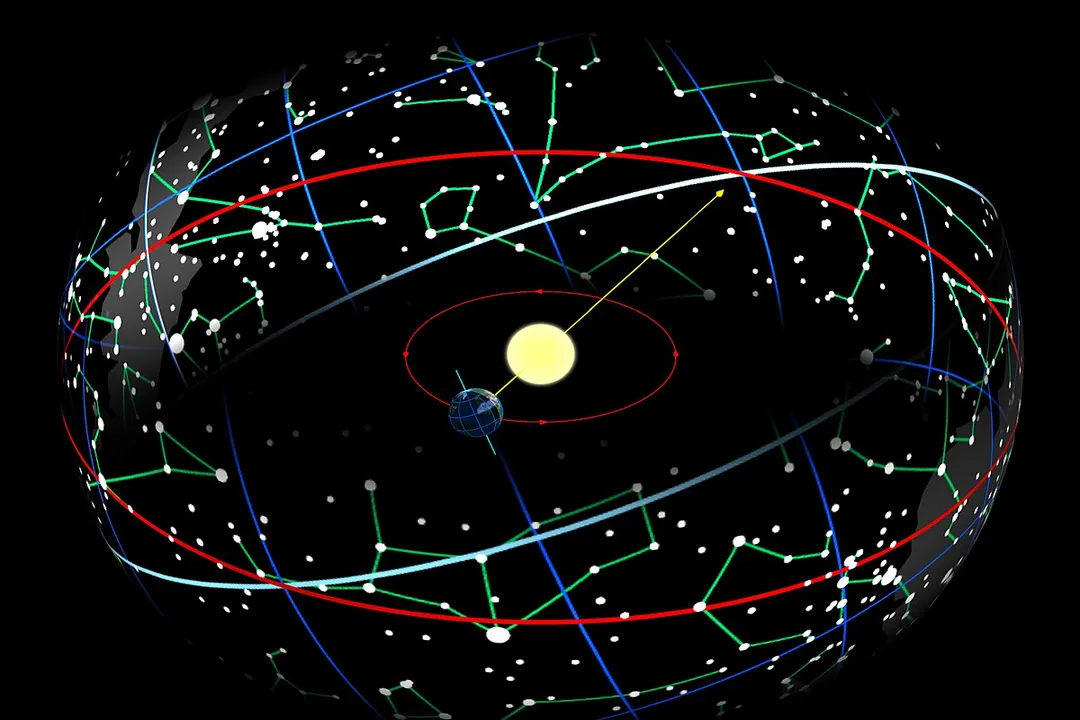
For a casual sky watcher, understanding the ecliptic is exceptionally practical. Since the Moon and all the naked-eye visible planets (Mercury, Venus, Mars, Jupiter, and Saturn) are always found near this imaginary line, observing them becomes a matter of looking along this specific path. [2][5] If you locate one of the Zodiac constellations—say, Taurus—you have instantly bracketed the region where you are most likely to find Jupiter or Saturn on any given night. [2]
Here is a helpful way to track the solar system's movement:
- Find the Moon: The Moon is the easiest of the wandering bodies to spot, and it serves as a superb marker, as it is always within about of the ecliptic. [2]
- Locate the Planets: Once you spot the Moon, look slightly above or below that line to find the slower-moving planets, remembering that Mercury and Venus stay very close to the Sun's apparent path. [2]
- Identify the Constellation: Once you see a planet near the Moon, check which of the twelve (or thirteen) Zodiac constellations forms the background. You have successfully identified a Zodiacal area of the sky. [7]
An insightful way to approach this is to visualize the ecliptic not as a fixed belt of stars, but as a cosmic highway marker. For instance, if you are trying to spot Mars during its rare retrograde motion, knowing it must be near the ecliptic instantly narrows your search area from the entire dome of the sky down to a relatively narrow band defined by the positions of the Zodiacal constellations. [3] Imagine that the entire solar system is moving on a flat, invisible plane—the ecliptic is the shadow of that plane on the celestial sphere. [1]

# Star Density and Visibility
While the Zodiacal constellations are defined by their intersection with the ecliptic, they are not uniformly dense with stars or equally prominent across the sky. [4] Some, like Leo and Sagittarius, contain very bright, easily recognizable asterisms or are located near the bright center of the Milky Way (as Sagittarius is). [4] Others, such as Cancer or Libra, are historically fainter and require darker skies for easy recognition. [6]
It is a common misconception that because they lie along the Sun’s path, these constellations are visible year-round. This is inaccurate. Just like any other constellation, they rise and set according to the Earth’s rotation, and they are only truly visible at night when the Sun is not in that region of the sky. [5] For example, during the summer months in the Northern Hemisphere, the Sun is passing through the Zodiacal constellations of Gemini, Cancer, and Leo; therefore, these areas are obscured by daylight and cannot be viewed as night sky objects until later in the year. [5]
When considering an annual observing plan, linking the seasons to the Zodiacal backdrop is key. The constellations visible in the winter sky are those the Earth has already passed on its orbit during the preceding months. For example, Orion, which is not a Zodiac constellation, is spectacularly visible in winter, precisely because the Sun is far away from it, passing through Capricornus and Aquarius during that time. [7]
# Precision in Naming
The very concept of defining a group based on the ecliptic highlights an early human attempt to organize the chaos of the night sky into predictable, usable charts. Early mapmakers, whether in ancient Babylon or later Greek astronomy, needed a stable reference point. [4] The Sun's predictable, annual circuit provided that anchor. [1]
We can observe a modern parallel in how we define celestial boundaries today. The International Astronomical Union (IAU) formally defined the boundaries of all 88 constellations in the early 20th century, ensuring that every square degree of the sky belongs to exactly one official constellation. [4] This means the Zodiacal constellations are defined by these modern, mathematically precise borders crossing the ecliptic line, which sometimes results in unexpected inclusions or exclusions compared to older, more artistic drawings. [6] This move toward official demarcation provides the certainty that observers today can check star charts and know precisely when a planet has officially moved from, say, the boundary of Aries into the boundary of Pisces. [9]
Ultimately, the group of constellations falling along the ecliptic—the Zodiac—is more than just a list of names. It is the celestial map key for locating every major object in our solar system as we observe it from our planet, anchoring the Sun's yearly journey against the distant, fixed background stars. [2][5]
#Videos
The Ecliptic: Crash Course Kids #37.2 - YouTube
Related Questions
#Citations
Ecliptic - Wikipedia
How the Ecliptic and the Zodiac Work - Space
The Ecliptic: Crash Course Kids #37.2 - YouTube
Sky Tellers - Constellations - Lunar and Planetary Institute
What Is the Ecliptic: The Sun's Path In the Sky - Star Walk
What are the Zodiac constellations and what makes them special?
AstroPages | Zodiac | Western Washington University
Constellations that lie along the ecliptic are known as zodiac ...