What is the meaning of the word "ecliptic"?
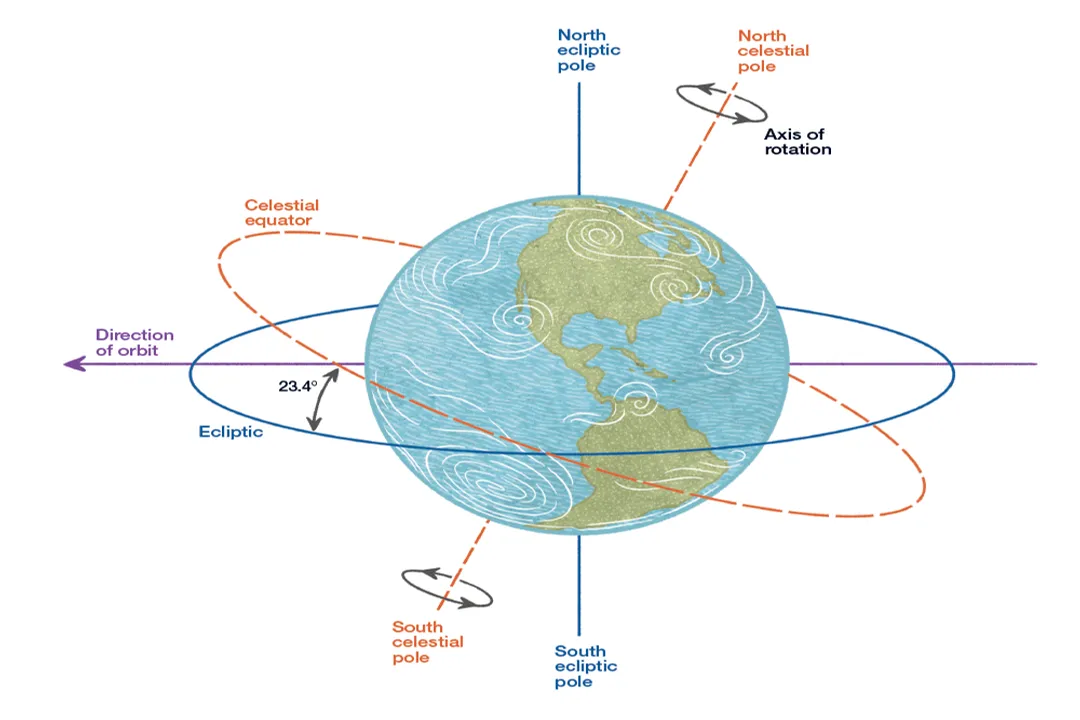
The term ecliptic immediately conjures images of the heavens, though its meaning is rooted in a very specific geometric concept describing the motion of our home planet. At its most fundamental level in astronomy, the ecliptic refers to the apparent path that the Sun traces across the celestial sphere over the course of one year. [2][4][8] It is not the Sun actually moving in a circle around us, but rather this appearance results from the Earth completing its orbit around the Sun. [2][8] This plane, defined by Earth’s orbital path, is a crucial reference line in celestial navigation and mapping. [2]
# Path Apparent
When we observe the sky throughout the year, the constellations the Sun appears to pass through—those forming the familiar band of the Zodiac—all lie very close to this imaginary line we call the ecliptic. [2][8] The Sun rises and sets along lines that are constantly shifting relative to the fixed stars because the Earth is revolving around it, making the ecliptic the central reference for marking the Sun’s yearly progression. [4] If one were to map the Sun’s position against the background stars day by day, the resulting line of travel would be the ecliptic. [4]
The word itself carries a historical echo of its most significant consequence. As an adjective, ecliptic can mean relating to or resembling an eclipse, [1] or more commonly, pertaining to the plane of the Earth’s orbit. [3] The origin of the word ties directly back to Greek, stemming from ecliptikos, which signifies "of the eclipse". [7] This connection is not coincidental; it is the key to understanding why this path was named this way.
# Etymological Roots
The naming convention originates from the fact that both solar and lunar eclipses can only occur when the Moon crosses the ecliptic plane. [2] Specifically, an eclipse happens when the Sun, Earth, and Moon align along this plane or very near it. [5] If the Moon’s orbit were perfectly aligned with the Earth’s orbital plane—the ecliptic—we would experience a solar eclipse every new moon and a lunar eclipse every full moon. [2] Since eclipses are relatively rare events, the path defining when they can happen naturally became known by the name signifying that potential for obscuration. [7]
# Geometric Definition
In a more generalized, mathematical sense, the ecliptic is a plane. [5] Geometrically, it is defined as the plane that contains the center of a sphere and the center of a circle drawn upon its surface. [6] In the context of our solar system, it is precisely the plane in which the Earth orbits the Sun. [2][8] Therefore, when astronomers talk about celestial coordinates or mapping the solar system, the ecliptic plane serves as the fundamental reference plane, much like the Earth’s equator serves as the reference for latitude and longitude on our world. [5]
The ecliptic is considered a great circle on the celestial sphere. [5] This means it divides the celestial sphere into two equal hemispheres, analogous to how the Earth's equator divides our planet into Northern and Southern hemispheres.
To better appreciate the relationship between our planet and this celestial reference, it is helpful to look at how it compares to other major features of the sky:
| Reference Plane | Defining Element | Relationship to Ecliptic | Significance |
|---|---|---|---|
| Ecliptic | Earth's orbital plane around the Sun | Baseline reference | Defines the Sun's apparent yearly path |
| Celestial Equator | Projection of Earth's equator into space | Intersects the Ecliptic at the Equinoxes | Defines celestial latitude and longitude |
| Lunar Orbit Plane | Moon's orbital plane around Earth | Intersects the Ecliptic at about | Determines eclipse geometry |
# Celestial Tilt
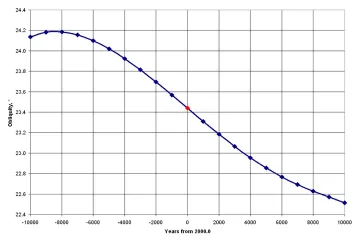
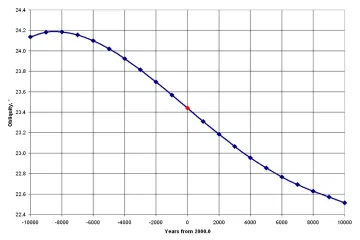
One of the most profound astronomical consequences of the ecliptic is its angular relationship with the Earth's equator. The Earth spins on an axis, but this axis is not perpendicular to the plane of the Earth's orbit around the Sun. [2] Instead, the Earth's axis of rotation is tilted relative to the ecliptic plane by an angle that currently measures approximately . [2][8] This angle is technically known as the obliquity of the ecliptic. [5]
This persistent tilt is the direct cause of our planet’s seasons. [2] Because the Earth maintains this angle as it revolves around the Sun, different hemispheres are tilted more directly toward the Sun at different times of the year. [8] When the Northern Hemisphere is tilted toward the Sun, we experience summer, and the Sun’s path across the sky is highest; six months later, when it is tilted away, we experience winter, and the Sun’s path is lower. [2]
The points where the Sun crosses the celestial equator are incredibly important markers in our calendar and astronomical tracking. These intersection points between the ecliptic and the celestial equator are called the equinoxes. [2][5] These occur twice a year: the Vernal (Spring) Equinox around March 20th and the Autumnal (Fall) Equinox around September 22nd. [5] At the moment of an equinox, day and night are of nearly equal length everywhere on Earth because the terminator (the line dividing day and night) passes directly through both geographic poles. [5]
# Solstices and Sky Paths
The farthest points the Sun reaches north or south of the celestial equator mark the solstices, which are away from the equinoxes along the ecliptic. [5] In the Northern Hemisphere, the Summer Solstice (around June 21st) is when the Sun reaches its northernmost point, and the Winter Solstice (around December 21st) is when it reaches its southernmost point. [2]
Think about observing the noon sun throughout the year. If you were standing at a latitude where the Sun passes directly overhead (the Tropic of Cancer or Capricorn), you would notice that the Sun is never directly overhead at noon anywhere else on Earth, except for those two specific latitudes on those specific days. The maximum angle north or south the Sun ever reaches from the celestial equator is precisely equal to the tilt of the Earth's axis—that obliquity. [5] This tilt is fundamental to determining local noon shadow lengths. For instance, if you chart the shadow cast by a vertical stick at noon on the Summer Solstice versus the Winter Solstice in a location like London or New York, the difference in shadow length is a direct, measurable manifestation of the angle between the celestial equator and the ecliptic. [8] This measurable angular separation provides a tangible, local way to appreciate a concept that otherwise seems purely abstract and cosmic.
# Motion and Reference Frames
The ecliptic plane establishes a coordinate system that helps map celestial objects. Just as we use latitude and longitude on Earth, astronomers use ecliptic coordinates (ecliptic longitude and latitude) to specify positions in the sky relative to the ecliptic plane. [2] Ecliptic longitude measures the angular distance along the ecliptic from the Vernal Equinox, while ecliptic latitude measures how far an object is north or south of the ecliptic itself. [2]
Since the Earth is orbiting in this plane, the ecliptic plane is the natural "zero" latitude reference for the solar system. Most of the major planets orbit the Sun in paths that lie very close to the ecliptic plane, though they are not perfectly aligned. [2] This contrasts with the Moon, whose orbit is inclined relative to the ecliptic by about . [2] This slight misalignment is critical for understanding why eclipses are not monthly occurrences. If the inclination were zero, every orbit would result in an eclipse. Because the inclination is small but present, the Moon’s shadow sometimes misses the Earth (solar eclipse) or the Earth’s shadow misses the Moon (lunar eclipse). [2] The intersections of these two planes—the Earth's orbital plane (the ecliptic) and the Moon's orbital plane—are known as the nodes, and these are the only places where an eclipse is possible. [5]
# Eclipses and Plane Intersections
The relationship to eclipses is what gave the ecliptic its name, so it deserves deeper consideration. An eclipse happens when three celestial bodies align in a straight line. [5]
- Solar Eclipse: The Moon passes between the Sun and Earth, blocking the Sun's light. This requires the Moon to be at or very near a node during the New Moon phase. [2]
- Lunar Eclipse: The Earth passes between the Sun and Moon, casting a shadow on the Moon. This requires the Moon to be at or very near a node during the Full Moon phase. [2]
Imagine the ecliptic as a massive, fixed hula-hoop that the Earth is perpetually traveling around. The Moon's orbit is like a second, slightly tilted hula-hoop threading through the first one. An eclipse only occurs when the Moon is passing through the intersection points (the nodes) of the two hoops precisely when the Sun is also in the right spot relative to those points. [5]
The apparent path of the Sun—the ecliptic—is therefore not just a feature of Earth's yearly motion; it is the geometric stage upon which the drama of solar system alignments, leading to eclipses, must be set. [7]
# General Usage and Other Contexts
While predominantly astronomical, the term finds its way into other descriptive fields, often retaining a sense of a primary path or defining circle. For example, in the field of Geographic Information Systems (GIS), the term can be used more generally. There, the ecliptic might refer to the plane containing the center of a sphere and the center of a circle drawn on its surface, often used when modeling planetary orbits or other circular paths in space. [6] This definition shows how the core geometric concept—a defining plane of revolution—is abstracted from the specific Earth-Sun system. [6]
Furthermore, when used as a simple adjective, ecliptic simply describes anything related to or resembling an eclipse. [1][3] If one were describing a very sudden, dramatic change in a system's state, one might metaphorically say the event was "ecliptic" in nature, implying a sudden obscuring or overriding force, although this usage is far less common than the astronomical definition. [1][3]
Understanding the ecliptic provides a clearer picture of how we measure time and map the sky. It is the fundamental circle against which we measure the ever-changing position of the Sun relative to the background stars, thereby defining our celestial coordinate system and the very rhythm of the seasons. [2][5] It is the fixed plane that our dynamic world orbits within, a silent, invisible line that dictates the length of our days and the timing of celestial shadow play. [4][8] Recognizing the ecliptic as the plane of Earth's orbit, rather than just the Sun's path, anchors our understanding of astronomy back to the mechanics of our own solar system. [2]
#Videos
The Ecliptic: Crash Course Kids #37.2 - YouTube
Related Questions
#Citations
ECLIPTIC Definition & Meaning - Merriam-Webster
What Is the Ecliptic? - Sky & Telescope
The Ecliptic: Crash Course Kids #37.2 - YouTube
Ecliptic - Definition, Meaning & Synonyms - Vocabulary.com
Ecliptic | Definition, Facts, Obliquity, & Zodiac - Britannica
Ecliptic Definition | GIS Dictionary - Esri Support
Ecliptic - Etymology, Origin & Meaning
The ecliptic is the path of the sun - EarthSky
ECLIPTIC Definition & Meaning - Dictionary.com