What does it mean to clear an orbit of debris?

The concept of "clearing an orbit of debris" sounds straightforward—like sweeping up litter in a park—but in the realm of space, it represents one of the most complex technical, legal, and logistical challenges humanity faces in maintaining access to space. [5] It doesn't merely mean removing the handful of large, defunct satellites we can easily track; rather, it requires systematically addressing millions of hazardous objects ranging from spent rocket bodies to tiny paint chips, all moving at orbital velocities where even a small particle carries destructive kinetic energy. [8][5]
# Defining Objects
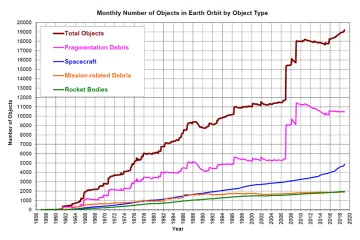
Space debris, or orbital debris, encompasses any human-made material orbiting Earth that no longer serves a useful function. [8] This population is incredibly diverse. It includes objects larger than 10 centimeters, which are generally tracked by ground-based radar systems, and objects between 1 cm and 10 cm, which pose significant risk but are difficult to catalog reliably. [5] Even smaller fragments, less than 1 cm, number in the hundreds of millions and can degrade spacecraft surfaces over time. [8] When we talk about "clearing an orbit," the immediate priority is usually tackling the larger, trackable items that have the potential to cause catastrophic fragmentation events upon impact. [5]
# Orbital Danger
The necessity for cleanup stems from the increasing risk of collisions, which threaten the operational viability of current and future space missions. [5] The major concern driving the push for active debris removal (ADR) is the Kessler Syndrome. [8] This theoretical scenario posits that if the density of objects in Low Earth Orbit (LEO) becomes high enough, a collision between two objects could generate enough new debris to cause further collisions, leading to a runaway chain reaction that could render certain orbital altitudes unusable for generations. [8] Clearing debris, therefore, is an act of space traffic management designed to actively lower the orbital density below the threshold where such a cascade becomes inevitable. [1][5]

# Active Removal
To truly clear an orbit, operators must employ active removal methods rather than relying solely on mitigation strategies, which focus on preventing new debris from being created by designing satellites to deorbit safely after their mission ends. [1] Active debris removal involves engineering dedicated spacecraft whose sole purpose is to intercept and remove existing derelict objects. [4]
These removal techniques fall into several broad categories, each with unique advantages and associated risks:
- Contact Methods: These involve physically interacting with the target object. Proposals include using robotic arms to grapple the target, [10] firing nets to ensnare smaller objects, [4] or using harpoons to secure a towing cable. [1] The challenge here is ensuring the capture mechanism works perfectly on an object tumbling unpredictably, often without any standardized grapple points. [4]
- Non-Contact Methods: These aim to alter the debris’s trajectory without touching it. Ideas such as using high-powered lasers to ablate (vaporize) a small portion of the object's surface to create a tiny thrust, nudging it into a lower orbit, are being studied. [4] Another concept involves using an ion beam shepherd, which fires an ion beam at the debris to impart a gentle push. [10] While potentially safer as they avoid close-proximity contact, these methods are generally less effective for very large objects and require significant power. [4]
The overall objective of any ADR mission is deorbiting the captured object—that is, imparting enough energy to send it down into the Earth's atmosphere where it will burn up harmlessly, or moving it into a graveyard orbit far above operational altitudes. [1]
# Defining Cleared Space
The very definition of "clearing an orbit" is open to interpretation and depends heavily on the required level of assurance. If an orbit is considered "clear," does it mean there are zero objects remaining, or that the collision probability has returned to pre-1970s levels?. [5]
A crucial distinction arises when considering the sheer mass of material that needs addressing. In certain densely used LEO bands, hundreds of trackable objects might need removal to stabilize the environment. [5] However, the untrackable, smaller fragments—which are numerous enough to cause significant damage—still remain a pervasive threat even after the large objects are gone. [8] A practical cleanup mission, therefore, often focuses on removing the objects posing the highest risk of creating a cascade, knowing that a complete sterilization of the orbital band is likely infeasible with current technology and budget constraints. [4]
An operational insight here is that the target state must be defined economically. If the cost to remove the final 10% of hazardous debris (which might be moving slowly or be extremely difficult to reach) exceeds the cost of building a fully shielded, fully redundant constellation that can survive the remaining 10% of predicted debris impacts, operators might declare the orbit "functionally clear" despite residual junk. [1] This calculation shifts the problem from pure engineering to policy and insurance risk assessment.
# Technical Hurdles
Removing objects is fundamentally difficult because they are moving incredibly fast—around 7.8 kilometers per second in LEO. [6] Changing the velocity () of even a kilogram-sized object requires a significant expenditure of energy for the removal vehicle. [6] Furthermore, the target debris is uncooperative; it is not designed to be captured, often tumbles chaotically, and might be structurally unsound following previous collisions or explosions. [4]
This dynamic complexity mandates that the removal spacecraft must possess advanced autonomy, robust navigation systems, and the ability to precisely match the target’s trajectory before attempting contact. [10] These requirements make ADR missions inherently high-risk and extremely expensive compared to routine satellite launches. [4]
# Legal Status
Beyond the physics, the legal landscape presents significant obstacles to orbital clearing. In international space law, objects placed in orbit, even if they fail or become defunct, are generally considered the property of the launching state or the state that owned the launch vehicle. [1] This means an ADR mission requires explicit permission from the object’s original owner to approach, attach to, and deorbit it. [1] Getting multinational agreement on who pays for the cleanup, and who gets liability if the removal attempt inadvertently creates more debris, adds layers of political complexity that can slow down deployment even when the technology is ready. [1]
# Maintaining Cleanliness
Clearing an orbit is not a one-time achievement; it is better conceptualized as establishing an ongoing maintenance service. If a major cleanup operation successfully removes a high-risk population of derelict satellites, but no new regulatory or technical enforcement mechanisms are put in place, the environment will eventually degrade back to its original dangerous state due to ongoing collisions or mission failures. [5] Sustainable space access demands a dual approach: diligently cleaning up the historical backlog of debris while simultaneously ensuring that every new object launched carries an integrated, guaranteed plan for its timely removal or controlled destruction at the end of its service life. [1] This continuous upkeep—a sort of celestial sanitation department—is the true meaning of maintaining a clear, usable orbital environment for the long term. [5]
#Videos
Clearing Space Debris - YouTube
Related Questions
#Citations
ESA - Active debris removal - European Space Agency
Space Debris 101 | The Aerospace Corporation
Need help understanding the "cleared orbital neighborhood ... - Reddit
How Can We Clean up Space Debris | astrobites
Orbital Debris - Sma.nasa.gov.
Clearing Space Debris - YouTube
Mea culpa: Planet definitions and Earth clearing its orbit
Space debris - Wikipedia
How do they remove space junk and debris from Earth's orbit?
REMOVAL of SPACE DEBRIS | CRD2 | JAXA