What do stellar cycles mean?
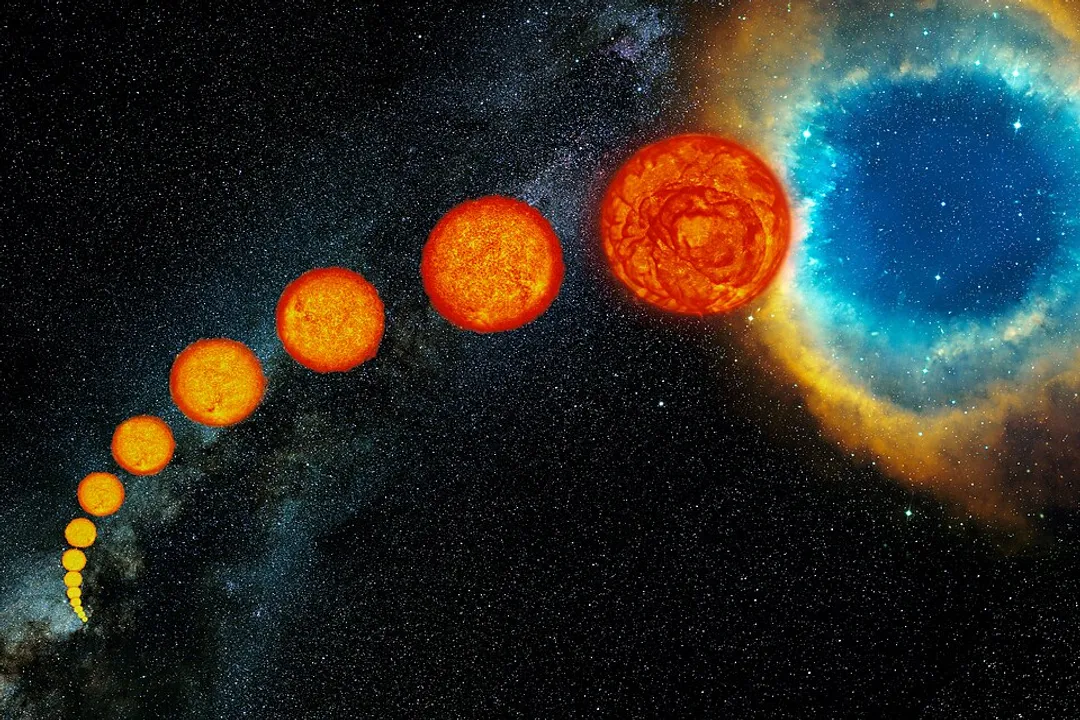
The progression of a star through its lifespan, often referred to as its stellar cycle or evolutionary path, describes the series of physical changes an astronomical body undergoes from its formation out of interstellar matter to its final state, whether that be a faint stellar remnant or a massive black hole. [1][5] This process is not a repeating loop in the traditional sense, but rather a unidirectional transformation dictated by the star's initial mass and its ongoing internal physics, primarily nuclear fusion and gravity. [1]
# Star Formation
A star’s existence begins within vast, cold regions of space known as molecular clouds or nebulae, which are composed mainly of hydrogen and helium gas, along with trace amounts of heavier elements. [1][8] The trigger for the star-making process is typically the gravitational collapse of denser regions within these clouds. [1][5] As a segment of the cloud begins to contract under its own gravity, the material heats up, forming a dense core called a protostar. [5][8]
The protostar stage continues until the core temperature and pressure become high enough to ignite sustained nuclear fusion reactions. [1][8] For our Sun, this critical point, where the inward pull of gravity is finally balanced by the outward pressure from fusion, marks the true beginning of its active life. [5] Before this ignition, the object is simply condensing, drawing energy from gravitational contraction, a phase that can take millions of years depending on the mass of the developing star. [1]
# Main Sequence
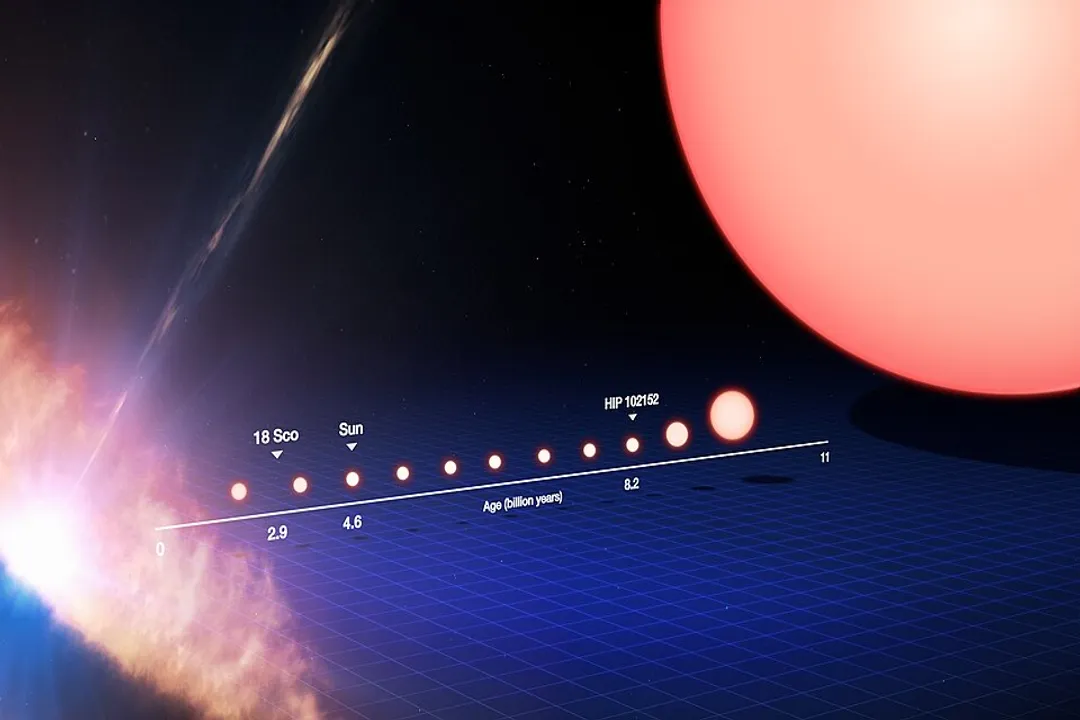
Once fusion begins, the star enters the main sequence, which represents the longest and most stable phase of its existence. [1][5] During this period, the star consistently fuses hydrogen into helium in its core. [1][5][8] The luminosity, temperature, and size of the star remain relatively constant throughout this stage. [1] The duration of the main sequence is intimately linked to the star's initial mass: more massive stars are significantly hotter and burn through their nuclear fuel at a vastly accelerated rate compared to smaller stars. [1][5]
Considering the sheer scale of these lifespans, it is instructive to compare the expected duration of different stellar classes. A star with the mass of our Sun is projected to spend about on the main sequence. [5] In contrast, stars that are far less massive, sometimes called red dwarfs, burn their fuel so slowly that their main sequence lifetimes can extend for trillions of years, far exceeding the current age of the universe itself. [1] This leads to an observation that nearly all the red dwarfs that have ever formed are still burning hydrogen today, a stark difference when contrasted with the relatively fleeting existence of giant stars. [1]
# Stellar Death
When the hydrogen fuel in the core is largely exhausted, the star's internal equilibrium is broken, and it begins its final evolutionary transitions, which diverge sharply based on initial mass. [1][5]
# Low Mass Stars
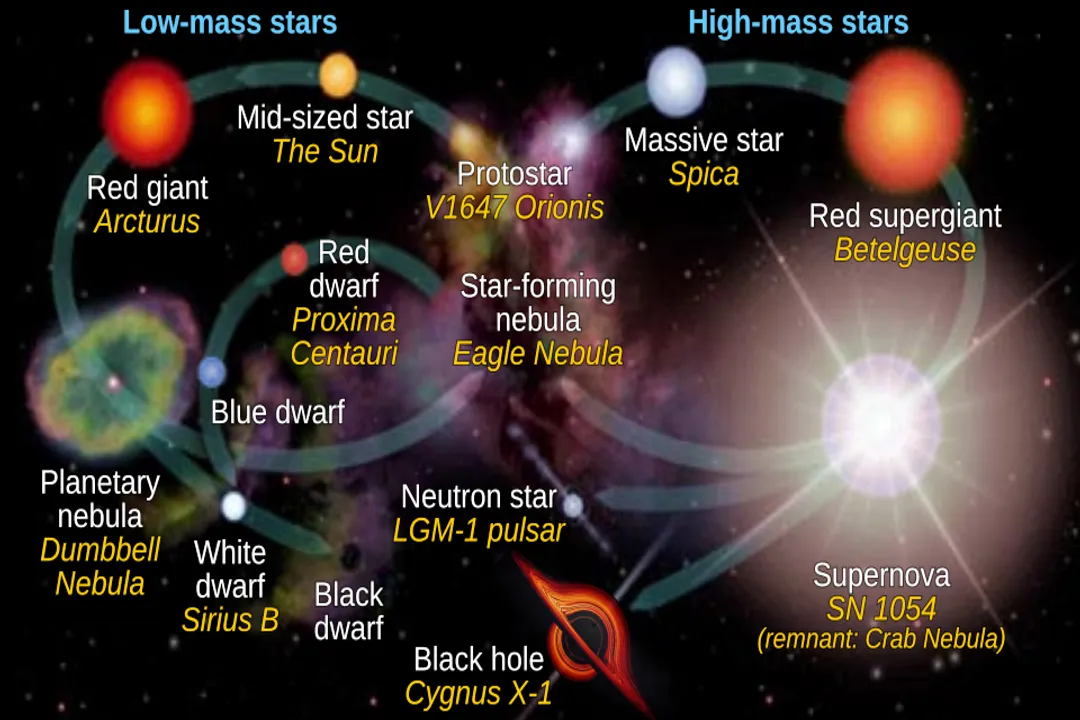
Stars similar to the Sun will expand dramatically as they begin fusing the remaining hydrogen in a shell surrounding the inert helium core. [5] This expansion turns the star into a red giant. [5][8] As the core continues to contract and heat up, eventually helium fusion into carbon can ignite. [1] After this phase concludes, the outer layers of the star are gently expelled into space, forming a beautiful, expanding shell of gas known as a planetary nebula. [1][5][8] What remains at the center is the hot, dense, carbon-oxygen core, now a white dwarf. [5] Over immense timescales, this white dwarf will cool and fade into a theoretical black dwarf. [1]
# High Mass Stars
Stars significantly more massive than the Sun (greater than about ) experience a far more dramatic end. [1][5] After exhausting core hydrogen, they evolve rapidly, fusing progressively heavier elements in nested shells—carbon, neon, oxygen, silicon—until an inert iron core forms. [1][5] Iron fusion consumes energy rather than releasing it, causing the core to collapse catastrophically in less than a second. [1][5]
This rapid collapse rebounds violently, generating a tremendous explosion known as a Type II supernova. [1][5][8] The energy released during this single event can briefly outshine an entire galaxy. [8] The remnant left behind depends on the mass of the remaining core. If the remnant is between roughly and solar masses, gravity compresses it into an incredibly dense object composed almost entirely of neutrons, known as a neutron star. [1] If the residual core mass exceeds about solar masses, the collapse cannot be halted by neutron degeneracy pressure, and it continues indefinitely, forming a black hole—a region of spacetime where gravity is so strong that nothing, not even light, can escape. [1][5]
# Cycles Terminology
While astronomical stellar evolution describes a linear path dictated by physics, the term "cycle" itself can carry different connotations depending on context, which is something to keep in mind when discussing celestial mechanics or even fictional timelines. [3][6] In astronomy, the life cycle is a sequence; in other domains, a cycle implies periodicity or repetition. [4] For instance, one might discuss the magnetic cycles of our Sun, which involve changes in its magnetic field and corresponding activity like sunspots over an approximately 11-year period. [1] This solar magnetic cycle is a recurring pattern of activity superimposed upon the star's overall billion-year life cycle. [1] The distinction is crucial: the star is not reborn as the same star after an 11-year solar cycle, but its surface activity rhythmically waxes and wanes within its stable main-sequence phase. [1]
If we look at the data describing the physics driving stellar change, we can see how mass sets the entire schedule. For example, considering the relationship between mass and lifetime, we can establish a simple heuristic: if a star is twice as massive as the Sun, it burns through its fuel approximately to $2^3$ times faster, leading to a lifetime much shorter than , whereas a star half the Sun's mass might last . [1][5] This non-linear relationship means that the initial conditions—the star's birth mass—are the single most important factor determining when it undergoes its various evolutionary phases and how it will eventually end. [1] This sensitivity to initial mass dictates the entire stellar cycle from cradle to grave.
The study of these long-term evolutionary paths provides deep insight into the universe itself. The end products—the heavy elements forged in the cores of massive stars and scattered by supernovae—become the raw materials for the next generation of stars, planets, and, ultimately, life. Thus, while an individual star’s life is a one-way trip, the process viewed across cosmic time is inherently cyclical, constantly recycling matter and driving chemical enrichment across the cosmos. [1][8]
We can map the general steps using a table to compare the two primary evolutionary paths for clarity, emphasizing that the divergence point rests entirely on the initial mass boundary, often approximated around ():
| Evolutionary Phase | Low-to-Intermediate Mass Stars () | High Mass Stars () |
|---|---|---|
| Main Sequence Fuel | Hydrogen to Helium | Hydrogen to Helium (and beyond) |
| Post-Main Sequence | Red Giant | Red Supergiant |
| Final Stage Core | White Dwarf | Neutron Star or Black Hole |
| Final Event | Planetary Nebula Ejection | Type II Supernova Explosion |
It’s interesting to note that even the method of energy generation changes fundamentally. In lower-mass stars, the core fusion slows down and eventually stops as the star runs out of core hydrogen, leading to a gradual cooling of the remnant. [5] In massive stars, however, the process accelerates through heavier and heavier elements, creating an unstable onion-like structure that rushes toward its inevitable iron catastrophe. [1] The internal physics governing the "cycle" transitions from a slow, steady burn to a rapid, dramatic implosion.
To truly appreciate the scale of these stellar cycles, one must consider how our understanding has evolved. Early models were based primarily on theoretical physics and observation of stars currently in their main sequence phase. [7] Modern astrophysics, however, uses computational models that track the thermodynamic and structural changes throughout the entire lifespan, including exotic physics relevant to the later stages like core collapse or the behavior of matter in degenerate states. [7] These advanced models allow astronomers to trace a star's path on the Hertzsprung-Russell (H-R) diagram across millions or billions of years, confirming that the "cycle" is a predictable, physics-governed trajectory rather than a random series of events. [1][7]
Related Questions
#Citations
Stellar evolution - Wikipedia
Stellar Evolution - | The Schools' Observatory
Units of time/Continuity | Teletraan I: The Transformers Wiki | Fandom
Cycles : r/transformers - Reddit
Life Cycle of Stars - BYJU'S
Units of time - Transformers Wiki
Stellar Cycles in Fully Convective Stars and a New Interpretation of ...
The Life Cycles of Stars: How Supernovae Are Formed
Stellar Life Cycles | Black Hole Apocalypse - PBS Learning Media