What does it mean for an orbit to be elliptical?
When we look up at the night sky or study the paths of our neighboring planets, the term elliptical orbit often comes up. Simply put, an elliptical orbit is a closed, curved path that one object takes around another due to gravitational attraction, where that path is shaped like a slightly squashed circle, or an oval. [5][6] It is the fundamental shape that celestial mechanics dictates for most stable, two-body gravitational systems, such as a planet circling a star or a satellite circling a planet. [1][6]
This shape stands in contrast to the intuitive idea of a perfect circle. While a circle is a special case of an ellipse—one where the two focal points are perfectly overlapped—the vast majority of real orbits are distinctly elliptical. [1] Understanding what makes an orbit elliptical is really understanding the laws of motion put forth by Johannes Kepler, refined by Isaac Newton, and observed across the cosmos for centuries. [2][6]
# Kepler's Law Geometry
The very definition of an elliptical orbit is codified in Kepler's First Law of Planetary Motion. This law states that the orbit of every planet is an ellipse with the Sun at one of the two foci. [1][5][6]
To grasp this geometrically, one must first understand the components that describe an ellipse: [1]
- The Foci (Focal Points): An ellipse has two fixed points called foci. In an orbit, the central body, like the Sun, resides exactly at one of these foci, not in the center of the ellipse. [1]
- The Center: This is the geometric midpoint between the two foci.
- The Semi-Major Axis (): This is half the longest diameter of the ellipse. It represents the average distance between the orbiting body and the central mass. [1] For the Earth, this value is used to define one Astronomical Unit (AU). [1]
- The Semi-Minor Axis (): This is half the shortest diameter of the ellipse.
The relationship between these geometric features and the degree of "squash" is quantified by a single, critical parameter: eccentricity (). [1] Eccentricity is a unitless number that describes how much an orbit deviates from a perfect circle. [1] Mathematically, it is the distance from the center to a focus divided by the semi-major axis (). [1]
A perfectly circular orbit has an eccentricity of exactly zero (). [1] As the eccentricity increases, the ellipse becomes more elongated or "stretched out." An orbit with an eccentricity close to 1, such as many comets, is very long and narrow. [1] For example, if the Earth’s orbit had an eccentricity of , its path would be drastically different, far more stretched than its actual, nearly circular path of about . [1]
If you were to take a piece of string and attach it to two thumbtacks (the foci) on a piece of wood, then place a pencil under the string and draw a shape, the path traced by the pencil is an ellipse, provided the pencil is kept taut against the string. This physical demonstration perfectly models the definition: for any point on the ellipse, the sum of the distances from that point to the two foci is constant. [1]
# Dynamics of Speed Variation
The elliptical shape has immediate consequences for the orbiting body's speed, a concept captured by Kepler's Second Law, often called the Law of Equal Areas. [2][5]
# Area Swept
Kepler's Second Law states that a line segment joining a planet and the Sun sweeps out equal areas during equal intervals of time. [2] Since the orbital path is not a uniform radius away from the Sun, this implies that the orbiting body cannot maintain a constant speed throughout its entire revolution. [2][5]
Consider the geometry: if the body is far away from the Sun, the cross-section of the area swept out is broad, requiring the body to move slowly to cover that area in the same time it covers a narrow area when it is close. [2]
# Closest and Farthest Points
This variation in speed creates two critical points in any elliptical orbit:
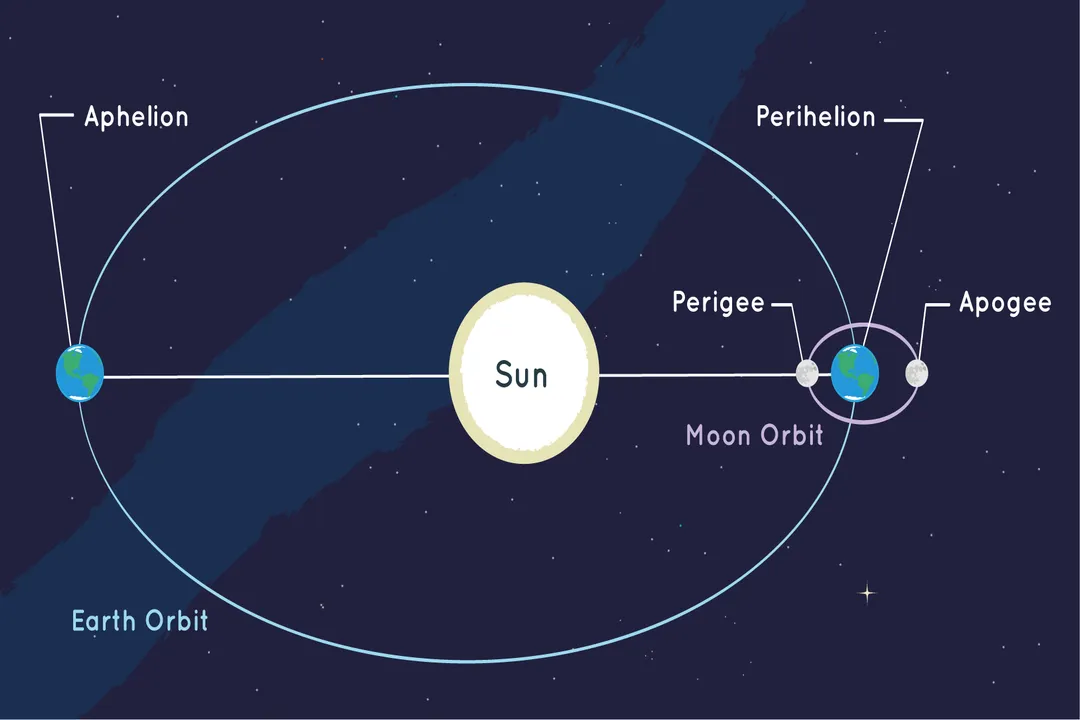
- Periapsis: This is the point in the orbit where the orbiting body is closest to the central mass. [5] For Earth orbiting the Sun, this point is called perihelion. [5][6] At perihelion, the object is moving at its maximum orbital velocity. [2][5]
- Apoapsis: This is the point where the orbiting body is farthest from the central mass. [5] For Earth, this is known as aphelion. [5][6] At apoapsis, the object is moving at its minimum orbital velocity. [2][5]
The difference in speed between these two points can be significant, though it depends heavily on the orbit's eccentricity. [2] For nearly circular orbits like those of the major planets, the speed variation is slight, meaning the orbital path looks very much like a circle from a distance. [5] However, for objects with high eccentricity, like many asteroids or most comets, the speed difference between perihelion and apohelion is dramatic, causing them to speed up greatly as they swing close to the star and then slow down significantly as they travel out to the far reaches of their path. [2]
If you track the Earth’s actual path, for instance, it reaches perihelion (closest approach to the Sun) around January 3rd and aphelion (farthest distance) around July 4th. [6] This means that the Earth is actually closer to the Sun during the Northern Hemisphere's winter than during its summer, which confirms that the seasons are caused by the axial tilt, not the orbital distance variation. [6]
# The Physics of Ellipticity
While Kepler described how the planets move, Isaac Newton provided the why using his law of universal gravitation. [6] Newton demonstrated that any inverse-square law force—where the force decreases proportionally to the square of the distance—will naturally lead to closed orbits that are conic sections: circles, ellipses, parabolas, or hyperbolas. [1]
# Conservation Laws
The shape of the orbit is fundamentally determined by the initial conditions of the orbiting body—its starting position and its starting velocity vector—relative to the central body, under the influence of gravity. [4] Specifically, the conservation of two quantities dictates the final shape:
- Conservation of Energy: The total energy (kinetic plus potential) of the orbiting body must be constant. [4] If the total energy is negative, the resulting orbit is a closed curve: a circle or an ellipse. [1][4]
- Conservation of Angular Momentum: This conservation law is what forces the orbit to be planar and dictates the equal areas swept in equal times (Kepler's Second Law). [2][4] Angular momentum is related to the body’s mass, velocity, and its distance from the central body. [4]
# The Two-Body Solution Spectrum
This is where the comparison between circular and elliptical orbits becomes physically insightful. The gravitational two-body problem mathematically has an infinite number of solutions, forming a spectrum of conic sections. [4]
- (Circle): Requires a very specific, precise initial tangential velocity. If the initial velocity is exactly what is needed to balance the inward pull of gravity at a specific radius, the result is a perfect circle. [4] Any slight deviation in speed or direction will immediately pull it into an ellipse.
- (Ellipse): If the initial velocity is less than the speed required for a circular orbit at that radius (but still high enough to avoid crashing), the object will fall inward toward the central mass, but its angular momentum will carry it back out again, resulting in an elongated, closed elliptical path. [4] If the initial speed is greater than the circular orbit speed (but still less than the escape velocity), it will still form an ellipse, just one where periapsis is the closest approach, not the start of the motion. [4]
- (Parabola) or (Hyperbola): These are open orbits. They occur if the object has exactly the escape velocity () or more than the escape velocity (), meaning the body will never return to the vicinity of the central mass, given an ideal system. [4]
The fact that most observed stable orbits are elliptical simply reflects the statistical likelihood that an object's initial velocity vector will be "just right"—having a negative total energy but not exactly the precise amount needed for a perfect circle. [4] It takes perfect symmetry and precise application of force to maintain a perfect circle; any minor perturbation, like a passing asteroid or slight atmospheric drag, will immediately nudge the orbit into an ellipse. [4]
# Characterizing Orbital Paths
When describing any elliptical path, we use specialized terms derived from the geometry and the physics of the orbit. We use the general terms periapsis and apoapsis, but specific contexts use more precise names based on the central body.
| Central Body | Closest Point (Periapsis) | Farthest Point (Apoapsis) |
|---|---|---|
| Sun | Perihelion | Aphelion |
| Earth | Perigee | Apogee |
| Another Planet | Periapsis/Peri-planet | Apoapsis/Apo-planet |
The eccentricity dictates the visual appearance and the physical consequence of the orbit. For instance, a spacecraft heading to Mars might be placed on a highly elliptical transfer orbit, sometimes called a Hohmann Transfer Orbit when used optimally. [5] This path is specifically designed to use the least amount of fuel to move between two circular orbits (like Earth's and Mars's) by using the two points of closest and farthest approach to make the required velocity changes. [5]
An interesting analytical point arises when considering how engineers might calculate the path length of an ellipse. While we have simple formulas for circumference in specific cases (like the area of the ellipse, ), the exact perimeter calculation requires an elliptic integral of the second kind. [1] For the Earth's orbit, where million km and , the formula must account for this slight deviation from a perfect circle, resulting in a path length that is only slightly longer than . If we were to approximate it using only the semi-major axis, we'd introduce a small error in calculating the exact time of flight for a deep-space mission. This computational hurdle is why early astronomers relied on Kepler's empirical laws before Newton provided the underlying physics.

# Real Worlds and Eccentric Objects
The elliptical nature of orbits is not just theoretical; it governs the movements we observe daily.
# Planetary Orbits
As noted, the Earth’s orbit is an ellipse, resulting in the yearly cycle of perihelion and aphelion. [6] While the distance difference is small—about 5 million kilometers between the closest and farthest points—it confirms the law. [6] Mercury has the most eccentric orbit of the major planets in our solar system, making the variation in its speed and distance from the Sun more pronounced than Earth's. [1]
# Comets and Asteroids
The most dramatic examples of elliptical orbits are often found among smaller bodies. Comets, in particular, are famous for their highly elongated paths. [1] A long-period comet might have an orbit so eccentric that its apoapsis lies far beyond the orbit of Pluto, perhaps even out in the Oort cloud, while its perihelion brings it blazing close to the Sun inside Earth's orbit. [5] This extreme elongation causes the enormous, temporary changes in brightness we associate with comets: they move incredibly slowly at their distant aphelia and whip past the Sun at immense speeds at perihelion. [2]
For those involved in tracking near-Earth objects (NEOs) or designing satellite constellations, understanding eccentricity is crucial for mission planning. A common goal for communication or weather satellites is to place them in a geostationary orbit, which must be circular () and lie directly above the equator. [5] If a satellite's orbit is elliptical, it will appear to drift north and south relative to an observer on the ground—this is called a ground track oscillation—which complicates communication link management. To correct this, ground controllers must periodically fire small thrusters to reduce the eccentricity, nudging the orbit closer to the required circular state.
# Defining the Orbit Type
To categorize orbits beyond just "elliptical," we often look at the relationship between the orbital parameters and the central body's radius, or we simply rely on the eccentricity value itself. [1]
For a bound orbit (one that will return, meaning ), the eccentricity directly tells us the type of ellipse:
- If is very small (close to 0), the ellipse is nearly circular.
- If is moderately larger (e.g., $0.1$ to $0.7$), the ellipse is visibly elongated.
- If is close to 1, the path is very long and thin.
In the context of celestial mechanics generally, any closed orbit is elliptical. If we include the possibility of unbound paths, the full set of possible Keplerian orbits includes the circle (), ellipse (), parabola (), and hyperbola (). [1] All these paths are mathematically derived from the exact same gravitational relationship, making the elliptical orbit the representative closed, gravitationally bound path. [4]
Ultimately, an elliptical orbit means that the orbiting body is held in a closed loop by gravity, but its momentum prevents it from settling into the more constrained circular geometry. It is a dynamic path where the orbital speed is constantly trading off against the distance from the primary body, ensuring that the product of velocity and distance from the focus remains constant over time, a beautiful manifestation of the conservation of angular momentum in action. [2][4]
#Videos
Why Are Planetary Orbits Elliptical? - YouTube
Related Questions
#Citations
Elliptic orbit - Wikipedia
Elliptical Orbits Definition, Equations & Example - Lesson | Study.com
Why are planetary orbits elliptical instead of circular? - Reddit
Why Are Planetary Orbits Elliptical? - YouTube
What Is an Orbit? | NASA Space Place – NASA Science for Kids
What is the definition of an elliptical orbit? Why does this ... - Quora
Why is the Earth's Orbit Around the Sun Elliptical?
Why are celestial body orbits elliptical rather than circular? - Facebook
What is an elliptical orbit? - Astronomy & Space
Why do planets move in an elliptical orbit? [duplicate]