What is a simple definition of orbital?
The term "orbital" floats across different scientific fields, sometimes referring to the grand paths of celestial bodies, and other times describing the strange, probabilistic neighborhoods where the smallest particles of matter reside. At its most basic, an orbital describes something that belongs to, or is related to, an orbit. [1][2] However, the context shifts the meaning dramatically, moving from the predictable sweep of a planet around a star to the abstract mathematical description of an electron's location inside an atom. [4] To gain a clear picture, we must separate these two primary scientific uses: the astronomical orbital and the quantum mechanical orbital.
# Space Motion
When most people first encounter the word outside of a science class, it usually relates to space travel or astronomy. In this context, an orbital path defines the trajectory an object takes when it is pulled by the gravity of another, larger object. [6] Think of the Earth circling the Sun, or a communication satellite circling the Earth—these are both examples of objects traveling in an orbit. [6]
An object is said to be in orbit when it is continuously falling toward a central body but moving fast enough sideways that it continually misses hitting it. [6] For spacecraft, being "in orbit" is a state of perpetual freefall around a planet or moon. [6] The specific path an orbiting object takes—its orbital path—is dictated by the laws of gravity and the object's velocity and position. [6] A satellite's path might be nearly circular or highly elliptical, but it is a defined, physical path in three-dimensional space that can be mapped with high precision. [6] When engineers plan missions, they are calculating a precise, classical orbit.
# Atomic Regions
The term takes on a much more subtle and fundamental meaning when we move into the realm of chemistry and quantum mechanics. Here, an atomic orbital is not a physical path but a region of space around an atom's nucleus where an electron is most likely to be found. [3][7][10] This is a key departure from earlier, simpler models of the atom, like the solar system model where electrons followed neat, definite paths, much like planets orbiting the Sun. [4][8]
The modern understanding, rooted in quantum theory, tells us that electrons do not move in set orbits; their locations can only be described in terms of probability. [4][7] The atomic orbital is essentially the mathematical solution, derived from the Schrödinger wave equation, that maps out this probability distribution. [4][9] If you could take a snapshot of an electron's location over a long period, the density of those snapshots would form the shape of the orbital. [3] This spatial description is incredibly important because the arrangement of these orbitals determines how an atom will interact with other atoms—in other words, it governs chemical bonding. [4][10]
# Quantum Description
Because the behavior of electrons is governed by quantum numbers, orbitals are categorized based on these numbers, which define the orbital's size, shape, and orientation in space. [3][9] The principal quantum number, usually denoted as , determines the size and energy level of the orbital. [3][9] Higher values of mean the orbital is larger and the electron is, on average, farther from the nucleus. [3]
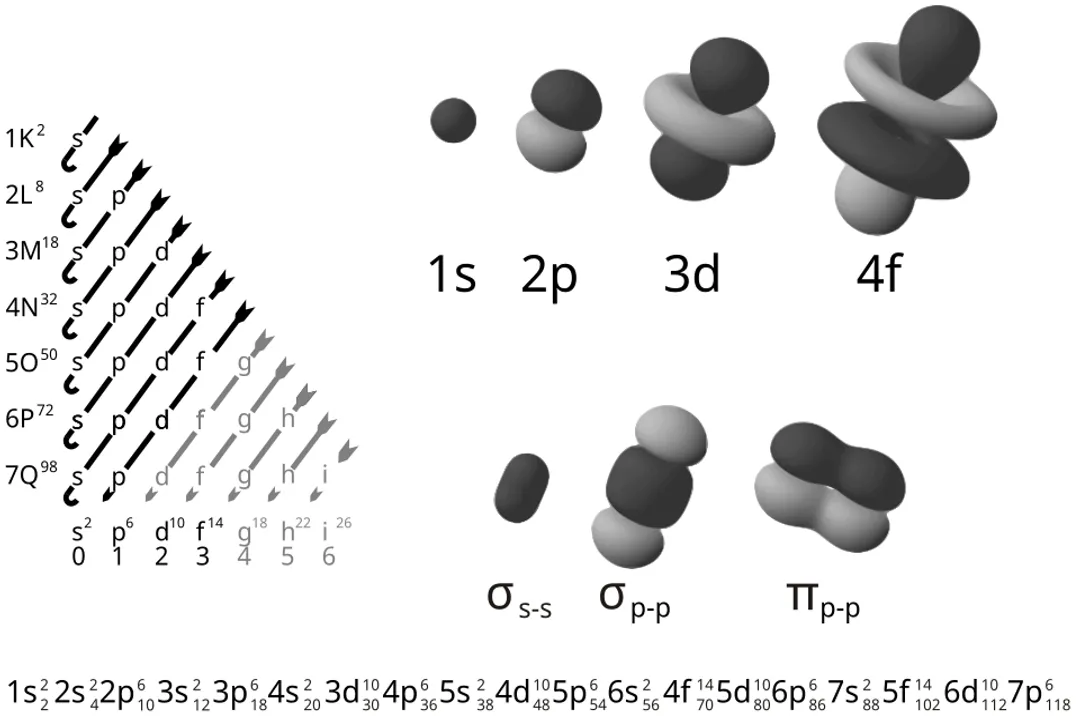
For any given energy level (), there are specific shapes the orbitals can take. These shapes are often represented by letters: , , , and , corresponding to the angular momentum quantum numbers ( respectively). [3][7][9]
- The orbital is the simplest, characterized by a perfectly spherical shape, meaning the electron probability density is the same in all directions around the nucleus. [7][9] Every energy level ( etc.) has one orbital. [3]
- The orbitals are dumbbell-shaped, with two lobes on opposite sides of the nucleus. [7][9] There are always three orbitals in any given energy level (except ), oriented along the three perpendicular axes: , , and . [3][7]
- The orbitals are more complex, typically appearing as four-leaf clovers, and there are five of them for energy levels and higher. [3][7]
- The orbitals are even more intricate, with seven different orientations, appearing in levels where is 4 or greater. [3][7]
This categorization provides chemists with a powerful map. For instance, an atom's electron configuration—how its electrons fill these designated regions—is entirely predictable based on the Aufbau principle, Hund's rule, and the Pauli exclusion principle. [9]

# Shape and Orientation

When visualizing an atomic orbital, it is crucial to remember that the shape defines the space, not the path of the particle. [4] It's easy to picture a tiny planet following a line, but the quantum orbital is a fuzzy cloud of potential locations.
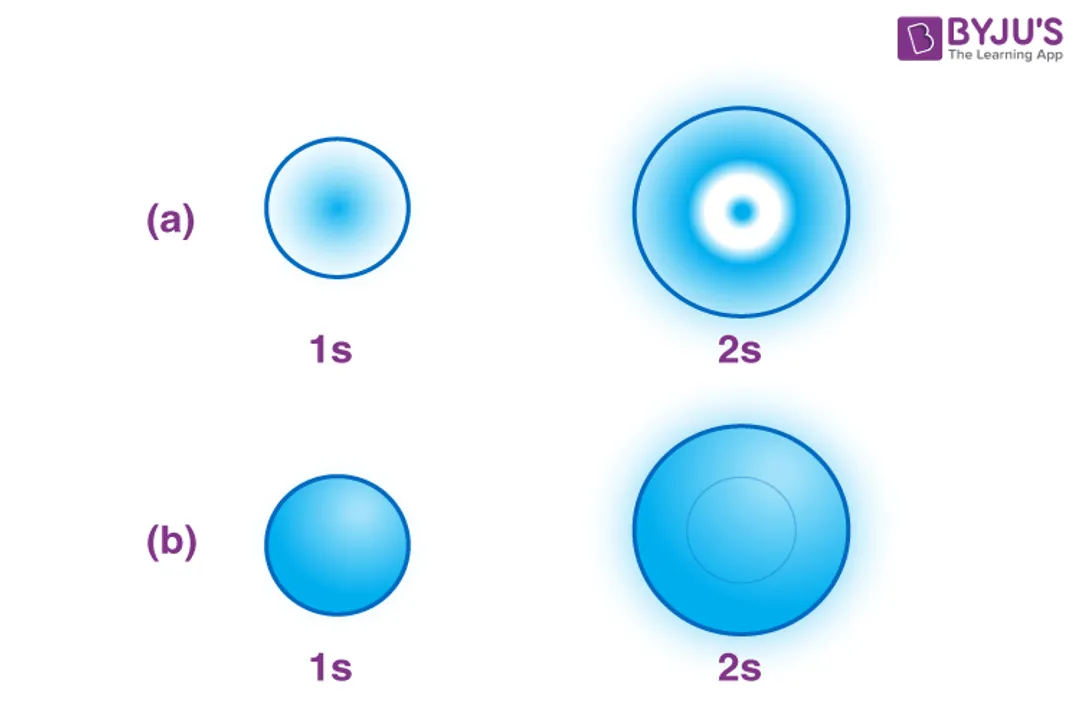
Consider the difference between an orbital and a orbital in the second energy level (). The orbital is a larger sphere than the orbital, but it has a node—a region of zero probability—closer to the nucleus. [7] The orbitals, while having a complex shape, have a nodal plane that runs directly through the nucleus, meaning the probability of finding that electron exactly at the nucleus is zero for a orbital. [7] This is a subtle but essential structural difference.
If we compare the physical reality of a satellite's orbit with a orbital, the contrast becomes stark. A satellite's orbit can be described mathematically using classical mechanics (like Kepler's laws), providing a position at any time . [6] Conversely, the electron's location is described by a wave function (), and the square of that function () gives the probability density. [4][9] We cannot say where the electron is, only where it is likely to be found, which is a profound limitation and freedom of quantum theory all at once. [4]
# Conceptual Divide
The conceptual gap between the macroscopic "orbit" and the microscopic "orbital" is one of the most significant intellectual leaps in modern science.
Conceptual Contrast: Orbit vs. Orbital
| Feature | Macroscopic Orbit (e.g., Moon around Earth) | Microscopic Orbital (e.g., electron) |
|---|---|---|
| Nature | A defined, physical path [6] | A region of space defined by probability [3][7] |
| Predictability | Deterministic (path known if initial conditions are known) [6] | Probabilistic (only likelihood of location known) [4] |
| Description | Classical mechanics, position over time | Quantum mechanics, wave function () |
| Shape | Typically elliptical or circular | Spherical (), dumbbell (), cloverleaf (), etc.[7] |
One area where this distinction is particularly useful for analysis is in understanding chemical reactivity. When two atoms approach each other to form a bond, they are not simply nudging their electron paths together. Instead, the overlapping of their respective atomic orbitals—the fuzzy probability clouds—creates a new, shared region of higher electron density called a molecular orbital. [10] This merging of probability spaces is what holds molecules together. If we were only dealing with fixed paths, the rules of bonding would have to be entirely different, perhaps requiring some sort of geometric locking mechanism rather than the continuous sharing of probability density we observe.

# Applications Beyond the Textbook
Understanding what an orbital is, in both its physical and quantum sense, directly impacts technology and our daily lives. In space technology, the precision calculation of an orbital path is everything; a small error in thrust or timing can mean a multi-billion dollar probe misses its target planet entirely. [6] This is high-stakes classical mechanics.
In chemistry, the concept of the orbital is the foundation of modern materials science and pharmacology. For example, the way a drug molecule binds to a protein receptor in the body is determined by the complementary shapes and electron distributions of their respective molecular orbitals, which are built from the parent atomic orbitals. [10] Understanding that a valence electron resides in a orbital rather than an orbital dictates whether a molecule will be polar, what kind of bonds it will form, and even what color light it might absorb. [3][7]
Consider the subtle effect of the orbitals. Because they have more complex shapes and can point between or directly at connecting atoms, they allow for coordination chemistry, the study of transition metals like iron or copper. This complexity, derived from those five orbital shapes, is responsible for the vibrant colors seen in many metal compounds and is central to the function of hemoglobin in your blood, which relies on the precise spatial orientation of its central iron atom's electrons to pick up and release oxygen. [3] This highlights how the probabilistic fuzziness of the quantum orbital directly dictates tangible, macroscopic properties we see every day.
In summary, while the adjective "orbital" describes anything related to a closed path or route, [1][2] its primary scientific uses diverge. It is either the predictable, gravitationally bound trajectory of a large object in space [6] or the mathematically defined three-dimensional map of where an electron is most likely to be found inside an atom. [3][7] Grasping this duality—the concrete path versus the probabilistic cloud—is the first step to understanding both the cosmos above and the chemistry that constitutes everything around us. [4]
#Videos
Orbital - Chem Definition - YouTube
Related Questions
#Citations
ORBITAL Definition & Meaning - Merriam-Webster
ORBITAL | definition in the Cambridge English Dictionary
Atomic orbital - Wikipedia
Orbital | Chemistry, Physics & Applications | Britannica
Orbital - Chem Definition - YouTube
What Is an Orbit? | NASA Space Place – NASA Science for Kids
Orbitals
What are Orbitals? - Chemistry Stack Exchange
Atomic Orbitals and Quantum Numbers - BYJU'S
What is orbital? And orbital can accommodate how much electrons?