Why do planetary nebulas have so many different shapes?
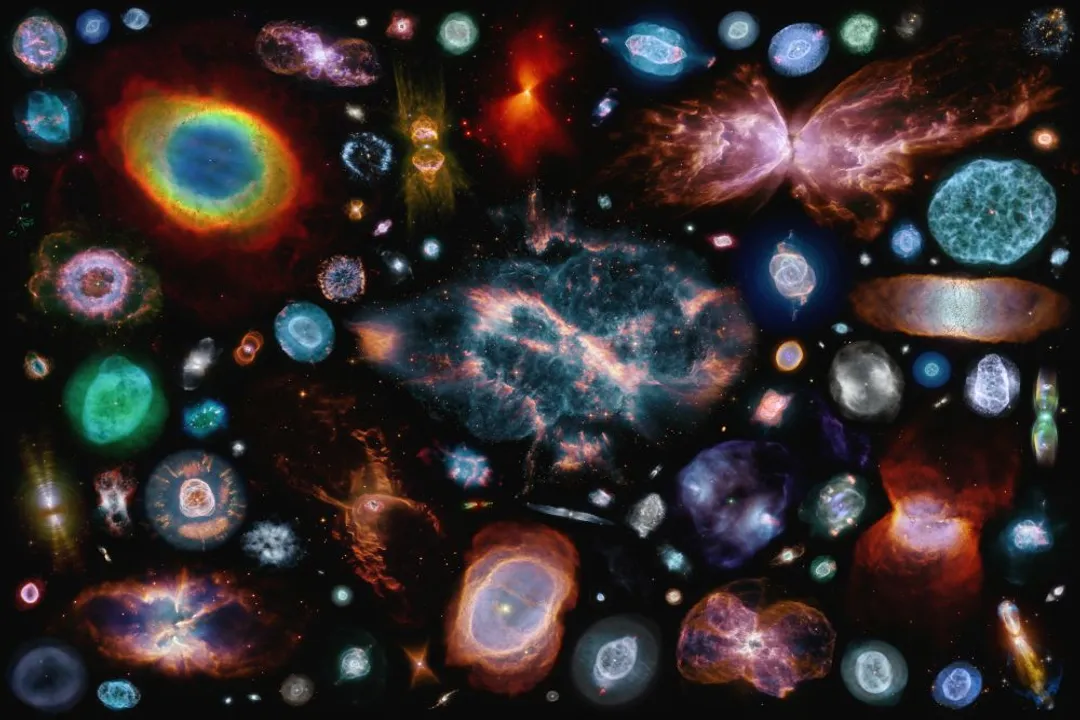
The vast, glowing clouds known as planetary nebulas present a stunning array of forms across the night sky, from simple spheres to intricate knots and dramatic hourglasses. The diversity is remarkable, leading many to wonder what controls the final shape of this stellar remnant as it expands into space. [3][7] Understanding these shapes requires looking closely at the last stages of a sun-like star's life, a period marked by extreme instability and rapid material ejection. [7]
# Stellar Winds
Planetary nebulas begin forming after a star exhausts the fuel in its core and swells into an Asymptotic Giant Branch (AGB) star. [7] During this phase, the star sheds its outer layers via a relatively slow wind, moving outward at speeds of perhaps only 10 to 20 kilometers per second. [2][7] This initial, slow outflow creates a large, relatively spherical shell of gas and dust that surrounds the dying star. [2] This slow wind constitutes the nebula's building material. [8]
The transformation from a gentle AGB star to the dramatic nebula occurs when the star's core collapses, heats up intensely, and starts emitting a second, much faster wind. [2][7] This fast wind travels at speeds potentially exceeding 1,000 kilometers per second. [2] When this high-speed material slams into the slower, cooler material ejected earlier, the resulting shock and pressure carve out the dramatic structures we observe. [2][8] The final shape is, therefore, a consequence of the interaction between these two distinct winds. [2][7] If the initial slow wind were perfectly uniform in all directions, and the subsequent fast wind was perfectly spherical, the resulting nebula would simply be round. [7] Since very few are perfectly round, something must be influencing the asymmetry of one or both of these outflows. [7]
# Companion Stars
One of the most widely accepted explanations for the complex, non-spherical shapes involves the presence of a secondary object orbiting the dying star. [3][6] If the central star has a binary companion, that partner can profoundly influence the expanding gas. [3]
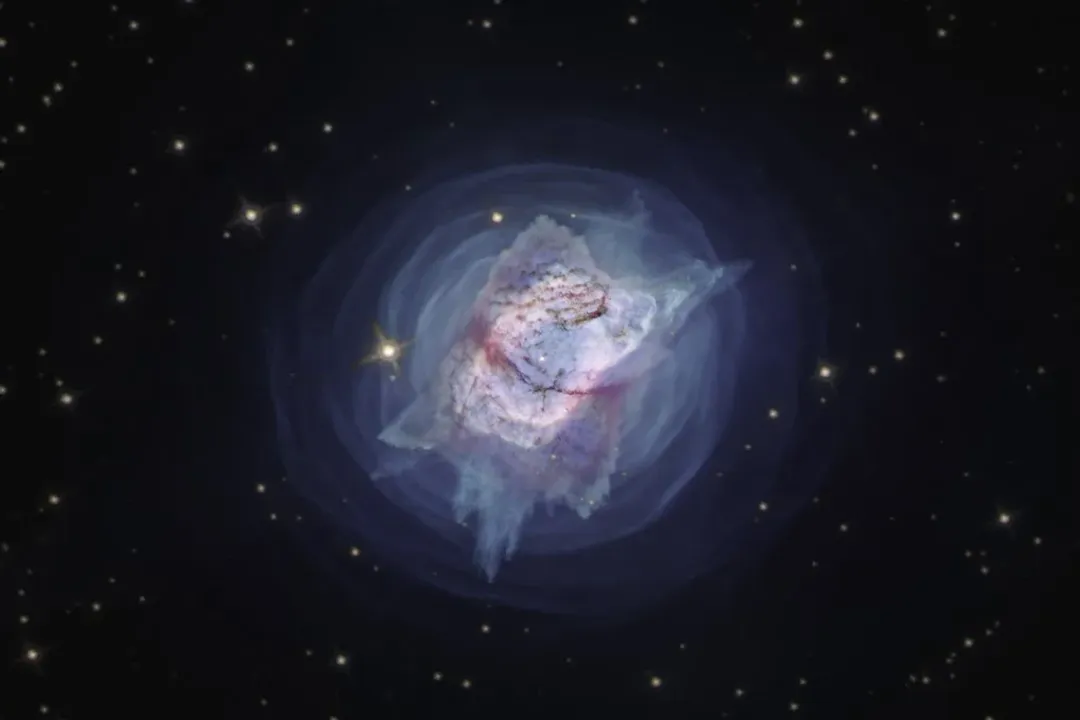
When the primary star begins shedding mass, the companion star, or perhaps a smaller disc of material formed from the captured wind, can act like a funnel or a shield. [2][6] As the fast wind streams out, the companion or its surrounding disc might block the flow in certain directions or focus the material into tighter beams. [2] This focusing effect naturally leads to shapes like hourglasses or bipolar structures, where material is ejected strongly along an axis defined by the orbital plane of the two stars. [3][7] Systems where the material is channeled into two opposite lobes are common, suggesting that something is constraining the expansion along an equator or middle plane. [7] A system that has experienced multiple bouts of mass ejection might look particularly messy because the subsequent fast winds are interacting with previously ejected material that wasn't uniformly distributed in the first place. [4]
# Field Dynamics
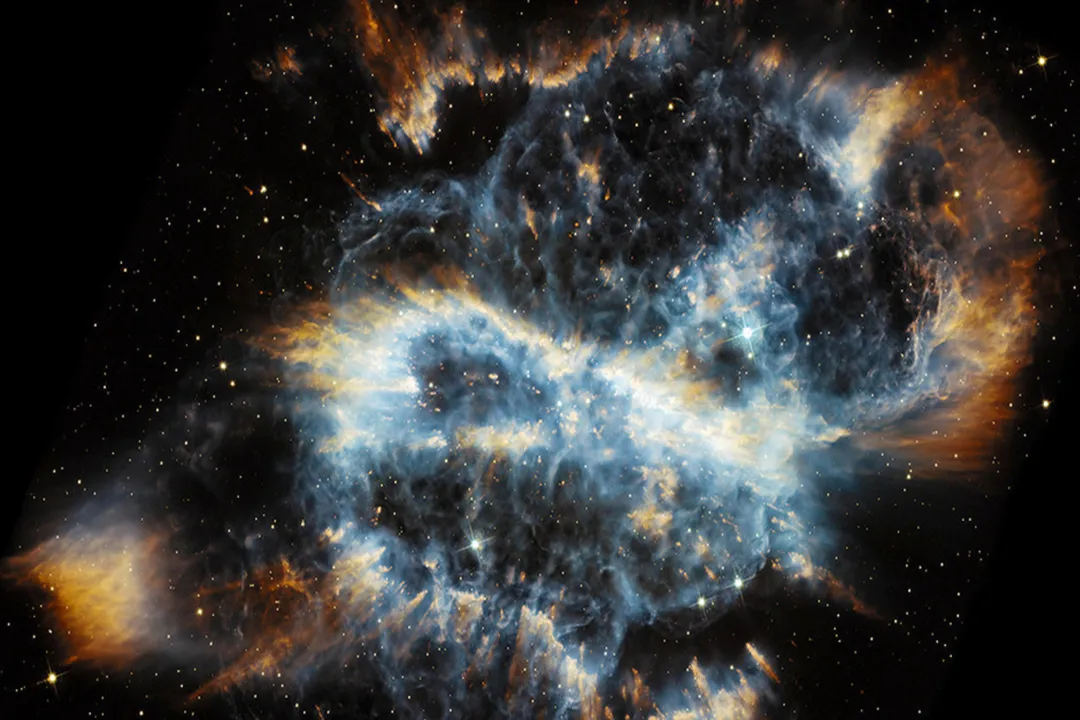
Beyond gravitational interactions, the star’s intrinsic physical properties and its magnetic field must also be considered in the shaping process. [5][6] A rapidly rotating central star can generate powerful magnetic fields that influence the ionized gas as it flows away. [5]
These magnetic fields can act like invisible scaffolding, channeling the outflowing plasma into specific pathways, similar to how iron filings align around a bar magnet. [5] This mechanism could also lead to the creation of bipolar shapes, as the magnetic field lines might constrain the outflow predominantly along the magnetic poles. [7] Furthermore, some models suggest that the fast wind is not purely isotropic (the same in all directions) but is instead launched primarily in narrow jets. [5] Imagine the central engine acting less like a generalized explosion and more like a powerful water hose turned on intermittently or directed narrowly; the resulting structure etched in the surrounding slow wind would be highly collimated. [5]
It is worth noting that a common theme across theories—whether involving companions or magnetic fields—is the collimation of the fast wind. [2][5] The diversity comes down to how that collimation is achieved. Think of it this way: if a potter is shaping clay (the slow wind), using a simple paddle creates a flat disc, but using two close fingers to pinch the sides will result in a pinched, hourglass shape. [1] The "tool" in the case of planetary nebulae is either a gravitational partner or a magnetic field gradient. [3][5]
# Mass Loss History
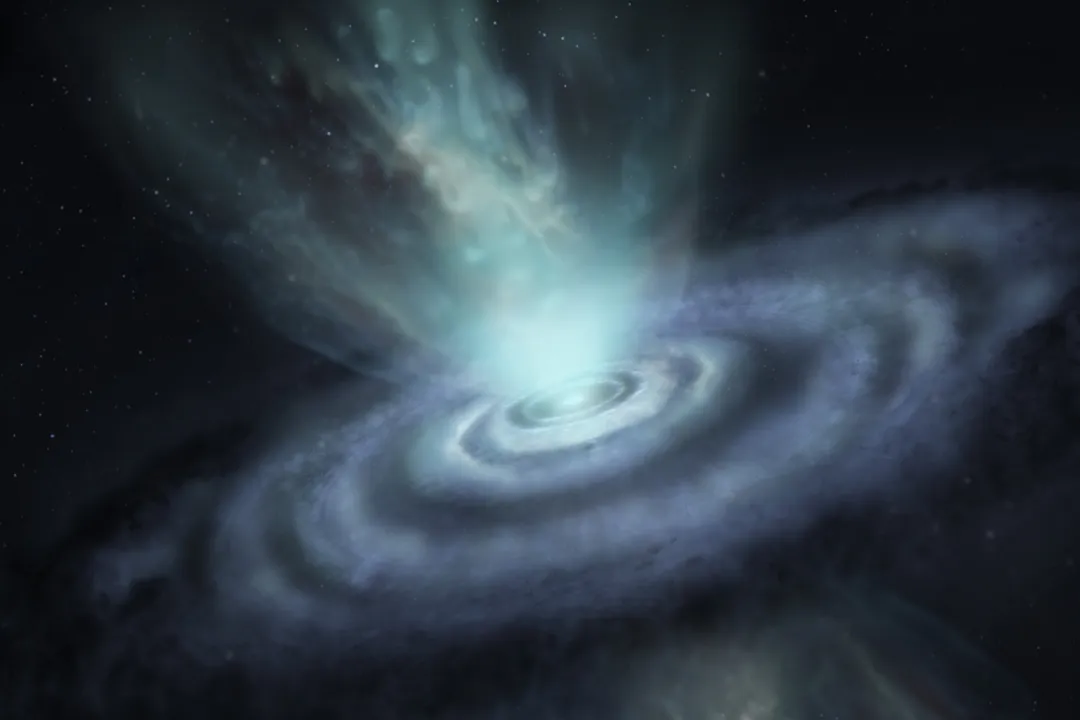
The historical record of mass loss is written into the nebula’s structure, providing a snapshot of the star’s final decade or millennia. [8] The final look of a nebula reflects the entire history of the fast wind interacting with the preceding slow wind. [8]
If the star had a very steady, symmetrical slow wind, but its final fast wind phase was brief or only slightly asymmetric, the resulting nebula might be nearly spherical or only slightly elliptical. [7] However, if the star went through multiple, highly energetic ejections separated by periods of relative calm, the nebula would show signs of these distinct events—perhaps rings, knots, or shells layered within the main structure. [4] The sheer range of time scales involved is fascinating; the luminous phase that creates the visible nebula lasts only about $50,000$ years. [7] For such a brief cosmic outburst, the intricate details we see must be imprinted very rapidly, meaning the shaping mechanisms are extremely efficient and perhaps even violent in their operation during that short window. [7] Observing a highly knotted or clumpy nebula, like the "messy" ones described, suggests a history where the ejection process was not smooth, perhaps fluctuating wildly in speed or direction before the material finally settled into its current outward trajectory. [4]
# Observed Shapes
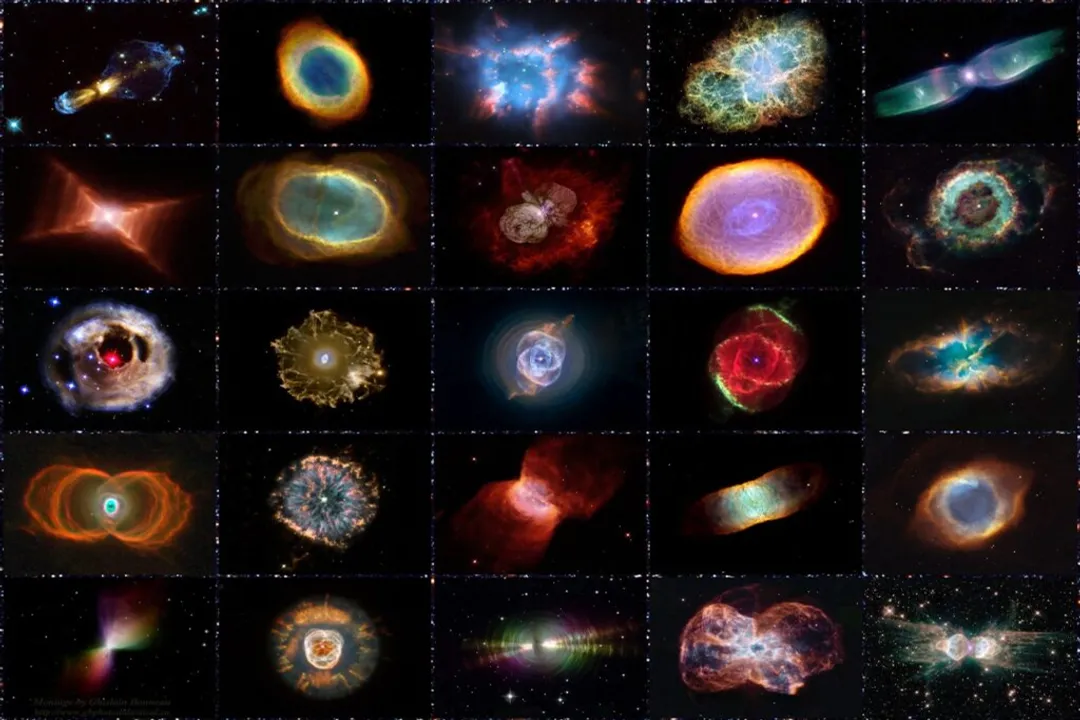
When astronomers look at images captured by instruments like the Hubble Space Telescope, the catalog of shapes is extensive, far exceeding simple spheres or dumbbells. [9] While the most common classifications include bipolar (two-lobed), elliptical, and round, there are many more complex forms, sometimes classified as irregular or highly structured. [7][9]
For instance, some nebulae exhibit clear rings or tight tori that intersect the central axis, indicating that a dense belt of material exists around the star’s equator. [7] Others, like the famous Cat's Eye Nebula (NGC 6543), show complex, multi-layered structures with knots and filaments that seem almost intentionally placed. [9] The variety is so great that astronomers cannot neatly sort all planetary nebulas into just a few geometric bins; every single one appears to possess unique features. [3] The Hubble archive shows structures that look like butterflies, spirals, and even objects resembling hourglasses that have been twisted or viewed at an angle. [9] The sheer physical scale reinforces the mystery—these objects can span light-years, yet their structure is determined by processes occurring over volumes barely larger than our solar system, making the influence of the central engine incredibly powerful. [2]
This bewildering variety implies that the initial conditions—the exact mass of the progenitor star, its precise rotation rate, the orbital parameters of any companion, and the strength of its magnetic field at the moment of peak mass loss—are never exactly the same twice. [6] It is the unique combination of these variables that acts as the cosmic fingerprint, defining the final, ephemeral shape we see before the gas dissipates entirely into the interstellar medium. [7]
#Videos
Here's Why Planetary Nebulae Look So Different...But ... - YouTube
Related Questions
#Citations
ELI5: What is the reason behind different shapes of various nebulae?
How a Planetary Nebula Gets its Shape - CosmoQuest
Each Planetary Nebula is Unique. Why Do They Look So Different?
Where Do Messy Planetary Nebulae Come From? - AAS Nova
Did we discover how nebulae hold their shapes?
Planetary nebula - Wikipedia
Here's Why Planetary Nebulae Look So Different...But ... - YouTube
Bizarre alignment of planetary nebulae - ESA/Hubble