What is the reason that planetary nebulae are visible?
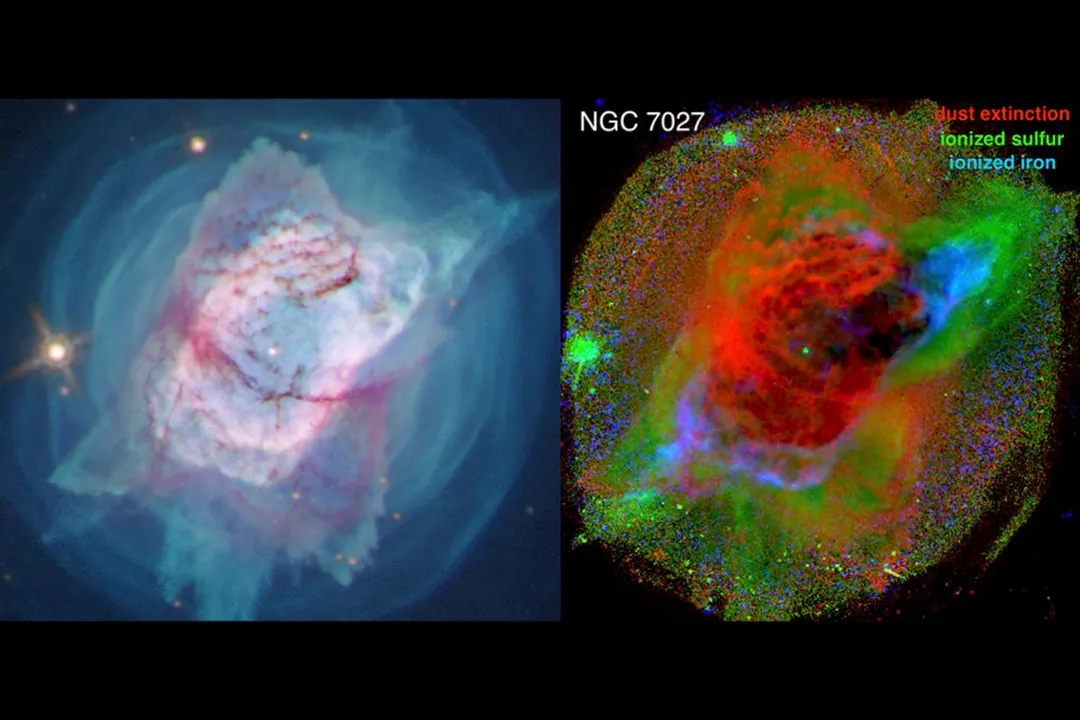
Planetary nebulae owe their ephemeral visibility to a dramatic final act in the lives of certain stars—specifically, medium-mass stars, those roughly between $0.8$ and $8$ times the mass of our Sun. [2][7] When these stars exhaust the fuel in their core, they evolve into a planetary nebula, a glowing shell of gas ejected into space. [7][9] The visibility is a direct consequence of two main physical processes: the physical ejection of matter and the subsequent illumination of that matter by the extremely hot stellar core left behind. [4]
The core, which shrinks and heats up significantly after the star sheds its outer layers, becomes a white dwarf. [2][7] This central remnant emits intense, high-energy ultraviolet (UV) radiation. [4][5] This UV radiation is energetic enough to ionize the gases that were previously expelled by the star. [4][5] Ionization occurs when the energetic photons knock electrons free from the atoms in the expelled shell, primarily hydrogen and helium. [5]
When these ionized electrons later recombine with the atomic nuclei, they cascade down energy levels, releasing photons—light—at specific wavelengths. [5] This process is similar to what happens in an excited gas tube, but on a cosmic scale. The light emitted by this energized gas cloud is what we observe as a planetary nebula. [4][7] If the central star did not become hot enough to produce this ionizing UV radiation, the expanding shell of gas would simply remain an invisible, expanding cloud of neutral material, not a bright nebula. [5] Therefore, the visibility hinges entirely on the hot white dwarf acting as an internal light source for the material it just ejected. [4][7]
# Stellar Transformation
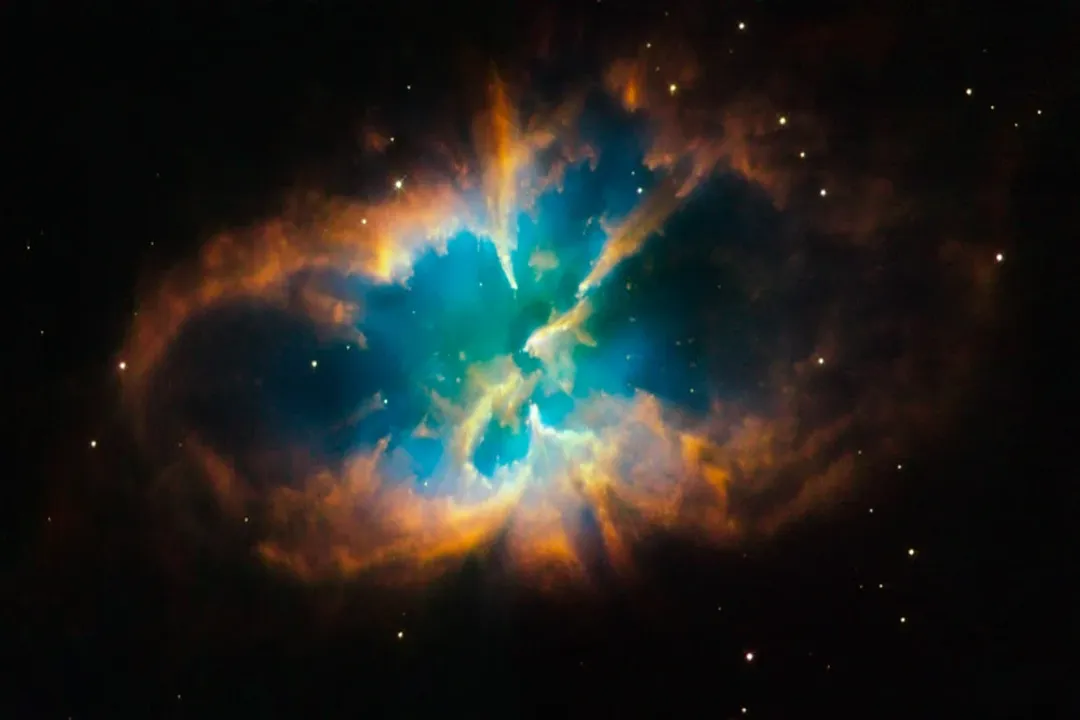
The process begins after a star exhausts hydrogen in its core and begins burning helium, causing it to swell into a red giant. [2][7] As the star ages further, it goes through thermal pulses, which are episodes of intense instability that drive off significant amounts of its outer material into space. [2][7] This outflow of gas is not always gentle; it can involve winds moving at speeds of several tens of kilometers per second. [5]
This slow, dense stellar wind continues for a long time, carrying away the bulk of the star's outer envelope. [2] Once this envelope is gone, the hot inner core is exposed. [2] This exposed core, a pre-white dwarf, can reach temperatures exceeding $100,000$ Kelvin. [5] It is this searing heat that drives the next phase: the creation of the visible nebula. [4][5] The material that forms the nebula is therefore the star's own recently shed atmospheric gases, illuminated by the star's newly exposed, extremely hot heart. [7] The entire visible phase is relatively brief on astronomical timescales, lasting perhaps only $10,000$ to $50,000$ years before the gas dissipates too much to be seen against the background of space. [2][7]
# Gas Emission Physics
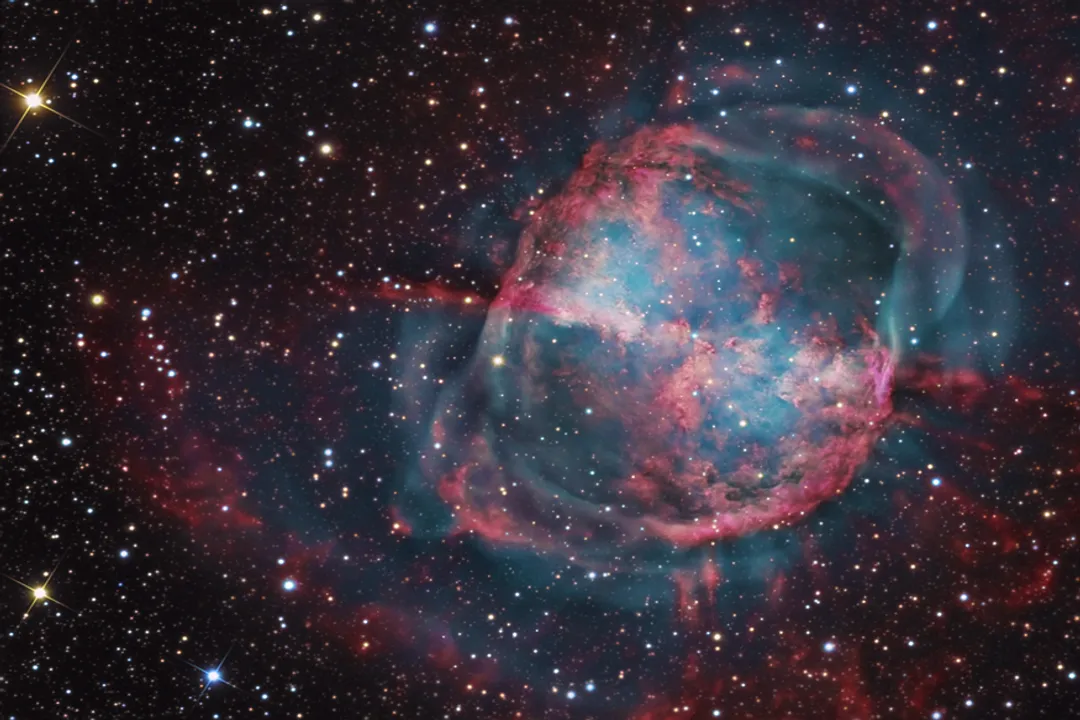
The colors we perceive in images of planetary nebulae are direct fingerprints of the chemical composition of these ejected shells. [1][3] The light is not just uniform white light; it comes from specific atomic transitions within the gas. [5] For instance, ionized oxygen often emits strongly in the blue-green part of the spectrum, while ionized hydrogen and nitrogen typically contribute reddish hues. [1]
This selective emission is key to their visibility and structure. Different elements require different amounts of energy to become ionized, and the central star's temperature dictates how much energy is available at various distances from the core. [5] Closer to the hot core, the radiation is more intense, capable of stripping more electrons (higher ionization states), leading to different colors and emission lines than in the dimmer, outer regions. [5]
An interesting consequence of this ionization process, which perhaps isn't immediately obvious, is how the visibility spectrum changes over time. A young nebula, closest to its extremely hot progenitor, will show lines from highly ionized species, often appearing blue or blue-green in false-color images if strong oxygen emission is present. [1] Conversely, older nebulae, where the central star has cooled down significantly or the gas has expanded too much, may only show lower-energy emissions from less-ionized hydrogen or nitrogen, causing them to appear redder or dimmer overall. [4] This means that observing a planetary nebula is somewhat like looking at a time-lapse of its own evolution, with color indicating the energy landscape at the time of the light we are currently seeing. [5]
# Shaping the Structures
The visibility of a planetary nebula is not just about brightness; it’s about shape. Many nebulae appear as perfect spheres or simple rings, but high-resolution images frequently reveal complex, bipolar, or highly structured forms, such as the Hourglass Nebula or the Cat's Eye Nebula. [1][3] The visibility of these intricate shapes is due to factors that modify the outflow before or during the ionization phase. [6]
The initial symmetric, spherical shell formed by the slow stellar wind is often sculpted by secondary, faster outflows or by interactions with material previously ejected by the star, such as when the star was a red giant. [2][6] The star might have a binary companion that sweeps up or redirects the ejected gas into denser rings or disks perpendicular to the star's axis of rotation. [2] As the hot ionizing radiation streams outward, it illuminates these pre-existing structures, making the denser regions glow brighter and creating the apparent shells, lobes, and knots we observe. [6]
Consider the geometry of viewing. A planetary nebula that is intrinsically a bipolar structure—like two opposing cones—will look like a simple sphere if we view it exactly pole-on (down the axis of the cones). [2][4] If viewed edge-on, we might only see a thin, elongated ellipse or a ring, as the central star blocks the view of the densest part of the interior. [4] This angle-dependence severely impacts how we perceive its visibility and structure; two otherwise identical nebulae viewed from different lines of sight can appear drastically different. [2]
# The Name Confusion
A point often cleared up when discussing visibility is the misleading nature of the term "planetary nebula" itself. [2] They have nothing to do with planets. [8] The name originated in the late 18th century when astronomers like William Herschel observed them through their early telescopes. [2][9] To their eyes, these relatively small, round, greenish-blue objects resembled the appearance of Uranus or Neptune, which were known as "planetary bodies" at the time. [2][9]
In reality, planetary nebulae are clouds of gas spanning light-years, while planets are tiny, local bodies orbiting a star. [8] This confusion is compounded because they are not diffuse nebulae, which are vast clouds of interstellar gas and dust that reflect or emit light from nearby massive stars, like the Orion Nebula. [8] Planetary nebulae are, by contrast, intimately connected to the death of a single, solar-mass star, meaning they are much smaller, brighter for a short time, and have a clear central source. [7][8]
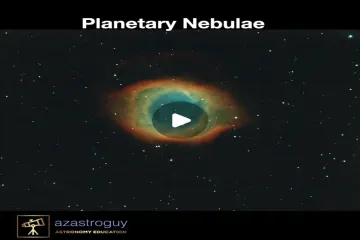
# Contrast with Other Nebulae
To fully appreciate why planetary nebulae are visible, it helps to contrast their illumination mechanism with other bright nebulae. [8]
| Nebula Type | Primary Illuminating Source | Visibility Mechanism | Typical Lifespan |
|---|---|---|---|
| Planetary Nebula | Central White Dwarf | Fluorescence/Emission from expelled, hot gas | Years [2] |
| Emission Nebula | Nearby Hot, Young Stars | Ionization of surrounding giant molecular cloud gas | Millions of Years |
| Reflection Nebula | Nearby Stars (no ionization) | Scattering of starlight by microscopic dust grains | Long-lived |
Planetary nebulae are unique because the light source is internal and dying. [7] Emission nebulae rely on massive, young stars (O and B types) that are far more luminous and long-lived than the central stellar remnant of a planetary nebula, allowing the nebula to remain illuminated for millennia. [8] Reflection nebulae, on the other hand, simply shine by reflecting existing starlight off dust, without requiring the intense UV ionization that powers the planetary nebula's glow. [8] The visibility of a planetary nebula is thus an instantaneous "snapshot" powered by a very specific, late-stage stellar event, which accounts for their relative rarity compared to the vast, persistent emission regions around hot, young star clusters. [2][5]
# Observing the Faint Glow
The apparent brightness, or visibility, of a planetary nebula depends on several interlocking factors: the temperature and luminosity of the central star, the density and amount of the expelled gas, and the total distance to the object. [5]
For a nebula to be easily visible to amateur or professional telescopes, it needs:
- High Central Star Temperature: This ensures sufficient UV flux to excite a large volume of gas. [5]
- Sufficient Mass Ejection: There must be enough material to form a dense enough shell to scatter or emit a detectable amount of light. [7]
- Proximity: Being closer means less light is lost through the vastness of intervening space. [5]
If the central star is too cool, the emission lines will be weak, resulting in a dim object. If the star ejected too little mass, the shell will be too sparse to glow brightly. Distance plays the final role; many planetary nebulae exist throughout the Milky Way, but only the nearest ones—like the Ring Nebula or the Dumbbell Nebula—achieve the visual prominence that makes them iconic astronomical targets. [3]
One subtle aspect affecting its visibility is the elemental abundance in the progenitor star's outer layers. Stars that were metal-poor (low abundance of elements heavier than helium) might produce fainter nebulae simply because there are fewer heavier elements like oxygen or nitrogen available to produce the bright emission lines that characterize the most stunning examples. [1] The star's own past history of mass loss dictates the visibility of its final light show. [6] The material we see is the star's own enriched material, finally brought into the light by the exposed, superheated core, making planetary nebulae direct probes of stellar evolution and nucleosynthesis. [7]
Related Questions
#Citations
Planetary Nebula - ESA/Hubble
Planetary nebula - Wikipedia
Planetary Nebulae
Why do Planetary Nebulae Look the Way They Do? - Universe Today
Planetary nebulae - Scholarpedia
Formation of Planetary Nebulae - Cosmotography
Planetary Nebulae - JIM KALER
Observing Planetary and Diffuse Nebulae - Minute of Space
Planetary Nebula | Definition, Facts & Structure - Lesson - Study.com