Why do many planetary nebulae appear spherical?
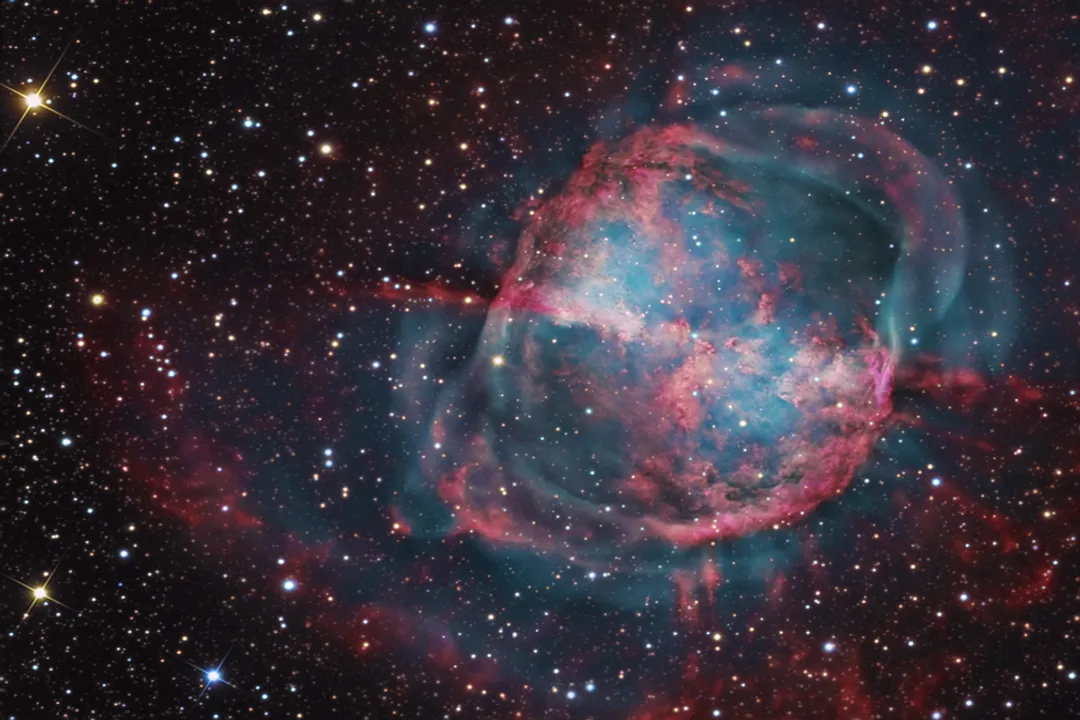
The moment we look up at stunning astronomical images, whether in print or online, the colorful, ghostly shells known as planetary nebulae often capture the imagination. While many feature dramatic structures—hourglass shapes, bipolar lobes, or complex knots—the underlying question of their geometry is fascinating. If these clouds of gas are ejected from a dying star, what dictates whether the resulting structure appears perfectly round or wildly asymmetrical? It turns out the default expectation, based on simple physics, is a sphere, but achieving that pristine shape in the messy final stages of a star’s life requires surprisingly specific conditions. [2][3]
# Spherical Baseline
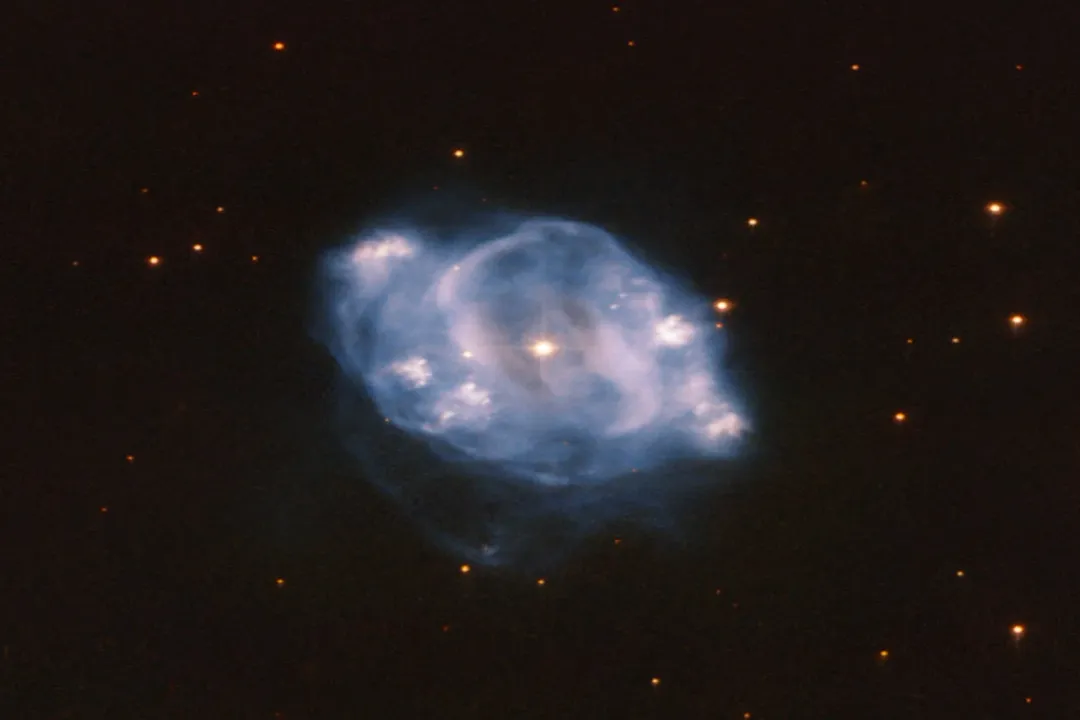
To understand why a planetary nebula might look like a perfect ball, we must first consider the most fundamental force at play: gravity. Any collection of mass large enough to generate its own significant gravitational field naturally settles into a configuration that minimizes its potential energy. For a star, this results in a nearly perfect sphere. [6] When a star like our Sun nears the end of its life, it swells into a red giant and begins shedding its outer layers. This ejection process, which creates the nebula, is initially driven by gentle stellar winds—a continuous outflow of material moving relatively slowly. [3][9] Because the central source generating this material is spherically symmetric, the initial shell of gas it produces is also expected to be spherical, much like the surface of an expanding soap bubble. [6] The physics dictates that an isotropic (equal in all directions) outflow from a single central point will create a sphere. [3]
# Simple Ejection
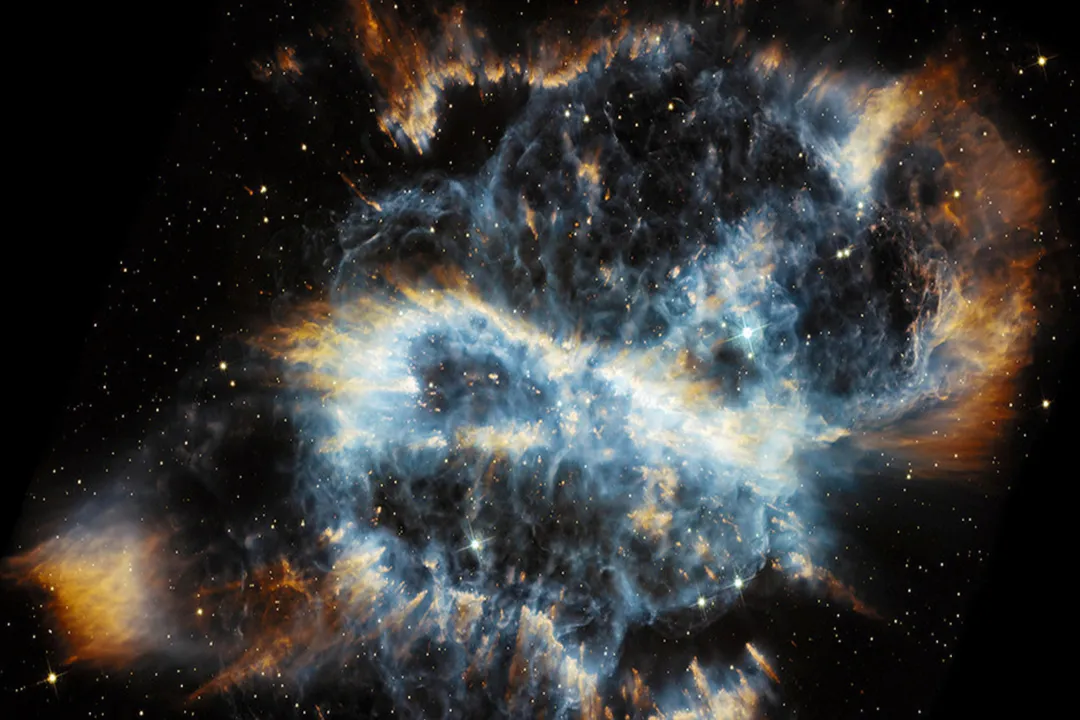
A planetary nebula forms in two main phases following the main sequence life of a Sun-like star. First, the star sheds mass via a slow wind, creating an initial, relatively cool, and dense envelope of gas and dust. [9] This slow wind establishes the initial template for the nebula's structure. [3] If the star were truly isolated, with no external influences, this shell would simply expand outward at a constant rate, maintaining its nearly perfect spherical symmetry as it moves away from the central white dwarf remnant. [7] The very simplest planetary nebulae, those that appear almost perfectly round when observed across the sky, are the direct, unadulterated expression of this single-star, uniform mass-loss event. [2] These spherical nebulae represent the baseline expectation of stellar death when only the star's own processes are involved. [3]
# Complexity Arises
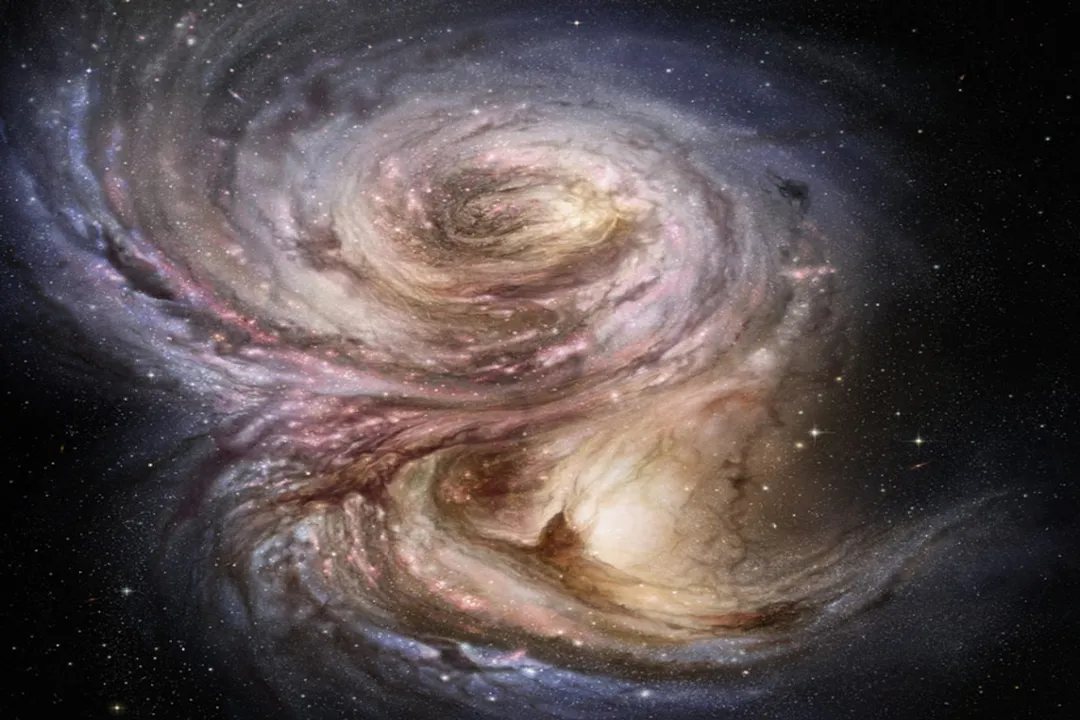
However, if we look at large catalogs of these objects, we quickly see that perfect sphericity is the exception rather than the rule. A significant fraction of planetary nebulae exhibit clear signs of distortion, often appearing bipolar (like two opposing cones) or elliptical, and sometimes displaying intricate, multi-layered structures. [2][5] This departure from the expected sphere is a major area of study, and the consensus points to interactions that disrupt that initial uniform outflow. [1][7]
The most significant culprit identified by astronomers is the presence of a binary companion orbiting the central dying star. [1][5][7] When a second star is present, even if it is relatively far away, its gravitational influence can sculpt the ejected material dramatically. [3] As the primary star sheds its outer layers, the companion’s gravity can stir the envelope, creating density variations or pulling material into streams. [5] Furthermore, the companion can capture some of the ejected gas, potentially forming an accretion disk around itself, which then channels the subsequent stellar wind from the primary star into two opposing jets, leading directly to the common bipolar shape. [1][4][5] This process essentially takes the simple spherical template and shears it, compresses it, or redirects the flow of the subsequent, faster wind that blows off the hot core. [3]
# Shaping Mechanisms
While binary companions are often cited as the primary shapers, other mechanisms can introduce asymmetry even around apparently single stars. [3] One such factor involves the star's own characteristics during the ejection phase. The slow wind phase might not be perfectly smooth; slight variations in the star's surface temperature or magnetic field strength could cause initial clumps or density knots in the slow wind envelope. [3] When the later, much faster wind erupts from the exposed hot stellar core—the wind that typically blows away the remaining envelope—it sweeps up this uneven material. [9] If the initial shell is slightly denser on one side due to a magnetic field anomaly or a remnant disk of dust and gas from the star's earlier life, the fast wind will carve a cavity more easily through the thinner region, resulting in an elliptical or somewhat lopsided shape, rather than a perfect sphere. [3][7]
Consider this: For a nebula to be truly spherical, the mass ejection must be perfectly uniform in both density and velocity for the entire duration of the slow wind phase, all while the central source remains perfectly centered and non-rotating relative to the outflow—a very tall order for a star undergoing such a chaotic transition. [9] If we model the initial ejection as , where is density and is velocity, the spherical case demands be independent of the angular coordinates and . Any slight deviation in is amplified when the high-speed wind interacts with it later, revealing the asymmetry. [3]
# Observing Distance and Time
Another important consideration relates to how we observe these objects and at what stage they are captured. Planetary nebulae are transient phenomena, lasting only tens of thousands of years before dissipating into the interstellar medium. [2] The geometry we see is a snapshot in time. A nebula might begin as a sphere, develop bipolar lobes due to a companion, and then, as the gas expands and the central star cools, the structures might become so diffuse that any initial asymmetry becomes harder to discern against the background sky, appearing more circular from our distant vantage point. [2]
There is also a matter of line-of-sight effects. A truly elliptical or bipolar nebula oriented perpendicular to our line of sight will appear rounder than one oriented edge-on. [1] Imagine looking down the barrel of a trumpet versus looking at it from the side—the cross-section changes dramatically based on the angle. Many of the PNe cataloged as spherical might, in fact, be slightly elliptical or bipolar structures that are pointed nearly directly toward or away from Earth, obscuring the elongation. [1] The visual representation relies entirely on the projection onto the 2D plane of the sky. [2]
# Implied Density Profiles
The distinction between spherical and non-spherical PNe also implies different internal density profiles, which affects how we interpret the emission. In a truly spherical nebula, the emission map should show a steady drop-off in brightness proportional to the inverse square of the distance from the central star, assuming uniform conditions. The light produced when the fast wind ionizes the slow wind material would be smooth across the shell. [9]
For bipolar nebulae, however, we see density concentrated along the axis of the jets. This means that the ionized gas density along the polar axis is significantly higher than the density near the equator, forcing us to revise our models of the stellar wind interaction to account for high-density knots or rings perpendicular to the axis, which confine the bipolar outflow. [5] This difference is stark: a spherical object requires a single density term, while a bipolar object requires at least two distinct density components governed by angular momentum or magnetic fields. [3]
| Shape Category | Primary Assumed Cause | Expected Symmetry in Mass Loss | Observational Difficulty |
|---|---|---|---|
| Spherical | Single star, uniform wind | High (Isotropic) | Identifying subtle non-sphericity |
| Elliptical | Single star, minor initial asymmetry or magnetic effects | Medium (Slight anisotropy) | Requires high angular resolution |
| Bipolar/Complex | Binary companion or strong magnetic field | Low (Highly anisotropic jets/lobes) | Generally easy to spot asymmetry |
If we were to catalogue the characteristics of a nebula known to be spherical, we would look for emission lines that are uniform across the face of the nebula, with no apparent central waist or pinch point. [9]
# Simplest Forms
Ultimately, the reason many planetary nebulae appear spherical is that sphericity is the mathematically and physically simplest outcome of a single source expanding into empty space. [3][6] The vast majority of the mass expelled by a dying star begins its journey via this simple mechanism. The more complex, visually striking shapes are the result of secondary physical processes—the stellar equivalent of introducing turbulence into a calm stream. [1][5] These deviations tell us more about the star's immediate environment (like the presence of a hidden partner) than the fundamental physics of a uniform stellar explosion. Therefore, when we see a perfectly round nebula, we are likely seeing the closest astronomical object can get to a pure, undisturbed expression of the final moments of a solitary star's life.
Related Questions
#Citations
Astronomers Solve Mystery of How Planetary Nebulae Are Shaped
Planetary nebula - Wikipedia
What determines the shape of a nebula? : r/askscience - Reddit
Why do nebulae turn into accretion disks but planets do not?
Where Do Messy Planetary Nebulae Come From? - AAS Nova
What's the reason for the spherical shape of the planets, stars ...
What Decides the Shape of Planetary Nebulae? Whatever's Orbiting ...
Formation of Planetary Nebulae - Cosmotography
Spherical planetary nebulae | Astronomy & Astrophysics (A&A)