What characterizes the initial phase of mass ejection from a Sun-like star forming a planetary nebula?
Answer
A slow wind that establishes a relatively cool, dense envelope of gas and dust, setting the initial template.
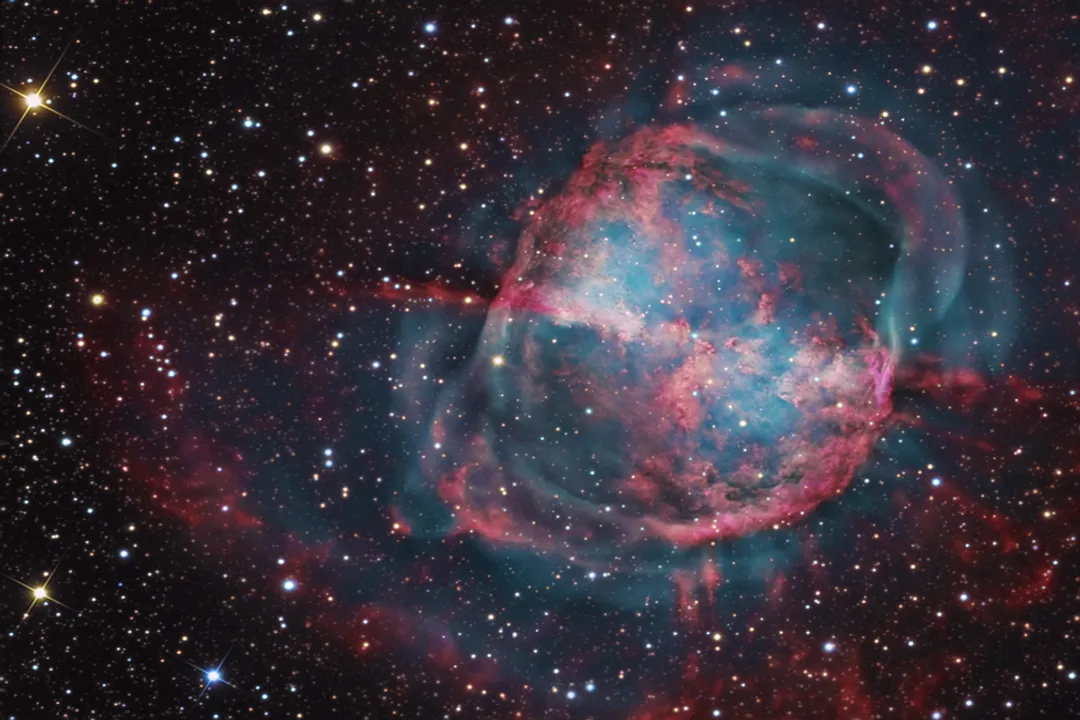
The formation of a planetary nebula occurs in distinct phases following the main sequence life of the star. The very first material ejection is characterized by a slow stellar wind. This outflow is relatively gentle and continuous, moving material outward slowly. This initial slow wind is responsible for depositing the first layer of gas and dust, creating a cool and dense envelope that serves as the foundational structure or template for the nebula. Only later, after the star expels this initial envelope, does the hotter core produce a much faster wind that sweeps up this material.
Related Questions
What determines whether a planetary nebula appears perfectly round or wildly asymmetrical?What fundamental physical principle causes a large stellar mass to naturally settle into a spherical shape?What is the consequence of a binary companion capturing ejected gas from the primary star?For the simple spherical case modeled by $M(t) =
ho(r, heta, ext{phi}) ext{cdot} v(t)$, what must be true about the density term $
ho$?What observational effect can cause a truly elliptical or bipolar planetary nebula to appear spherical?What characterizes the initial phase of mass ejection from a Sun-like star forming a planetary nebula?How does the internal density profile of a bipolar nebula contrast with that of a truly spherical nebula regarding emission?What factor related to the single star's characteristics can cause minor initial density knots in the slow wind envelope?Why is perfect sphericity considered the 'baseline expectation' for planetary nebula geometry based on simple physics?What characteristic is expected for emission lines in a nebula confirmed to be truly spherical?