Compared to other observed forms, how frequently are truly spherical planetary nebulae detected?
Answer
Truly spherical nebulae are relatively rare compared to the vast majority of observed forms.
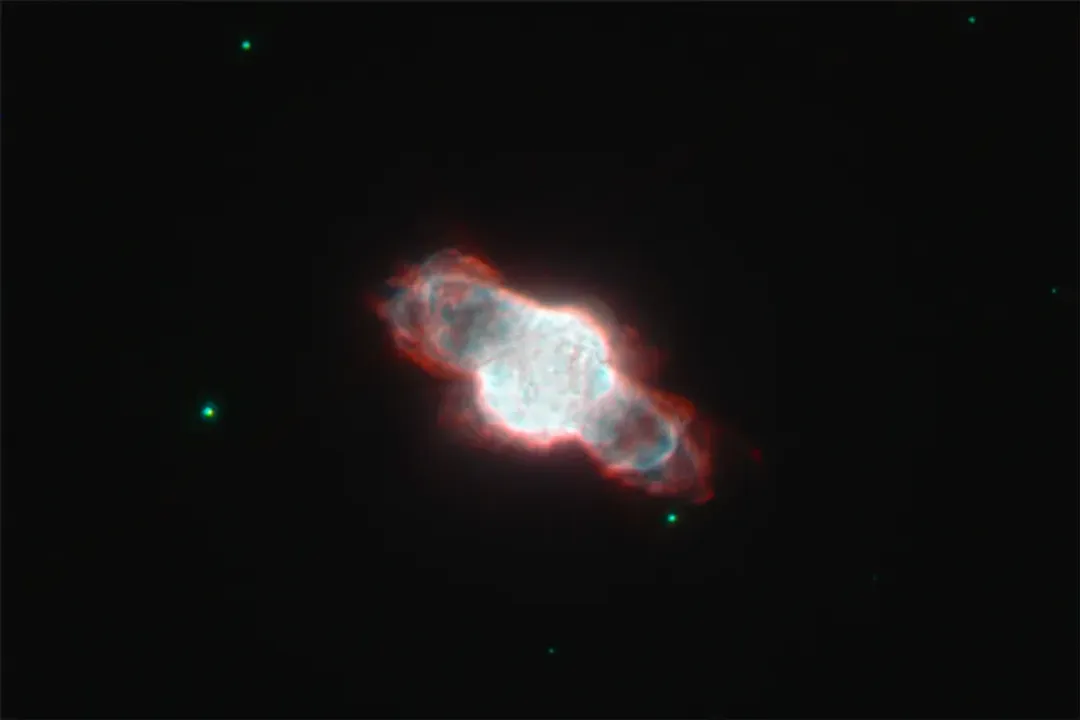
While the simplest theoretical model of mass shedding from a star—uniform dispersal in all directions—would result in a perfect sphere, observations indicate that perfectly spherical planetary nebulae are not the dominant type. The reality of observed nebulae demonstrates an enormous range of geometries, with spherical shapes being relatively uncommon. The majority of observed forms exhibit asymmetry or elongation, such as bipolar or elliptical shapes, suggesting that the mass ejection process is rarely perfectly uniform or uninfluenced by other factors.
Related Questions
Why is the name Planetary Nebula considered slightly misleading?What illuminates the expanding gas cloud comprising a planetary nebula?Compared to other observed forms, how frequently are truly spherical planetary nebulae detected?What visual characteristic defines the commonly observed Bipolar planetary nebulae?Which historical figure first cataloged planetary nebulae in the late 18th century?What is the primary process creating the visible glowing shell after mass loss occurs?What external influence is considered a leading candidate for explaining common bipolar shapes?How can a strong, rotating magnetic field influence the morphology of escaping gas?What intricate structures were revealed in NGC 3132 by the Hubble Space Telescope?What advantage does data from the James Webb Space Telescope provide in analyzing nebula structure?