How long does the glowing phase of a typical Planetary Nebula (PN) last before its gas dissipates into the ISM?
Answer
About ten thousand years.
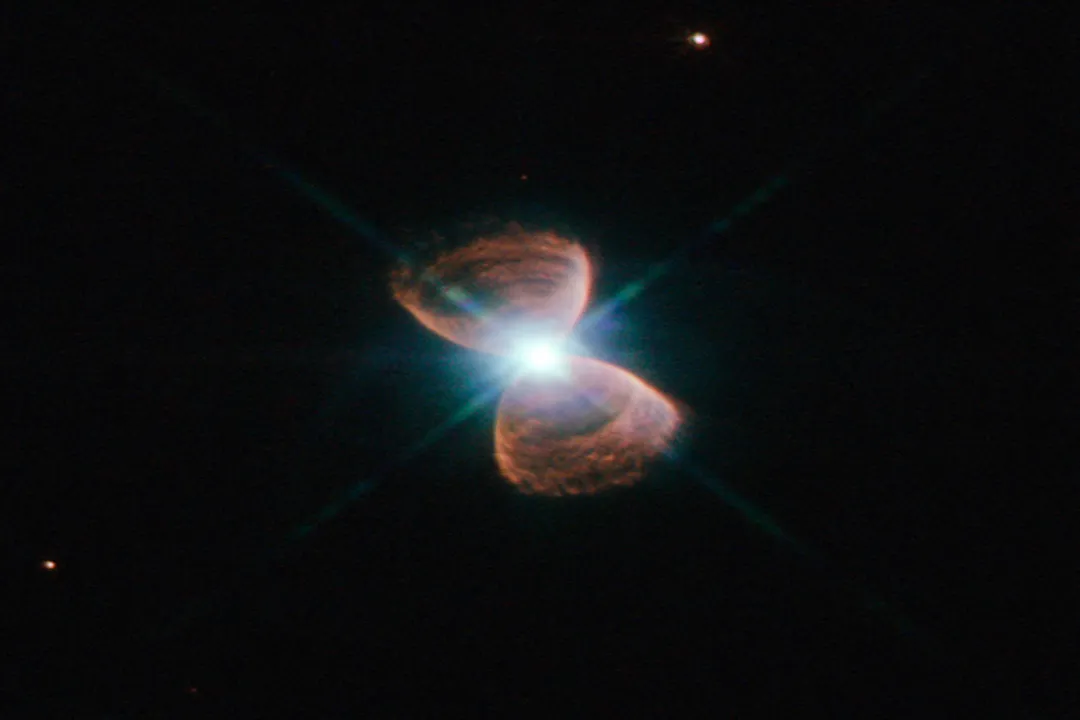
The phase during which a Planetary Nebula glows brightly is relatively short on cosmic timescales. This luminosity is generated because the gas shell, shed by the dying star, is ionized by intense ultraviolet radiation streaming from the exposed hot core, known as the White Dwarf Nucleus (P.N.N.). Once the shell is ejected via stellar winds during the Asymptotic Giant Branch (AGB) phase, this luminous stage persists for approximately ten thousand years before the expanding gas becomes too diffuse to remain visible or ionized.
Related Questions
What material primarily constitutes the diffuse gas and dust clouds comprising nebulae?How long does the glowing phase of a typical Planetary Nebula (PN) last before its gas dissipates into the ISM?Which three morphological types are identified as the most common categories for Planetary Nebulae (PNs)?How do Binary Companions influence the resulting structure of a Planetary Nebula (PN)?What two primary energetic outputs sculpt the morphology of young Emission Nebulae (H II regions)?What process lights up the interior structure of the Crab Nebula, a Supernova Remnant (SNR) from 1054?What shape tendency is predicted for PNs originating from progenitors more massive than Sun-like stars in that mass range?What surprising orderly arrangement was observed for bipolar PNs in the Milky Way’s central bulge?Why were Planetary Nebulae (PNs) historically given a misleading name unrelated to planets?In star-forming clouds, what carving mechanism is responsible for creating features like the Pillars of Creation in the Eagle Nebula?